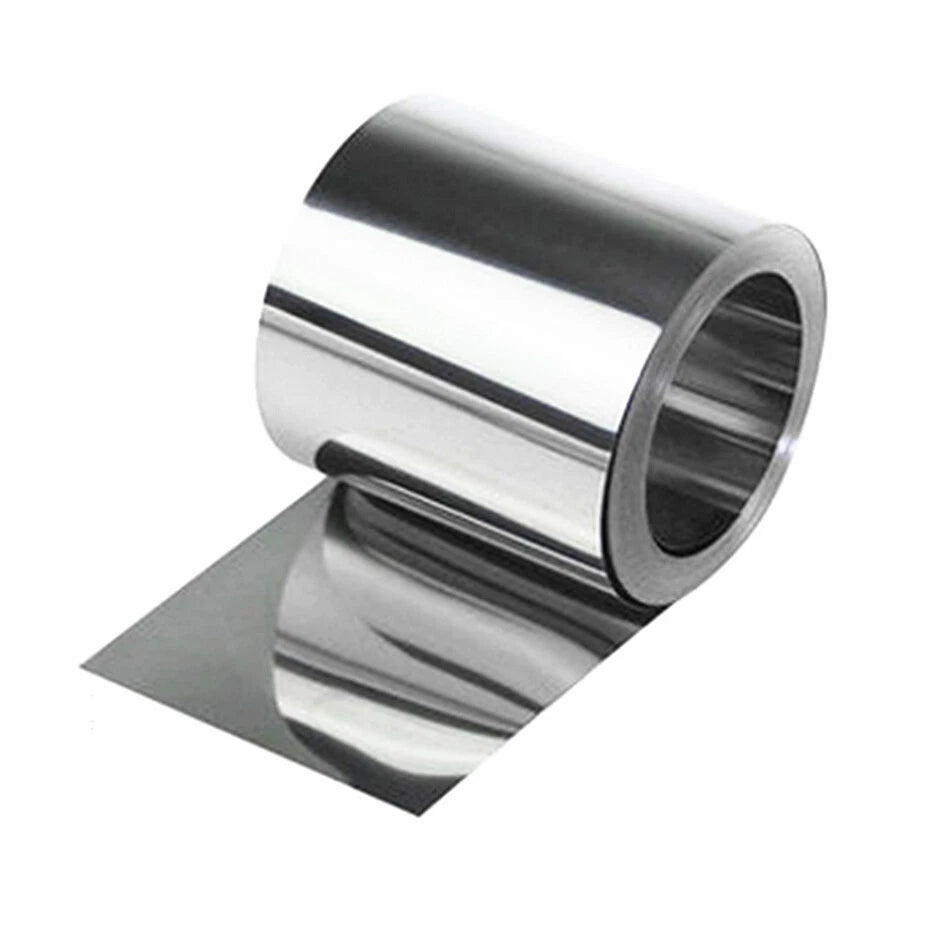
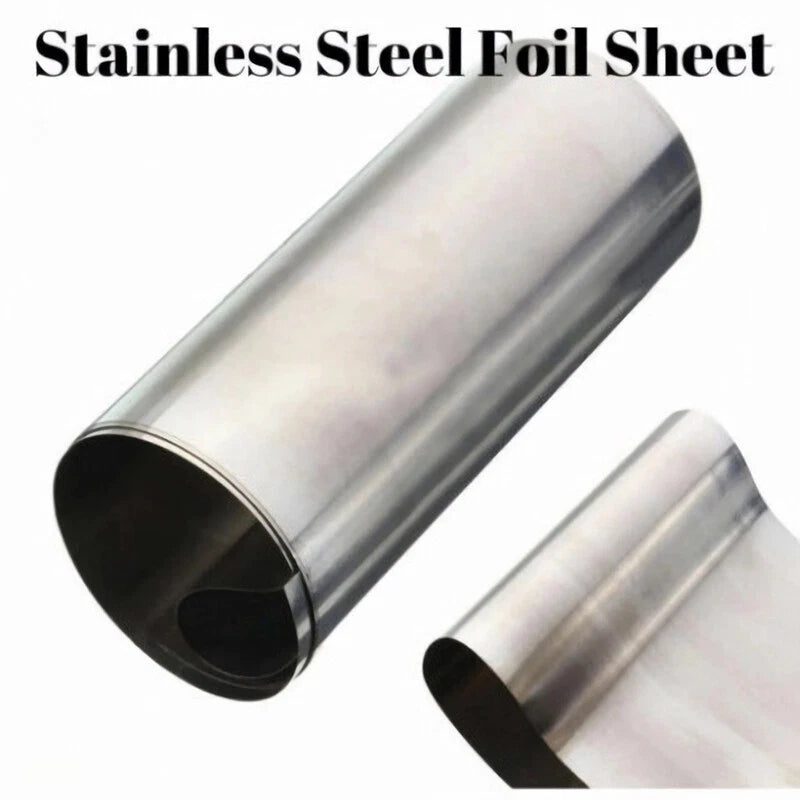
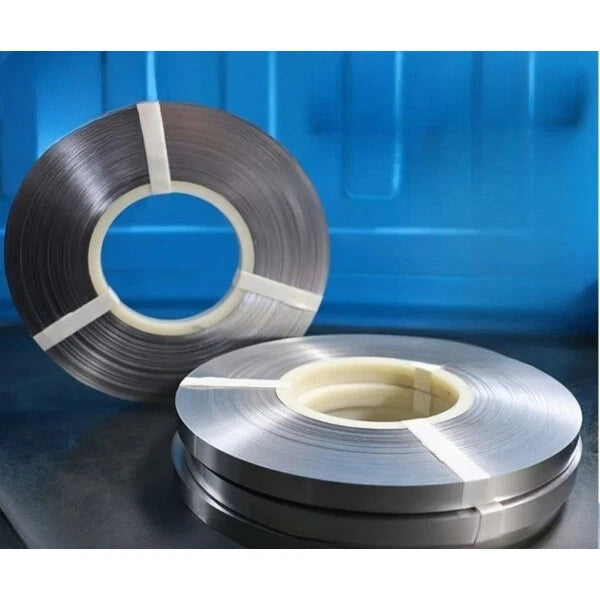
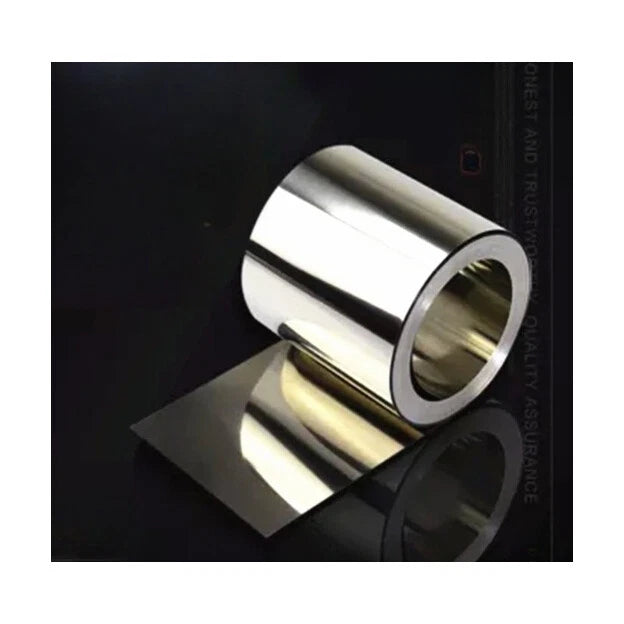
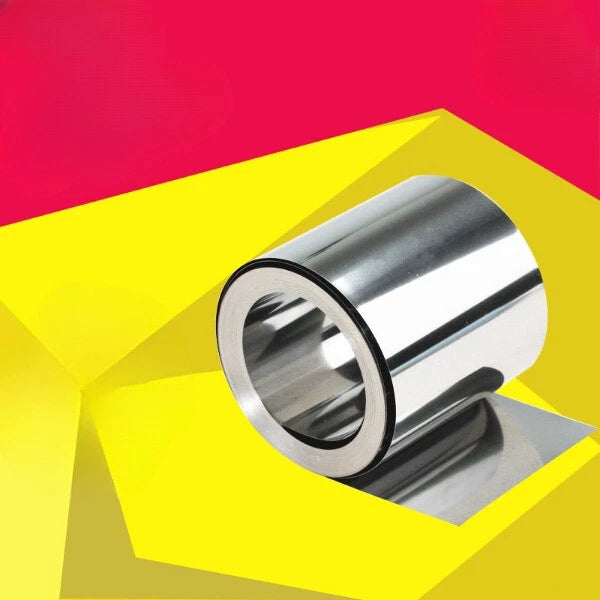
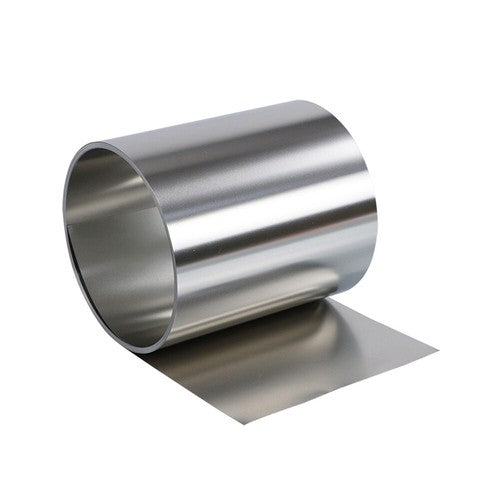
0.01mm-0.1mm Thick 304 Stainless Steel Foil Band Sheet Fine Plate Metal Strip

Keine Bewertungen

Preis:
Sonderpreis$6.95 USD
Lagerbestand:
Verfügbar (500 Stück), versandbereit

Payment & Security

Ach Direct Debit Amazon American Express Apple Pay Bancontact Diners Club Discover Google Pay iDEAL Wero Mastercard PayPal Shop Pay USDC Visa

Deine Zahlungsinformationen werden sicher verarbeitet. Wir speichern keine Kreditkartendaten und haben auch keinen Zugang zu deinen Kreditkartendaten.

Quantity Discount Promotion
🎯 BULK DISCOUNT: Buy More, Save More!
Buy 2 Items
5% OFF
Buy 4 Items
10% OFF
Buy 6 Items
15% OFF
Expert

DIY Expert Support

Get fitment advice & recommendations

Mon-Fri, 8:30AM-8PM
24-Hour Fast Ship
🚚
Arrives in 3-14 days
🌍
Global Reach
↩️
30-Day Returns
🌱 1 tree planted with every purchase

Beschreibung

304 Stainless Steel Foil Sheet — Precision Thin Metal Strip for Shims, Gaskets & Fabrication

When a project demands exact tolerances and a metal strip that won't corrode, warp, or fatigue under repeated stress, standard sheet stock rarely cuts it. Machinists, fabricators, hobbyists, and maintenance technicians who need ultra-thin flat stock in controlled thicknesses turn to 304 stainless steel foil sheet as the reliable answer.

This 304 stainless steel foil sheet is available in thicknesses ranging from 0.01 mm to 0.2 mm (approximately 0.0004" to 0.008") and widths of 50 mm, 100 mm, 200 mm, or 300 mm (roughly 2" to 12"). Each roll is offered in 1 m or 5 m lengths, giving you the flexibility to order exactly what a job requires without excess waste.

Typical applications include precision shimming between mating surfaces, custom gasket cutting for fluid or gas seals, heat-shield lining in enclosures, thin backing plates for electronics assemblies, and feeler-gauge stock for gap measurement. The consistent rolled finish also makes it suitable for decorative inlay work and craft metalworking where a clean, uniform surface matters.

🔩 Compatibility: Suitable for use with standard metal-cutting tools including tin snips, rotary cutters, laser cutters, and CNC routers. Compatible with common adhesives, spot welding, and mechanical fastening methods used in fabrication and maintenance workflows.

✅ Key Features of These 304 Stainless Steel Foil Strips

  • 📏 Ultra-thin precision thickness: Available from 0.01 mm to 0.2 mm, allowing selection of the exact gauge needed for shimming, gasketing, or layered assemblies without over-engineering the stack-up.
  • 🦠 Corrosion-resistant 304 alloy: The 18/8 chromium-nickel composition of 304 stainless resists oxidation, moisture, and mild chemical exposure, making these strips suitable for both indoor and outdoor applications where longevity matters.
  • 📐 Multiple width options: Choose from 50 mm, 100 mm, 200 mm, or 300 mm widths to match the footprint of your workpiece, reducing the need for secondary trimming and material loss.
  • 🔄 Flexible length selection: Order in 1 m rolls for small-batch or one-off jobs, or 5 m rolls for production runs and ongoing maintenance stock — both options ship as a continuous strip without joins.
  • ✂️ Workable with common shop tools: The foil gauge allows clean cutting with tin snips, rotary cutters, or laser equipment. Edges can be deburred with a standard file, and the strip can be formed around curves without cracking at room temperature.
  • ⚖️ Consistent rolled surface finish: Each strip is produced with a uniform mill finish that provides a flat, burr-free starting surface — important for sealing applications where surface contact area directly affects performance.

📐 Technical Specifications — Stainless Steel Foil Strip

Material 304 Stainless Steel (18/8 Cr-Ni alloy)
Thickness Range 0.01 mm – 0.2 mm (approx. 0.0004" – 0.008")
Width Options 50 mm, 100 mm, 200 mm, 300 mm
Length Options 1 m / 5 m per roll
Surface Finish Mill finish (uniform rolled)
Temper See variant options
Tensile Strength Typically 515–690 MPa (standard 304 range)
Form Flat strip / foil roll
Magnetism Slightly magnetic (work-hardened 304)
Operating Temperature Up to approximately 870°C (1600°F) intermittent

❓ Frequently Asked Questions

How do I choose the right thickness for a shimming application?

Measure the gap you need to fill with a feeler gauge or dial indicator, then select the foil thickness closest to that measurement. For adjustable stacks, combine two or more layers — for example, two 0.02 mm strips give you 0.04 mm total. Start thinner than your target gap and add layers until you achieve the desired fit without forcing the assembly.

Is 304 stainless steel strong enough for load-bearing shim applications?

304 stainless has a typical tensile strength of 515–690 MPa, which is adequate for most shim and gasket applications where the strip is in compression rather than tension. For high-cycle fatigue or extreme point-load scenarios, consult an engineer to confirm the gauge and alloy are appropriate for your specific load case.

Will this strip rust or corrode outdoors?

304 stainless steel resists rust and oxidation well in most outdoor environments due to its chromium oxide passive layer. It performs reliably in rain, humidity, and mild industrial atmospheres. However, prolonged exposure to chloride-rich environments (such as coastal salt air or de-icing salts) can cause surface pitting over time. For those conditions, 316 stainless is a better choice.

Can I cut this foil with scissors or a craft knife?

Thinner gauges (0.01 mm – 0.03 mm) can be cut cleanly with sharp scissors or a craft knife and steel ruler. Thicker gauges (0.05 mm and above) are better handled with tin snips or a rotary cutter to maintain a straight edge. Always deburr cut edges with a fine file or deburring tool before handling to avoid cuts.

Is this compatible with welding or soldering?

304 stainless can be spot-welded or TIG-welded; however, at foil thicknesses the heat input must be carefully controlled to avoid burn-through. Soldering with standard tin-lead solder is not recommended without a stainless-specific flux. For bonding thin foil without heat, structural adhesives rated for metal substrates are a practical alternative.

Which width should I choose for a gasket application?

Select a width that is equal to or slightly wider than the sealing face of your joint, then trim to the exact profile needed. For pipe flanges and small fittings, 50 mm or 100 mm widths are typically sufficient. For larger flat-face flanges or heat exchanger plates, 200 mm or 300 mm widths reduce the number of cuts and minimize waste.

Does the 5 m roll come as a single continuous strip?

Yes. Both the 1 m and 5 m options are supplied as a single continuous rolled strip with no joins or splices. This ensures consistent thickness and surface finish along the entire length, which is important for applications where a mid-strip joint would create a leak path or a stress concentration.

🛒 Select your size (THK*W) and length option above, then add to cart.

You may also like

Recently viewed