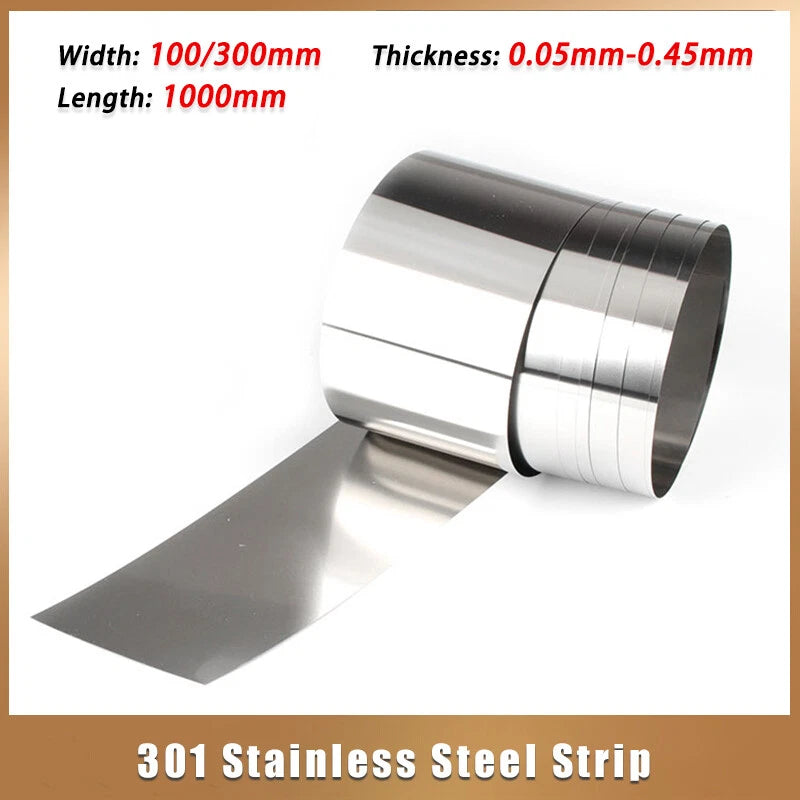
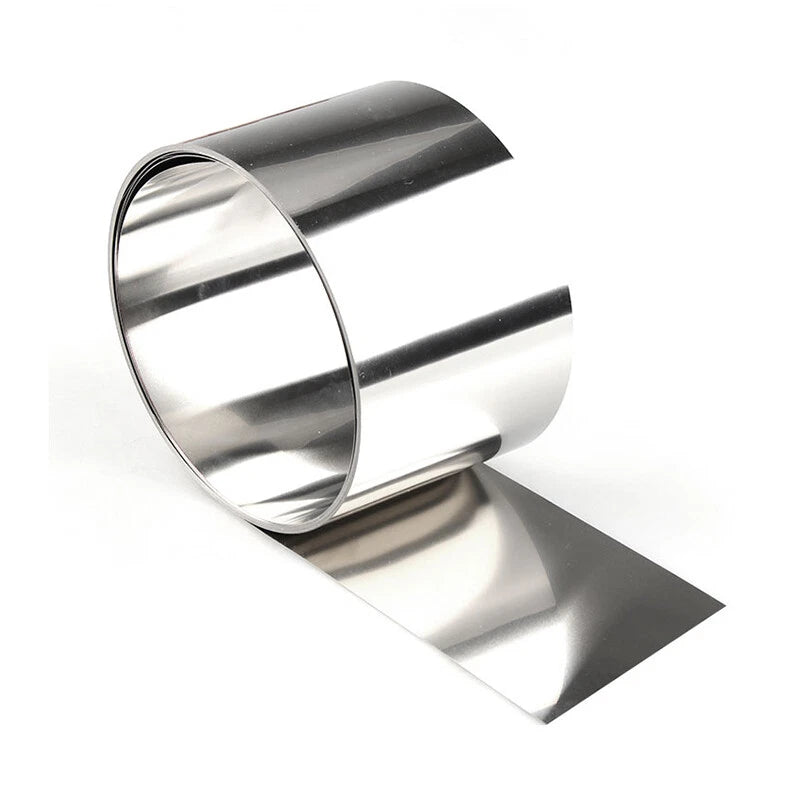
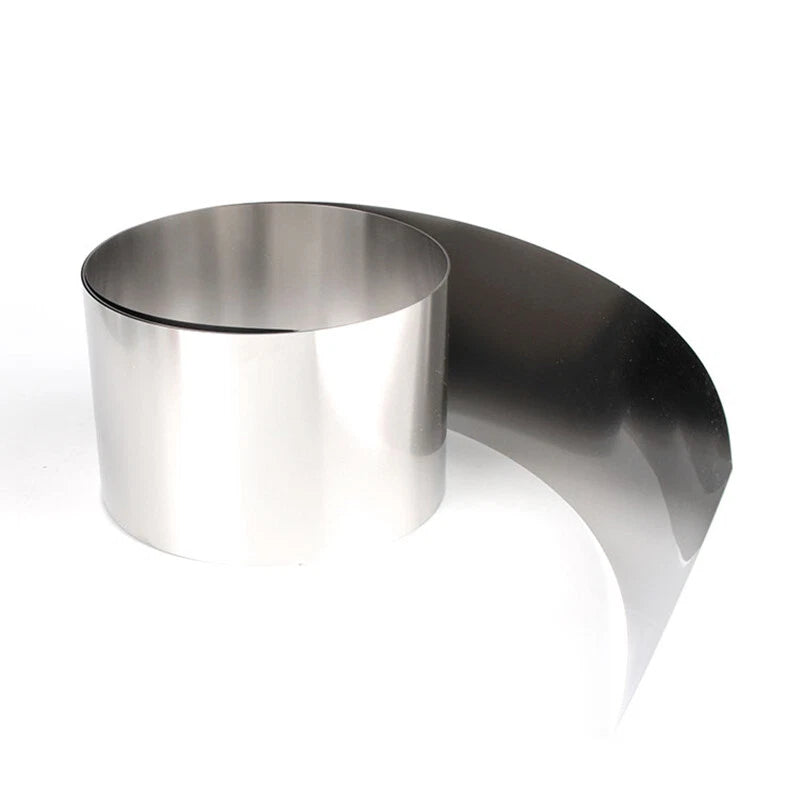
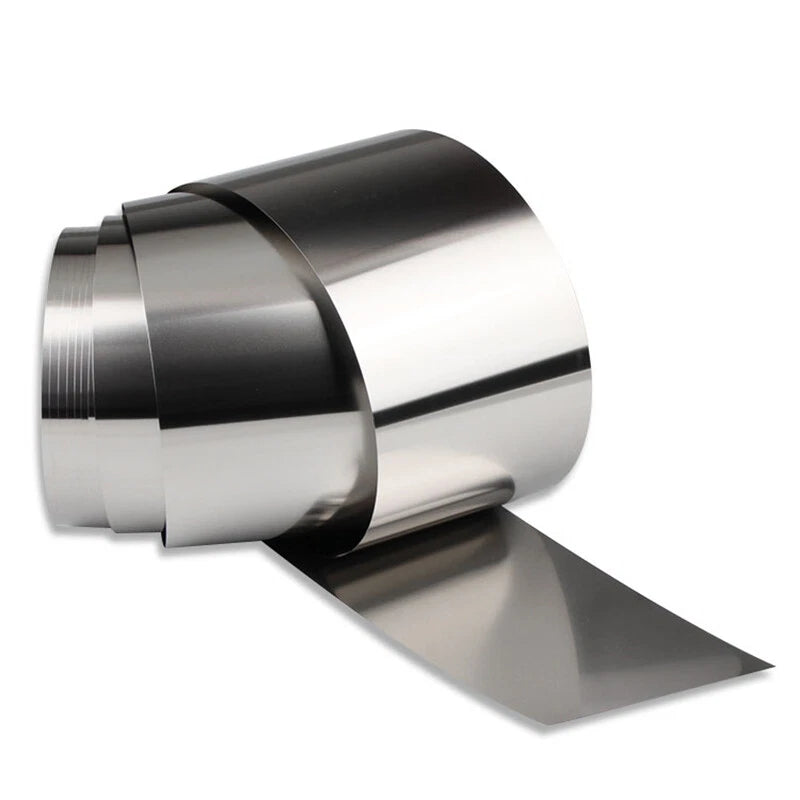
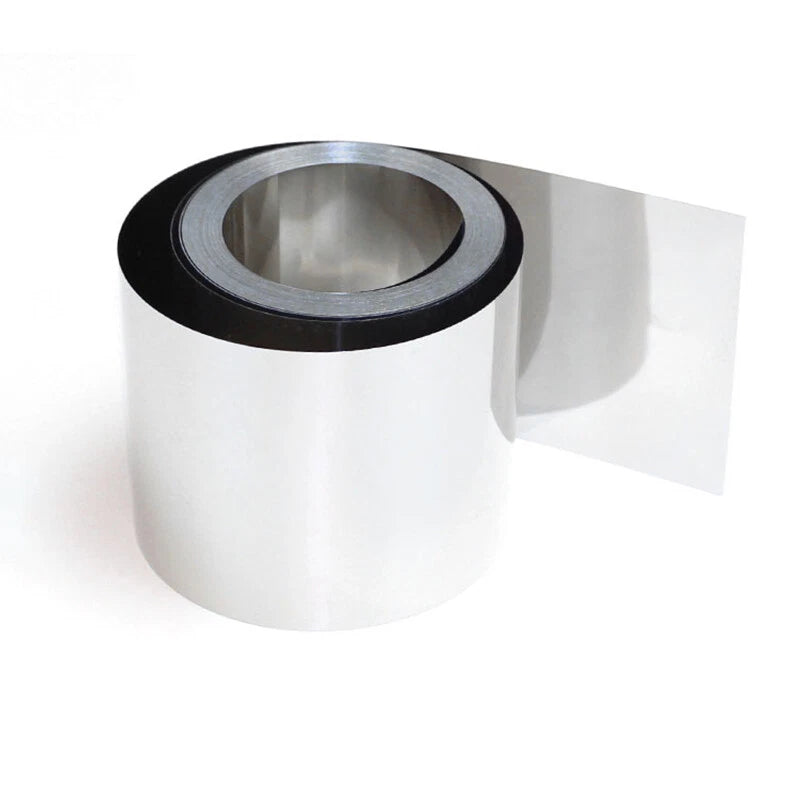
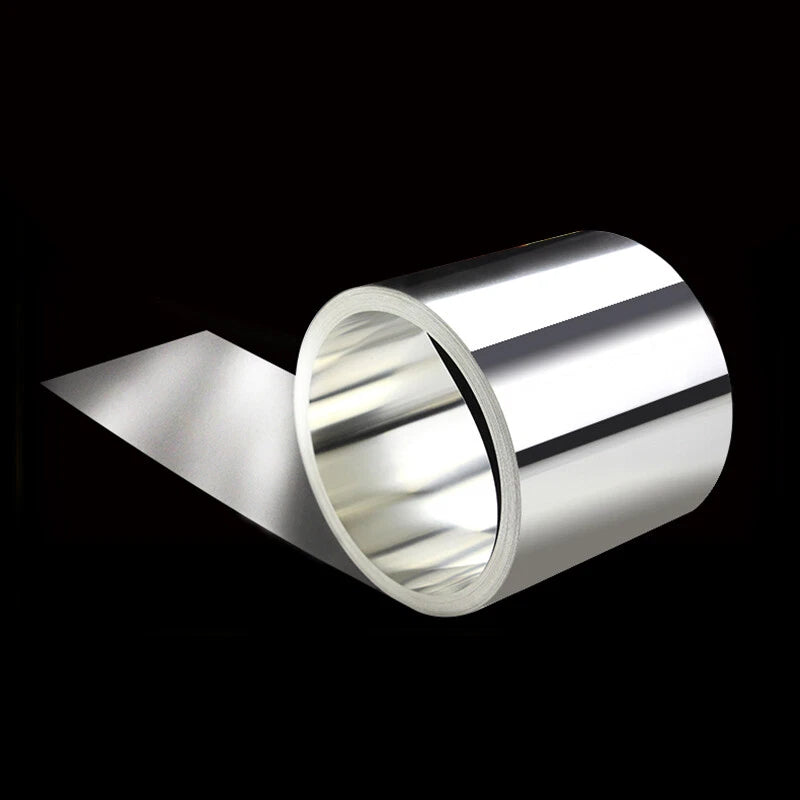

301 Stainless Steel Sheet Thin Plate Metal Foil Strip Roll Thickness 0.05-0.45mm

Keine Bewertungen

Preis:
Sonderpreis$9.64 USD
Lagerbestand:
Verfügbar (500 Stück), versandbereit

Payment & Security

Ach Direct Debit Amazon American Express Apple Pay Bancontact Diners Club Discover Google Pay iDEAL Wero Mastercard PayPal Shop Pay USDC Visa

Deine Zahlungsinformationen werden sicher verarbeitet. Wir speichern keine Kreditkartendaten und haben auch keinen Zugang zu deinen Kreditkartendaten.

Quantity Discount Promotion
🎯 BULK DISCOUNT: Buy More, Save More!
Buy 2 Items
5% OFF
Buy 4 Items
10% OFF
Buy 6 Items
15% OFF
Expert

DIY Expert Support

Get fitment advice & recommendations

Mon-Fri, 8:30AM-8PM
24-Hour Fast Ship
🚚
Arrives in 3-14 days
🌍
Global Reach
↩️
30-Day Returns
🌱 1 tree planted with every purchase

Beschreibung

301 Stainless Steel Foil Sheet & Strip Roll — Precision Thickness for Demanding DIY & Industrial Applications

When a project demands a metal that flexes without cracking, resists rust in humid environments, and cuts cleanly to exact dimensions, standard sheet stock often falls short. DIYers, fabricators, machinists, and hobbyists working on shims, gaskets, heat shields, or decorative inlays need a 301 stainless steel foil sheet they can trust at ultra-thin gauges without sacrificing structural integrity.

This 301 stainless steel foil strip roll is available in two widths — 100 mm (~3.94 in) and 300 mm (~11.81 in) — with a length of 1000 mm (~39.37 in) per piece. Thickness spans 0.05 mm to 0.45 mm (approximately 0.002 in to 0.018 in), letting you dial in exactly the gauge your application requires. The alloy is a cold-rolled austenitic grade with a bright, smooth surface finish on both faces.

Typical use cases include precision shimming between mechanical components, custom gasket cutting for plumbing or HVAC repairs, spring-temper strip stock for small mechanisms, and decorative metal inlay work in woodworking or furniture projects — all scenarios where a thin, corrosion-resistant stainless steel strip roll delivers measurable results.

⚙️ Compatibility note: Suitable for cold-forming, shearing, and laser cutting. Not recommended for applications requiring magnetic permeability — 301 SS is weakly magnetic only when cold-worked. Verify thickness tolerance with your tooling specs before ordering.

✅ Key Features of These 301 Stainless Steel Foil Sheets

  • 📏 Ultra-thin gauge range (0.05–0.45 mm)
    Twelve thickness options from 0.05 mm to 0.45 mm give you precise control over stiffness and flexibility — no need to source multiple alloys for different gauges.
  • 🔩 301 austenitic alloy — work-hardenable
    The 301 grade gains strength through cold working, making it well-suited for spring-temper strip applications, clips, and formed parts that need to hold their shape under repeated stress.
  • 💧 Corrosion-resistant surface
    The chromium content (typically 16–18%) forms a passive oxide layer that resists rust in moist indoor environments, making these sheets reliable for HVAC, plumbing, and marine-adjacent DIY tasks.
  • ✂️ Clean-cut, burr-minimized edges
    Cold-rolled to a smooth, consistent finish on both faces. Cuts cleanly with tin snips, rotary cutters, or laser equipment — reducing finishing time on precision shim and gasket work.
  • 📦 Flexible pack quantities (1, 2, or 5 pcs)
    Order a single piece to test fit, a 2-pack for paired applications, or a 5-pack for batch projects — all at a consistent per-piece dimension of 100×1000 mm or 300×1000 mm.
  • 📐 Two width options for different project scales
    The 100 mm width suits narrow shims, strips, and inlays; the 300 mm width covers wider gaskets, heat shields, and decorative panels without requiring a seam join.

📐 Technical Specifications — 301 Stainless Steel Foil Sheet

Material / Alloy 301 Austenitic Stainless Steel
Condition Cold-rolled
Surface Finish Bright / smooth (both faces)
Width Options 100 mm (~3.94 in) / 300 mm (~11.81 in)
Length 1000 mm (~39.37 in) per piece
Thickness Range 0.05 mm – 0.45 mm (0.002 in – 0.018 in)
Available Thickness Steps 0.05 / 0.06 / 0.07 / 0.09 / 0.10 / 0.15 / 0.20 / 0.25 / 0.30 / 0.35 / 0.40 / 0.45 mm
Packing Quantity 1 pcs / 2 pcs / 5 pcs (see variant options)
Magnetism Weakly magnetic (cold-worked); non-magnetic in annealed state
Typical Chromium Content 16–18%
Typical Nickel Content 6–8%
Weight per piece See variant options
Thickness Tolerance See variant options / Contact us to confirm

❓ Frequently Asked Questions

How do I choose the right thickness for a shim application?

Measure the gap you need to fill with a feeler gauge, then select the thickness that matches or can be stacked to reach your target clearance. For most mechanical shimming tasks, 0.05–0.1 mm covers fine adjustments, while 0.2–0.45 mm suits larger gaps or load-bearing shim stacks. Order a 2-pack or 5-pack if you anticipate needing to test multiple layers.

Is 301 stainless steel strong enough for spring-temper strip use?

Yes. The 301 grade is specifically chosen for applications requiring spring-like behavior because it work-hardens significantly during cold rolling. Thinner gauges (0.05–0.15 mm) offer more flexibility, while thicker gauges (0.3–0.45 mm) provide greater stiffness and return force. For high-cycle fatigue applications, verify your specific load requirements against the alloy's published tensile data.

Will this sheet rust if used in a damp environment?

301 stainless steel forms a passive chromium oxide layer that resists rust in typical indoor humid conditions, light outdoor exposure, and mild chemical environments. It is not intended for continuous immersion in saltwater or exposure to strong chlorides — for those conditions, 316-grade stainless is more appropriate. For HVAC, plumbing surrounds, and workshop use, 301 performs reliably.

Can I cut this foil with standard workshop tools?

Yes. Gauges up to 0.2 mm cut cleanly with sharp tin snips or a rotary cutter and straightedge. Thicker gauges (0.25–0.45 mm) are best handled with aviation snips, a metal shear, or laser cutting for straight, burr-free edges. Avoid using dull blades — they cause edge deformation on thin foil stock.

What is the difference between the 100 mm and 300 mm width options?

Both options share the same 1000 mm length and the same thickness range. The 100 mm width (≈3.94 in) is suited for narrow strips, shims, inlays, and small gaskets. The 300 mm width (≈11.81 in) covers wider heat shields, decorative panels, and gaskets that would otherwise require joining two narrow strips — eliminating a potential weak seam in the finished part.

Is 301 stainless steel weldable?

301 SS can be welded using TIG or MIG processes, but its higher carbon content compared to 304 means there is a greater risk of sensitization (carbide precipitation) in the heat-affected zone. For thin foil gauges, TIG welding with low heat input is recommended. If weld corrosion resistance is critical, consider post-weld passivation or switch to a low-carbon grade like 304L.

Should I order 1 pcs, 2 pcs, or 5 pcs?

Order 1 pcs when you need a single piece for a one-off repair or prototype. Choose 2 pcs for projects requiring paired pieces (e.g., symmetric shims on both sides of a component). The 5-pack offers the best per-piece value for batch fabrication, classroom use, or when you want spares on hand for future repairs of the same type.

🛒 Select your Width, Thickness, and Packing Quantity above, then add to cart.

You may also like

Recently viewed