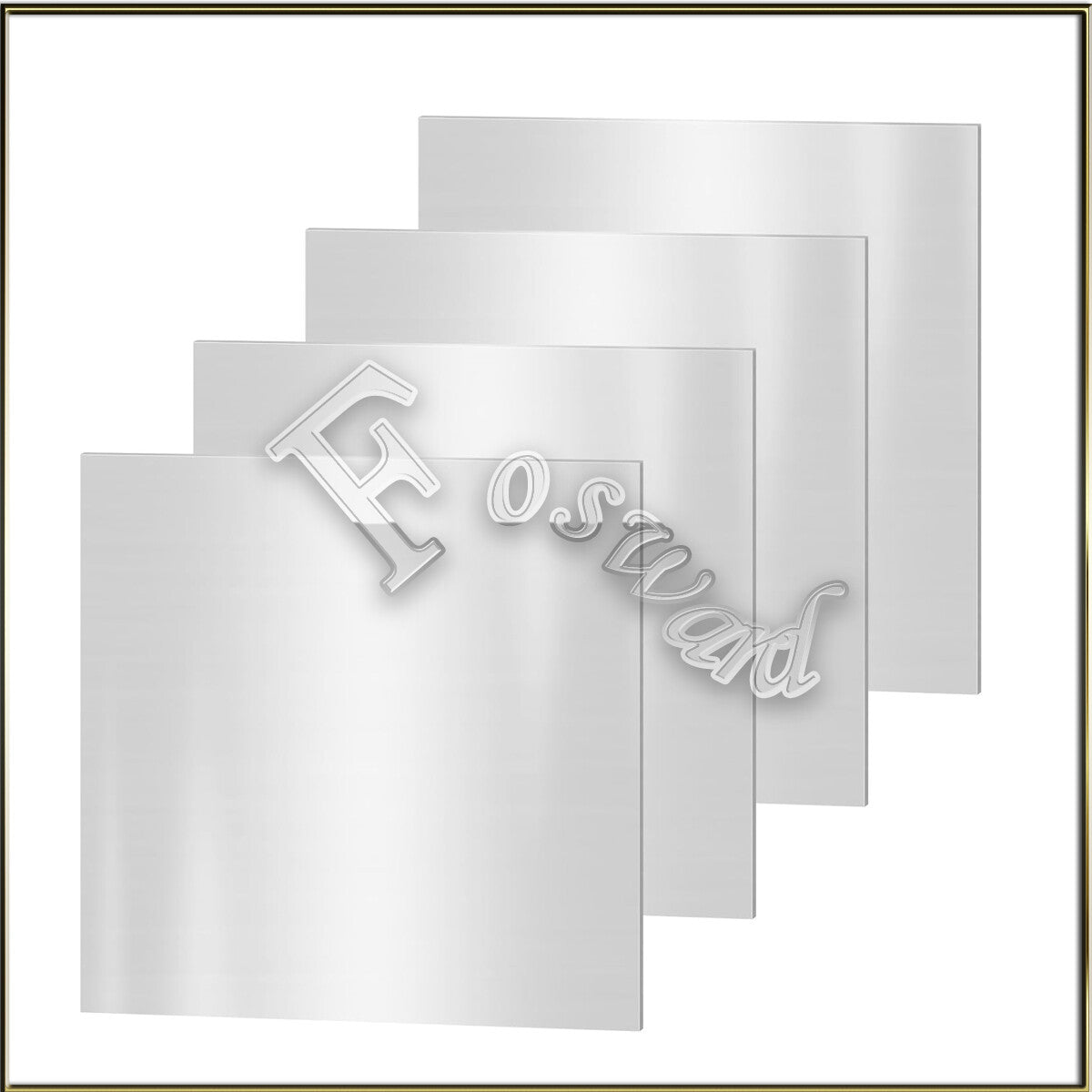
301 Stainless Steel Sheets, 0.01 to 3mm Thick Stainless Steel Shim Plates DIY

Keine Bewertungen

Preis:
Sonderpreis$6.56 USD
Lagerbestand:
Verfügbar (500 Stück), versandbereit

Payment & Security

Ach Direct Debit Amazon American Express Apple Pay Bancontact Diners Club Discover Google Pay iDEAL Wero Mastercard PayPal Shop Pay USDC Visa

Deine Zahlungsinformationen werden sicher verarbeitet. Wir speichern keine Kreditkartendaten und haben auch keinen Zugang zu deinen Kreditkartendaten.

Quantity Discount Promotion
🎯 BULK DISCOUNT: Buy More, Save More!
Buy 2 Items
5% OFF
Buy 4 Items
10% OFF
Buy 6 Items
15% OFF
Expert

DIY Expert Support

Get fitment advice & recommendations

Mon-Fri, 8:30AM-8PM
24-Hour Fast Ship
🚚
Arrives in 3-14 days
🌍
Global Reach
↩️
30-Day Returns
🌱 1 tree planted with every purchase

Beschreibung

301 Stainless Steel Shim Plates — Precision Thickness for Every DIY Gap

When a loose hinge, misaligned machine bed, or uneven mounting surface throws off your entire project, the right shim makes all the difference. These 301 stainless steel shim plates are built for hobbyists, machinists, and hands-on builders who need exact, repeatable spacing without cutting down thicker stock.

Each sheet is made from 301-grade stainless steel — a chromium-nickel alloy known for its spring-like resilience and moderate corrosion resistance. Sheets are available in thicknesses from 0.01 mm (≈ 0.0004 in) up to 1 mm (≈ 0.039 in), in two footprints: 100 × 100 mm (≈ 3.94 × 3.94 in) and 100 × 300 mm (≈ 3.94 × 11.81 in). Surface finish is a standard mill/2B finish unless otherwise noted in the variant.

Typical applications include leveling CNC router beds and lathe tool posts, shimming door hinges and cabinet hardware, filling tolerance gaps in custom metal fabrication, and creating thin spring-steel flexures for DIY robotics and automation projects. The 100 × 300 mm format is especially useful for stainless steel shim stock that needs to be scored and snapped to a custom length.

⚙️ Compatibility: Suitable for general metalworking, CNC setups, hinge shimming, and precision gap-filling applications. Not intended for high-temperature or strongly acidic environments where 304 or 316 grade may be required.

✅ Key Features of These 301 Stainless Steel Shim Plates

  • 📏 Ultra-thin range: Thicknesses from 0.01 mm to 1 mm let you dial in clearances that thicker shim stock simply cannot achieve.
  • 🔩 301 SS alloy: Higher carbon and manganese content versus 304 gives 301 a spring-temper quality — it holds its shape under repeated flex and compression loads.
  • 🛡️ Corrosion-resistant surface: The chromium-nickel composition forms a passive oxide layer that resists rust in typical indoor and light-outdoor conditions.
  • ✂️ Two sheet sizes: The 100 × 100 mm square suits compact shimming tasks; the 100 × 300 mm strip is ideal for scoring, snapping, or rolling into custom shapes.
  • 🎯 Consistent mill tolerance: Sheets are produced to tight thickness tolerances, so the dimension you select is the dimension you get — no guesswork on stack height.
  • 🔧 DIY-ready format: No secondary grinding or deburring required for most shimming tasks; edges are clean enough for direct installation between mating surfaces.

📐 Technical Specifications — Stainless Steel Shim Sheet

Material 301 Stainless Steel (Chromium-Nickel Alloy)
Thickness Range 0.01 mm – 1 mm (≈ 0.0004 in – 0.039 in)
Sheet Sizes 100 × 100 mm (≈ 3.94 × 3.94 in) / 100 × 300 mm (≈ 3.94 × 11.81 in)
Surface Finish Mill finish (2B)
Hardness See variant options
Tensile Strength Typically 515–860 MPa depending on temper
Corrosion Resistance Moderate — suitable for indoor and light-outdoor use
Magnetism Slightly magnetic when cold-worked
Quantity per Order 1 sheet per unit (see variant options for size/thickness)

❓ Frequently Asked Questions

How do I choose the right thickness for my shimming application?

Measure the gap you need to fill with a feeler gauge or dial indicator, then select the closest thickness — or stack two thinner sheets to reach an intermediate value. For precision machine work, start 0.01–0.05 mm under your target and test-fit before committing to a final stack height.

Can I cut these sheets to a custom shape?

Yes. Sheets up to about 0.3 mm can be scored with a sharp carbide scribe and snapped cleanly along a straight edge. Thicker sheets (0.4 mm and above) are best cut with aviation snips, a rotary tool with a metal-cutting disc, or a laser cutter for precise outlines. Always deburr cut edges before installation.

Is 301 stainless steel strong enough for load-bearing shim applications?

301 SS in its standard mill temper has a tensile strength typically in the 515–860 MPa range, which is adequate for most shimming tasks including hinge alignment, machine-bed leveling, and bracket spacing. For applications with sustained high compressive loads (e.g., press-fit assemblies), verify your specific load against the material's yield strength before use.

Will these sheets rust if used outdoors or in a damp environment?

301 stainless steel offers moderate corrosion resistance suitable for indoor and sheltered outdoor use. In continuously wet, salt-spray, or chemically aggressive environments, 316-grade stainless is a better choice. For occasional moisture exposure, the passive oxide layer on 301 SS provides reliable protection.

Are these sheets compatible with 304 or 316 stainless hardware?

Yes — 301, 304, and 316 are all austenitic stainless steels and are galvanically compatible with each other, meaning they will not cause accelerated corrosion when in contact. You can safely use these shims between 304 or 316 fasteners and structural members.

Which size should I choose — 100 × 100 mm or 100 × 300 mm?

The 100 × 100 mm square is ideal for compact tasks like shimming hinges, leveling small machine components, or filling gaps in electronics enclosures. The 100 × 300 mm strip gives you more material to work with — useful when you need to cut multiple pieces from one sheet, create a longer shim run, or roll the sheet into a thin-walled tube or flexure.

Can I use these as spring-steel flexures in robotics or automation projects?

301 stainless steel has a higher work-hardening rate than 304, which gives it spring-like characteristics after cold rolling. Thin sheets (0.1–0.5 mm) are commonly used as living hinges, compliant mechanisms, and leaf springs in DIY robotics. For cyclic fatigue applications, keep bending radii above 5× the sheet thickness to avoid cracking.

🛒 Select your Thickness and Width × Length above, then add to cart.

You may also like

Recently viewed