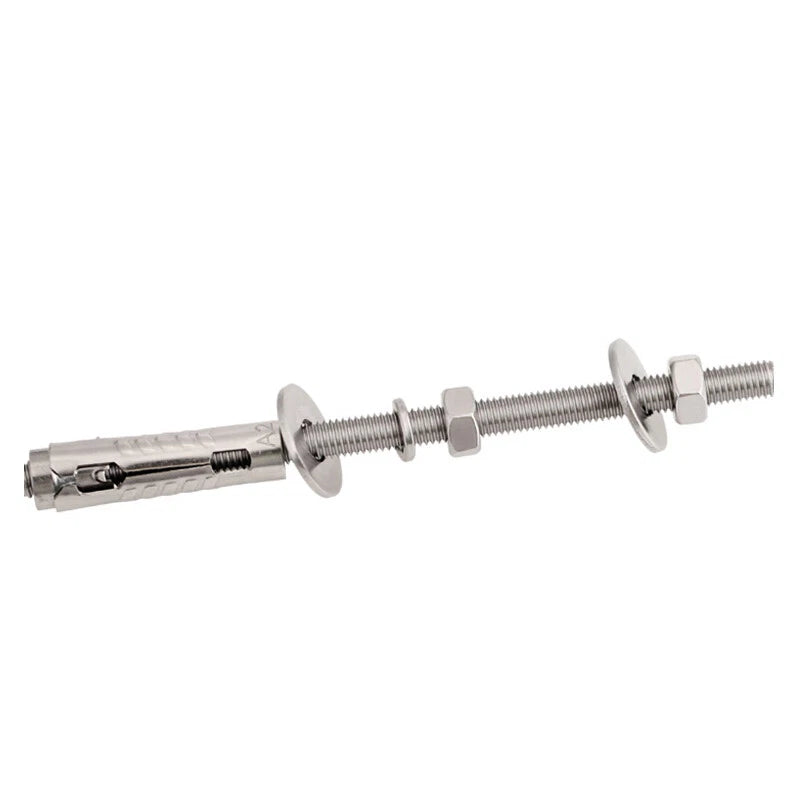
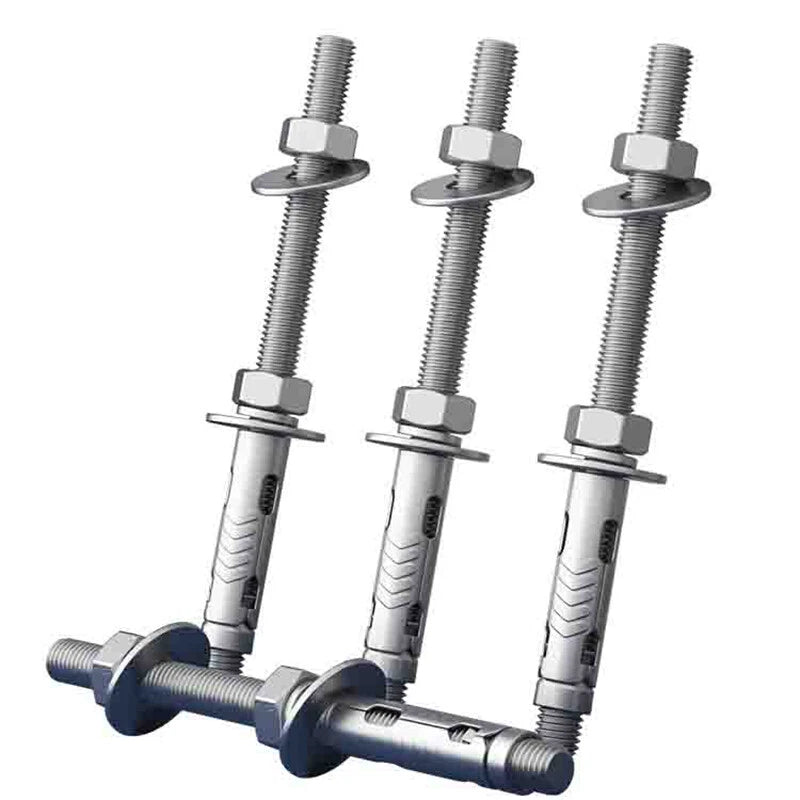
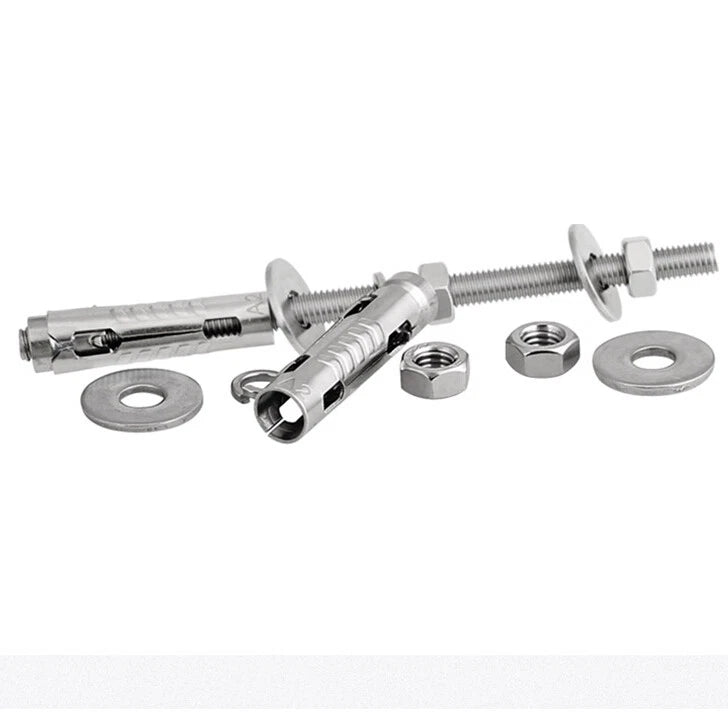
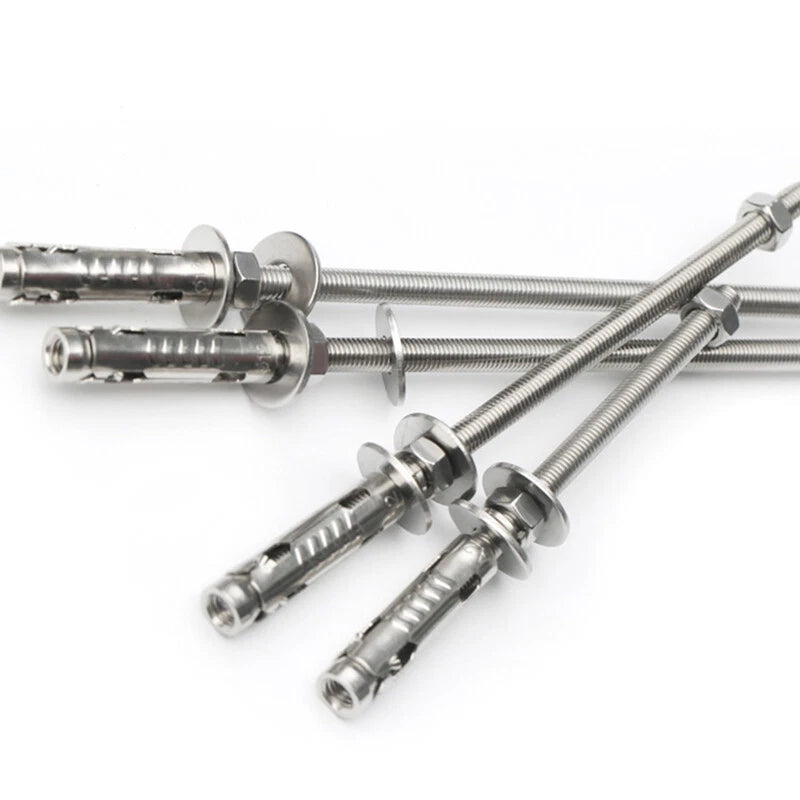
BRICK WALL MASONRY CONCRETE ANCHORS THROUGHBOLT LONG THREADED EXPANSION BOLTS

Keine Bewertungen

Preis:
Sonderpreis$2.16 USD
Lagerbestand:
Verfügbar (500 Stück), versandbereit

Payment & Security

Ach Direct Debit Amazon American Express Apple Pay Bancontact Diners Club Discover Google Pay iDEAL Wero Mastercard PayPal Shop Pay USDC Visa

Deine Zahlungsinformationen werden sicher verarbeitet. Wir speichern keine Kreditkartendaten und haben auch keinen Zugang zu deinen Kreditkartendaten.

Quantity Discount Promotion
🎯 BULK DISCOUNT: Buy More, Save More!
Buy 2 Items
5% OFF
Buy 4 Items
10% OFF
Buy 6 Items
15% OFF
Expert

DIY Expert Support

Get fitment advice & recommendations

Mon-Fri, 8:30AM-8PM
24-Hour Fast Ship
🚚
Arrives in 3-14 days
🌍
Global Reach
↩️
30-Day Returns
🌱 1 tree planted with every purchase

Beschreibung

Throughbolt Expansion Bolts for Brick, Masonry & Concrete — Reliable Through-Fixing for Structural Loads

When a standard surface anchor won't cut it and you need a fastener that grips from the inside out, DIYers and tradespeople alike reach for a throughbolt expansion anchor. Whether you're hanging a heavy gate bracket on a rendered brick wall, securing a structural steel post to a concrete slab, or mounting machinery to a masonry floor, a loose or undersized anchor is a liability you can't afford.

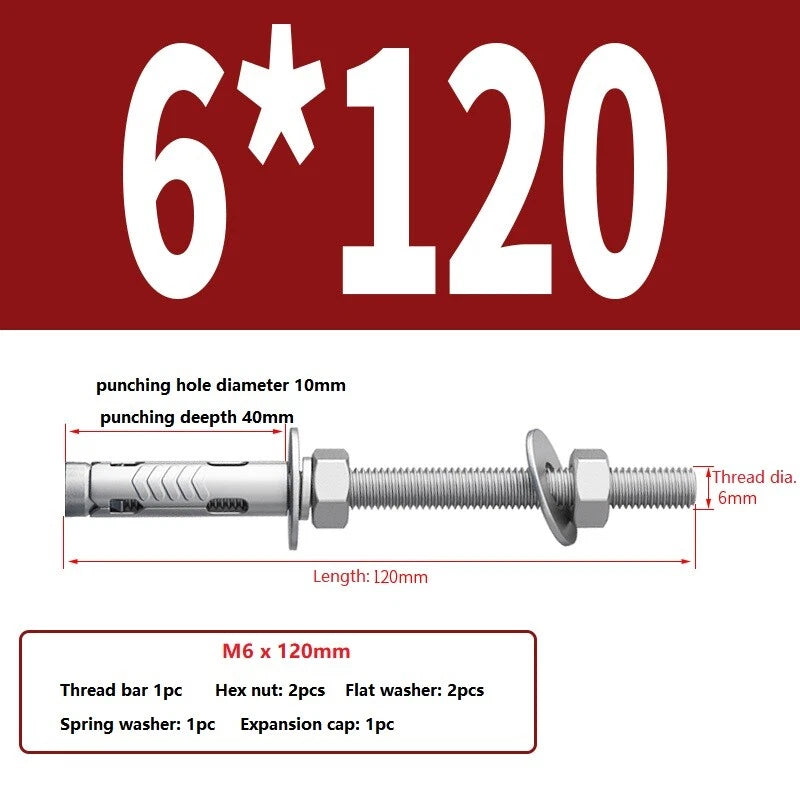
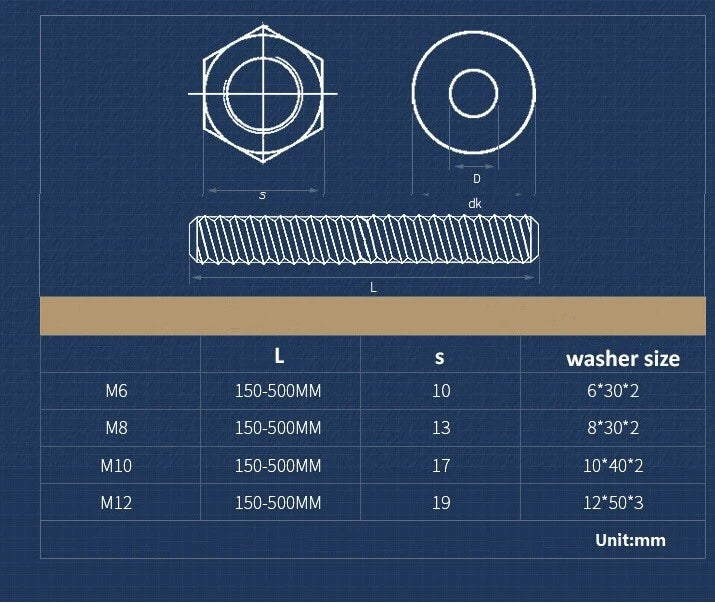
These concrete throughbolt expansion bolts are available in metric thread diameters of M6, M8, M10, and M12, with shank lengths ranging from 60 mm (approx. 2.4 in) up to 1000 mm (approx. 39.4 in). Each bolt requires a punched or drilled clearance hole sized to match the thread diameter — 10 mm hole for M6, 12 mm for M8, 14 mm for M10, and 16 mm for M12. The full thread design allows the nut and washer to be tightened from the accessible face, drawing the expansion sleeve tight against the substrate.

Typical applications include through-fixing timber ledgers to brick walls, anchoring railing posts through concrete kerbs, securing cable tray brackets to masonry columns, and bolting down equipment bases to concrete pads. The long-length options (250–1000 mm) are particularly suited to through-bolting thick masonry walls or stacked block construction where a standard short anchor cannot reach.

🧱 Compatible substrates: Solid brick, concrete block, poured concrete, natural stone, and dense masonry. Not recommended for hollow-core block, aerated concrete (AAC), or soft render without additional backing.

✅ Key Features of These Concrete Throughbolt Expansion Bolts

🔩 Full-thread shank design — The threaded rod runs the full usable length, so you can adjust the nut position to suit varying material thicknesses without losing clamping depth.
📐 Wide size matrix — Thread diameters M6, M8, M10, and M12 paired with lengths from 60 mm to 1000 mm give you a combination for almost every through-fixing scenario, from light brackets to heavy structural connections.
🕳️ Matched hole diameter — Each size specifies the exact clearance hole required (10 mm / 12 mm / 14 mm / 16 mm), eliminating guesswork and ensuring the expansion sleeve seats correctly in the substrate.
🔧 Standard hex nut and washer compatible — Tighten with a standard spanner or socket set; no proprietary tools required. The metric thread pitch is compatible with standard DIN nuts and washers.
📦 Flexible pack quantities — Order as a single bolt to replace a missing fastener, or choose packs of 2, 3, 4, 5, 8, 10, 20, or 25 to stock up for a project or ongoing maintenance work.
⚖️ Scalable pricing by quantity — Per-unit cost decreases with larger pack sizes, making bulk orders cost-effective for contractors and repeat builders who need consistent fastener stock.

📐 Technical Specifications — Throughbolt Expansion Anchors

Fastener Type Throughbolt expansion anchor (full-thread rod with expansion sleeve)
Thread Diameters Available M6, M8, M10, M12
Shank Lengths Available 60 mm – 1000 mm (approx. 2.4 in – 39.4 in)
Required Hole Diameter M6 → 10 mm | M8 → 12 mm | M10 → 14 mm | M12 → 16 mm
Thread Standard Metric coarse (ISO)
Drive / Tightening Method Hex nut (standard spanner or socket)
Material See variant options
Surface Finish See variant options
Pack Quantities 1, 2, 3, 4, 5, 8, 10, 20, 25 pcs (varies by size)
Compatible Substrates Solid brick, poured concrete, concrete block, dense masonry, natural stone
Installation Method Drill clearance hole through both materials, insert bolt, fit washer and nut, tighten to draw expansion sleeve
Minimum Edge Distance Contact us to confirm
Minimum Embedment Depth Contact us to confirm

❓ Frequently Asked Questions

What is the difference between a throughbolt and a standard expansion anchor?

A standard expansion anchor (such as a sleeve anchor or wedge anchor) is installed into a blind hole drilled into one material only — the anchor expands inside that single substrate. A throughbolt passes completely through both the fixture and the substrate, with the expansion sleeve gripping the back face of the material. This through-fixing method is often stronger in tension because the load is distributed across the full thickness of the substrate rather than relying solely on the drilled hole depth.

How do I choose the right thread diameter and length?

Start with the load requirement: M6 suits lighter brackets and cable management fixings; M8 and M10 are appropriate for medium structural loads such as railing posts and machinery bases; M12 handles heavy-duty structural connections. For length, add the thickness of the fixture (the item being bolted) to the thickness of the substrate (the wall or slab), then select the next available length that comfortably spans both. Leave enough thread protruding to fit a washer and nut with at least 3–4 full thread engagements.

What hole size do I need to drill?

The required clearance hole diameter is specified in each variant name. M6 bolts require a 10 mm hole, M8 requires 12 mm, M10 requires 14 mm, and M12 requires 16 mm. Drill through both the fixture and the substrate using a hammer drill and masonry bit of the correct diameter. A hole that is too small will prevent the bolt from passing through; a hole that is too large will reduce the clamping area of the expansion sleeve.

Are these bolts suitable for outdoor or wet environments?

Corrosion resistance depends on the material and surface finish of the specific bolt. For outdoor, coastal, or permanently damp environments, select a variant with a corrosion-resistant finish or material. If you are unsure which finish is appropriate for your exposure class, contact us to confirm before ordering. Using an uncoated carbon steel bolt in a wet environment without protection will lead to rust staining and eventual fastener degradation.

Can I use these in hollow block or aerated concrete (AAC)?

Throughbolt expansion anchors rely on solid substrate contact to develop their holding strength. Hollow-core concrete block, aerated autoclaved concrete (AAC / Hebel), and lightweight cellular block do not provide the continuous bearing surface needed for the expansion sleeve to grip reliably. For these substrates, use a chemical anchor system with a suitable resin and a threaded rod instead. Contact us if you need guidance on the correct anchor type for your substrate.

How many bolts do I need for a typical railing post or bracket installation?

Most standard railing post base plates use 4 fixing points, so a pack of 5 gives you one spare per post. For a run of 10 posts you would need 40 bolts — a combination of packs of 25 and 10 or 20 is typically the most economical. For structural brackets, always follow the engineer's specification for the number and size of fixings required. When in doubt, order a small quantity first to verify fit and installation before committing to a full project quantity.

What torque should I apply when tightening the nut?

Recommended installation torque varies by thread diameter and substrate type. As a conservative starting point for solid concrete: M6 typically 10–15 Nm, M8 typically 20–30 Nm, M10 typically 40–55 Nm, M12 typically 60–80 Nm. Always tighten gradually and evenly. Over-tightening can strip the thread or crack brittle substrates such as old brick. For load-critical applications, contact us to confirm the manufacturer's specified installation torque for the exact variant you are using.

🛒 Select your thread diameter × length and pack quantity above, then add to cart.

You may also like

Recently viewed