NBR TC Oil Seals — Double-Lip Rotary Shaft Seals That Keep Grease In and Contaminants Out
When a shaft seal fails, grease escapes and abrasive dust, water, and debris work their way into bearings — leading to premature wear and unplanned downtime. Mechanics, maintenance technicians, and DIY equipment rebuilders who work on gearboxes, axles, pumps, and agricultural machinery need a reliable metric TC seal they can source quickly in the exact size required.
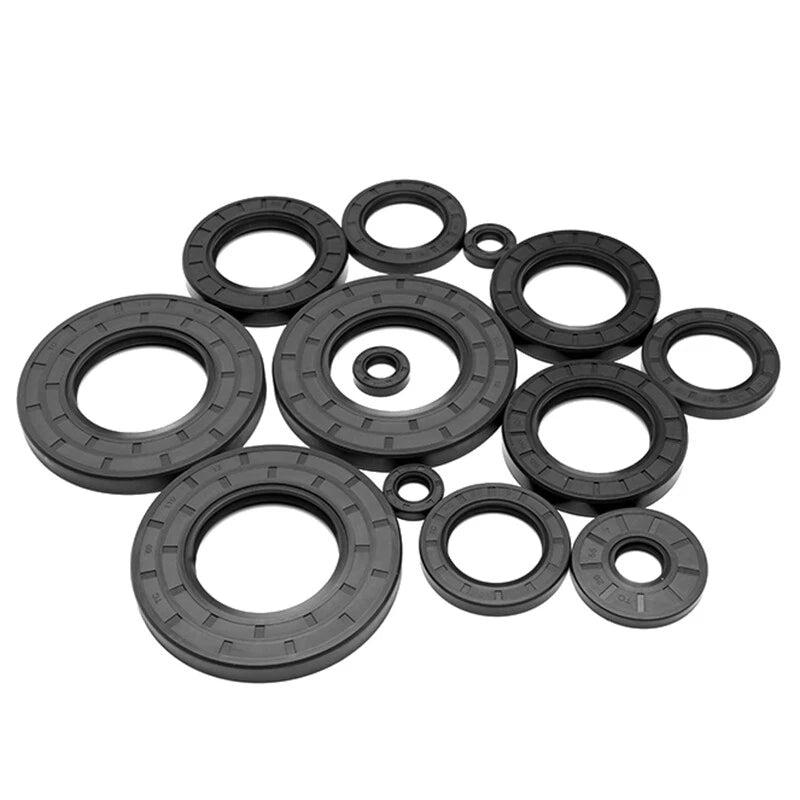
These NBR TC double-lip rotary shaft seals are constructed from nitrile rubber (NBR) bonded to a steel case, with a garter spring that maintains consistent lip contact pressure against the rotating shaft. Available in inner diameters from 34 mm (~1.34 in) to 95 mm (~3.74 in), outer diameters from 41 mm to 95 mm, and widths from 4 mm to 17 mm, the range covers a broad spectrum of metric shaft applications. Each seal ships in your choice of 1, 3, 5, 10, or 20 pieces per order.
Typical use cases include gearbox output shaft sealing on compact tractors and ATVs, front and rear axle seals on light utility vehicles, pump shaft sealing in irrigation and hydraulic systems, and electric motor shaft sealing in industrial equipment — all situations where a TC double-lip NBR oil seal with spring is the standard replacement specification.
⚙️
Compatibility: Designed for metric shaft applications. Match the ID to your shaft diameter, OD to your housing bore, and width to your housing depth. Confirm dimensions before ordering.
✅ Key Features of These NBR TC Double-Lip Rotary Shaft Oil Seals
-
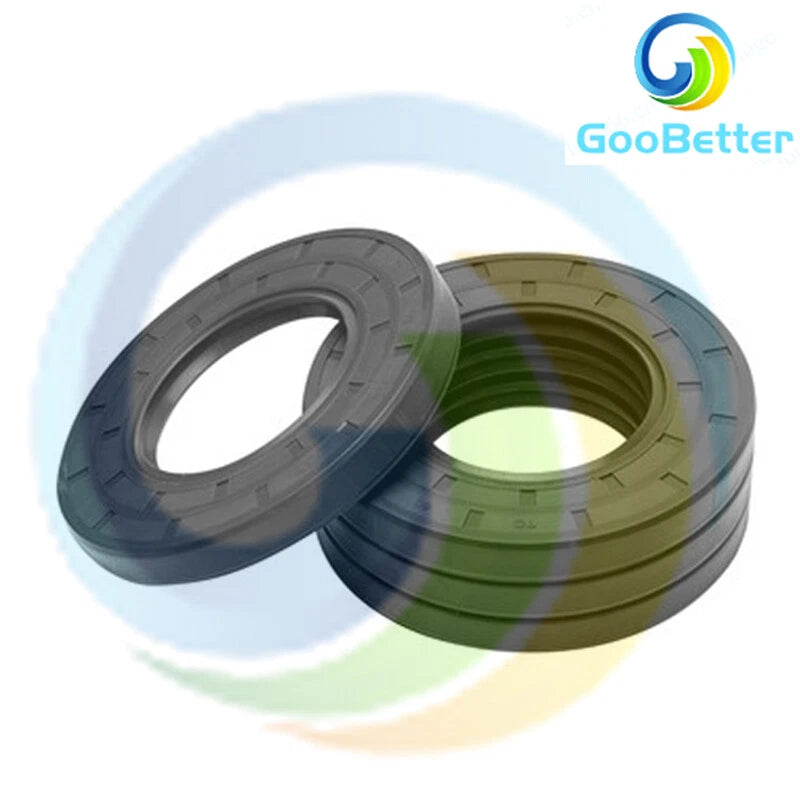
🔩TC Double-Lip Design — Primary sealing lip retains lubricant; secondary dust lip blocks contaminants, providing two-stage protection in a single seal.
-
🌀Garter Spring-Loaded Primary Lip — The integrated garter spring maintains consistent radial load on the shaft, compensating for minor shaft runout and lip wear over time.
-
🧱NBR Rubber Construction — Nitrile butadiene rubber offers resistance to petroleum-based oils, greases, and hydraulic fluids across a typical operating range of approximately −40 °C to +120 °C (−40 °F to +248 °F).
-
🔧Steel-Reinforced Case — The rigid steel outer shell provides a secure press-fit into the housing bore, maintaining concentricity and preventing seal rotation during operation.
-
📐Wide Metric Size Range — ID from 34 mm to 95 mm, OD from 41 mm to 95 mm, width from 4 mm to 17 mm — covering dozens of common metric shaft seal specifications in one product listing.
-
📦Flexible Pack Quantities — Order 1, 3, 5, 10, or 20 pieces to match your job requirement, whether a single repair or a workshop stock-up.
📐 Technical Specifications — TC Rotary Shaft Oil Seals
| Seal Type |
TC (Double Lip with Garter Spring) |
| Material |
NBR (Nitrile Butadiene Rubber) with steel case |
| Inner Diameter (ID) |
See variant options |
| Outer Diameter (OD) |
See variant options |
| Width (Thickness) |
See variant options |
| Operating Temperature |
Typically −40 °C to +120 °C (−40 °F to +248 °F) |
| Compatible Fluids |
Petroleum-based oils, greases, hydraulic fluids |
| Spring Type |
Garter spring (integrated) |
| Lip Configuration |
Primary sealing lip + secondary dust exclusion lip |
| Dimension Standard |
Metric (mm) |
| Pack Quantity |
See variant options (1 / 3 / 5 / 10 / 20 pcs) |
❓ Frequently Asked Questions
How do I choose the correct TC oil seal size for my application?
Measure three dimensions on your existing seal or housing: inner diameter (ID) — this must match your shaft diameter exactly; outer diameter (OD) — this must match your housing bore; and width (thickness) — this must fit within the housing depth. All three dimensions are listed in the variant name in the format ID × OD × Width (mm). If the old seal is worn, measure the shaft and housing bore directly with calipers.
What does "TC" mean on an oil seal?
"TC" designates a double-lip seal with a garter spring. The primary lip (spring-loaded) retains lubricant on the inboard side, while the secondary lip acts as a dust and debris excluder on the outboard side. This two-lip arrangement provides better contamination resistance than a single-lip (SC) seal, making TC the standard choice for most rotating shaft applications exposed to dirt or moisture.
Is NBR rubber suitable for my application?
NBR (nitrile) is compatible with petroleum-based mineral oils, greases, diesel fuel, and most hydraulic fluids. It performs well in the approximate range of −40 °C to +120 °C. NBR is not recommended for use with phosphate-ester hydraulic fluids, ketones, or strong acids. If your application involves synthetic esters or high-temperature environments above 120 °C, consider a Viton (FKM) seal instead.
How do I install a TC rotary shaft seal without damaging it?
Clean the housing bore and shaft thoroughly before installation. Apply a thin film of clean grease to the seal lip and the shaft surface. Use a seal driver or a flat press plate to drive the seal squarely into the bore — never strike the seal face directly with a hammer. Press until the seal face is flush with or slightly below the housing face. Avoid nicking the primary lip on shaft keyways or splines; use a thin plastic sleeve or tape over sharp edges during installation.
Can these seals handle shaft runout or misalignment?
The garter spring maintains radial lip contact and can accommodate minor dynamic runout — typically up to approximately 0.2–0.5 mm TIR at moderate shaft speeds. Excessive runout, misalignment, or shaft surface roughness (recommended finish: Ra 0.2–0.8 µm) will accelerate lip wear and reduce seal life. If significant misalignment is present, address the root cause before replacing the seal.
What shaft surface finish is required for a good seal?
For reliable sealing, the shaft contact surface should have a ground or polished finish with a roughness of approximately Ra 0.2–0.8 µm (8–32 µin). The surface should be free of longitudinal scratches, which can act as leak paths. Circumferential or lead-free machining marks are acceptable. A hardness of 45–60 HRC in the contact zone is recommended for extended seal life.
Do these seals work for both static and dynamic applications?
TC rotary shaft seals are designed for dynamic (rotating shaft) applications. The spring-loaded primary lip is engineered to maintain contact against a rotating shaft. They are not intended for purely static face-seal applications. For static sealing, an O-ring or gasket is typically the appropriate choice.
🛒 Select your Size (ID × OD × Thickness) and Pack Quantity above, then add to cart.