Open End PU Timing Belt — Cut-to-Length HTD & S-Series for CNC, 3D Printers & Conveyors
When a standard closed-loop belt doesn't fit your machine geometry — or you need a precise custom run length — an open-end timing belt is the practical solution. Engineers, machine builders, and repair technicians who work with CNC routers, 3D printers, linear actuators, and conveyor systems rely on open-end belts to cut exactly what they need without waste or compromise.
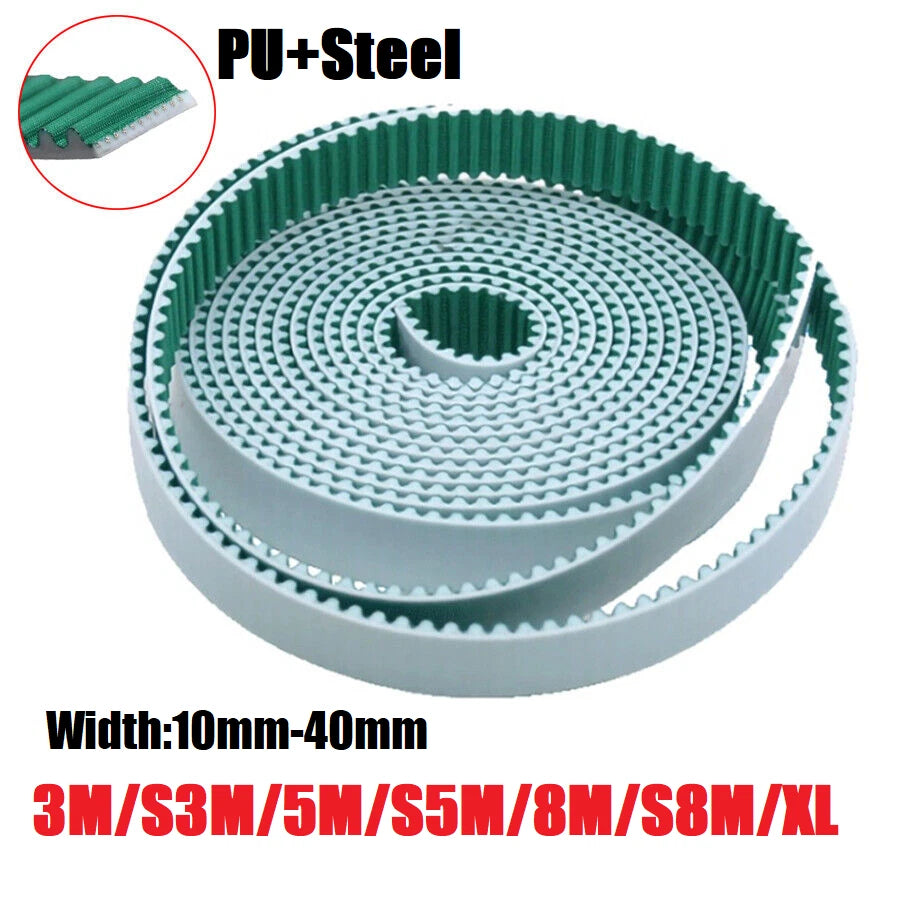
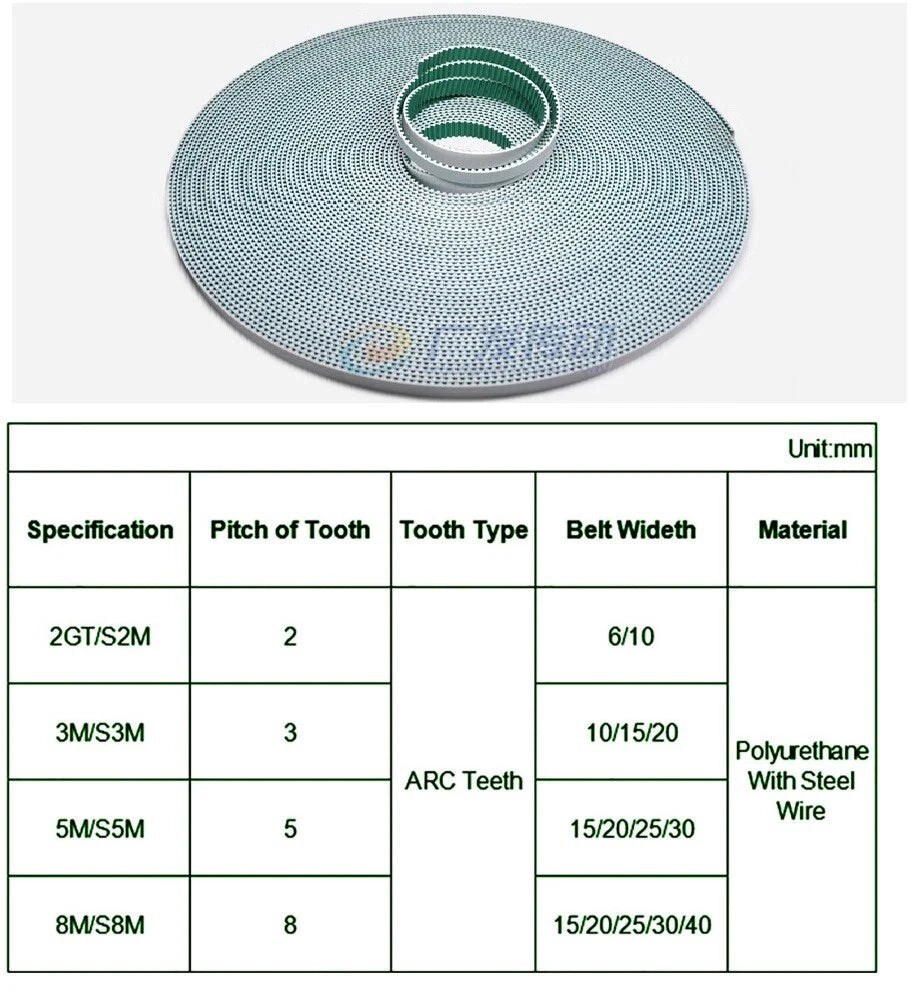
Each meter of belt is made from polyurethane (PU) with a steel wire tensile cord, combining flexibility with low elongation under load. Available in seven profiles — HTD-3M, HTD-5M, HTD-8M, S3M, S5M, S8M, and XL — and six widths from 10mm (≈3/8") to 40mm (≈1-9/16"). Lengths are sold in 1 m (≈39.4"), 2 m, 3 m, 4 m, 5 m, and 10 m increments; select the combination that matches your application.
Typical use cases include open-end timing belt for CNC gantry systems, replacement drive belt for 3D printer X/Y axes, and cut-to-length conveyor belt for light industrial automation. The open-end format also makes it straightforward to create custom loop lengths using standard belt clamps or lacing hardware.
🔗 Compatibility: Designed to work with standard HTD and S-series timing pulleys of the matching profile and pitch. Verify your pulley's profile designation (e.g., HTD-5M, S3M) and face width before ordering. XL profile is compatible with standard XL trapezoidal pulleys.
✅ Key Features of These Open End PU Timing Belts
-
🧵 Steel Wire Tensile Core — Embedded longitudinal steel cords deliver high tensile strength and minimal stretch, maintaining positioning accuracy in CNC and linear drive applications.
-
🔩 Seven Profile Options — HTD-3M, HTD-5M, HTD-8M, S3M, S5M, S8M, and XL cover a wide range of torque and speed requirements, from light-duty 3D printer axes to heavier conveyor drives.
-
📏 Six Width Choices (10–40mm) — Select 10mm (≈3/8"), 15mm (≈19/32"), 20mm (≈25/32"), 25mm (≈1"), 30mm (≈1-3/16"), or 40mm (≈1-9/16") to match your pulley's face width and torque needs.
-
✂️ Open-End Format — Cut to Any Length — Unlike closed loops, this belt can be trimmed to an exact dimension on-site, making it ideal for custom machine builds, prototyping, and field repairs.
-
🛡️ Polyurethane Body with Oil & Moisture Resistance — PU construction resists oils, mild chemicals, and humidity better than standard neoprene, extending service life in light industrial environments.
-
📦 Sold by the Meter — Up to 10 m Runs — Order 1 m through 10 m in a single SKU; longer runs reduce splicing points and simplify installation on extended linear axes or conveyor lines.
📐 Technical Specifications — Open End PU Timing Belt
| Belt Type |
Open End (non-looped), Synchronous Timing Belt |
| Available Profiles |
HTD-3M, HTD-5M, HTD-8M, S3M, S5M, S8M, XL |
| Pitch — HTD-3M / S3M |
3 mm (≈0.118") |
| Pitch — HTD-5M / S5M |
5 mm (≈0.197") |
| Pitch — HTD-8M / S8M |
8 mm (≈0.315") |
| Pitch — XL |
5.08 mm (1/5", standard XL trapezoidal) |
| Tooth Form |
HTD: rounded curvilinear; S-series: modified curvilinear; XL: trapezoidal |
| Belt Width Options |
10mm, 15mm, 20mm, 25mm, 30mm, 40mm |
| Available Lengths |
1 m, 2 m, 3 m, 4 m, 5 m, 10 m (sold per meter run) |
| Body Material |
Polyurethane (PU) |
| Tensile Cord |
Steel wire (longitudinal) |
| Tooth Side |
Single-sided (teeth on inner face) |
| Color |
Typically black or dark grey (see variant images to confirm) |
| Operating Temperature |
See variant options / Contact us to confirm |
| Tensile Load Rating |
See variant options — varies by profile and width |
| Compatible Pulley Standards |
HTD, S-series, and XL standard timing pulleys of matching profile |
⚠️ Confirm before ordering: Match the profile designation (e.g., HTD-5M) and belt width to your existing pulleys. If you are unsure, measure your pulley's pitch and tooth profile or contact us with your pulley part number.
❓ Frequently Asked Questions
How do I choose the right belt length?
Measure the required span between your pulleys and add enough for tensioning — typically 5–10% extra. This belt is sold by the meter (1 m ≈ 39.4 in), so round up to the next available length. For example, if you need 1.8 m, select the 2 m option. For closed-loop applications, calculate the total loop circumference and order accordingly, then join with belt clamps.
Which profile should I choose — HTD or S-series?
HTD (High Torque Drive) profiles use a rounded tooth form optimized for high-torque, moderate-speed drives. S-series profiles use a modified curvilinear tooth that generally offers slightly higher load capacity at the same pitch. XL is a trapezoidal profile suited for lighter-duty, precision positioning tasks. In all cases, the profile must match your pulleys exactly — they are not interchangeable.
What load or torque can these belts handle?
Load capacity depends on the profile, width, and operating speed. Wider belts (30–40 mm) in the 8M/S8M profile generally handle the highest torque loads. For precise ratings, consult your pulley manufacturer's datasheet or contact us with your application details. As a general rule, wider belts and larger pitch numbers indicate higher torque capacity.
Are these belts suitable for outdoor or wet environments?
Polyurethane (PU) typically offers better resistance to oils, mild chemicals, and moisture compared to neoprene rubber belts. However, prolonged UV exposure or immersion in harsh solvents may degrade performance over time. For outdoor installations, shielding from direct sunlight is generally recommended to extend service life.
Will this belt fit my existing pulleys?
Yes — provided your pulleys match the corresponding profile and pitch (e.g., HTD-5M pulleys for HTD-5M belt). The belt width must be equal to or narrower than your pulley's usable face width. Verify both the pitch designation and the belt width before ordering. If you have the pulley part number, contact us and we can help confirm compatibility.
Can I cut this belt to a custom length on-site?
Yes. Because this is an open-end belt, it can be cut to any length with a sharp utility knife or band saw. This makes it well-suited for custom machine builds, field repairs, and prototyping where standard closed-loop lengths do not fit. Cut cleanly and squarely across the belt width for the best joint when using clamps.
What is the tensile cord material, and why does it matter?
The tensile cord is steel wire running longitudinally through the polyurethane body. Steel wire provides high tensile strength and very low elongation under load, which is important for maintaining positioning accuracy in CNC routers, 3D printer axes, and other precision linear drives. Fiberglass-cord belts are an alternative for applications requiring non-magnetic or corrosion-free properties.
How do I join two pieces of open-end belt to form a loop?
Open-end PU timing belts can generally be joined using metal belt clamps or lacing connectors sized for the specific profile and width. Ultrasonic or thermal welding is also possible with appropriate equipment. For most DIY and light industrial applications, clamp-style connectors are the most practical option. Contact us if you need guidance on compatible joining hardware.
🛒 Select your model, width, and length above, then add to cart — ships from our US warehouse.