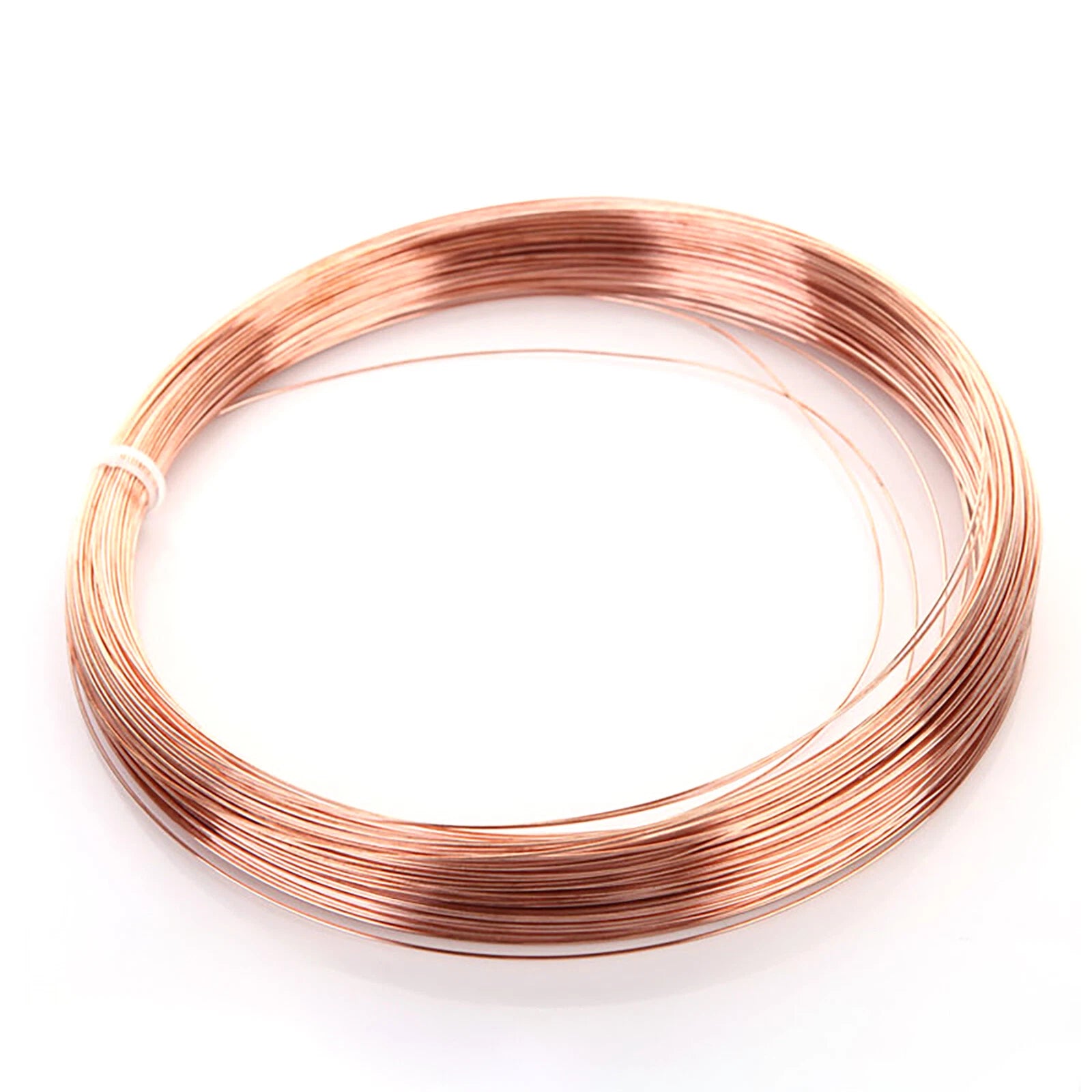
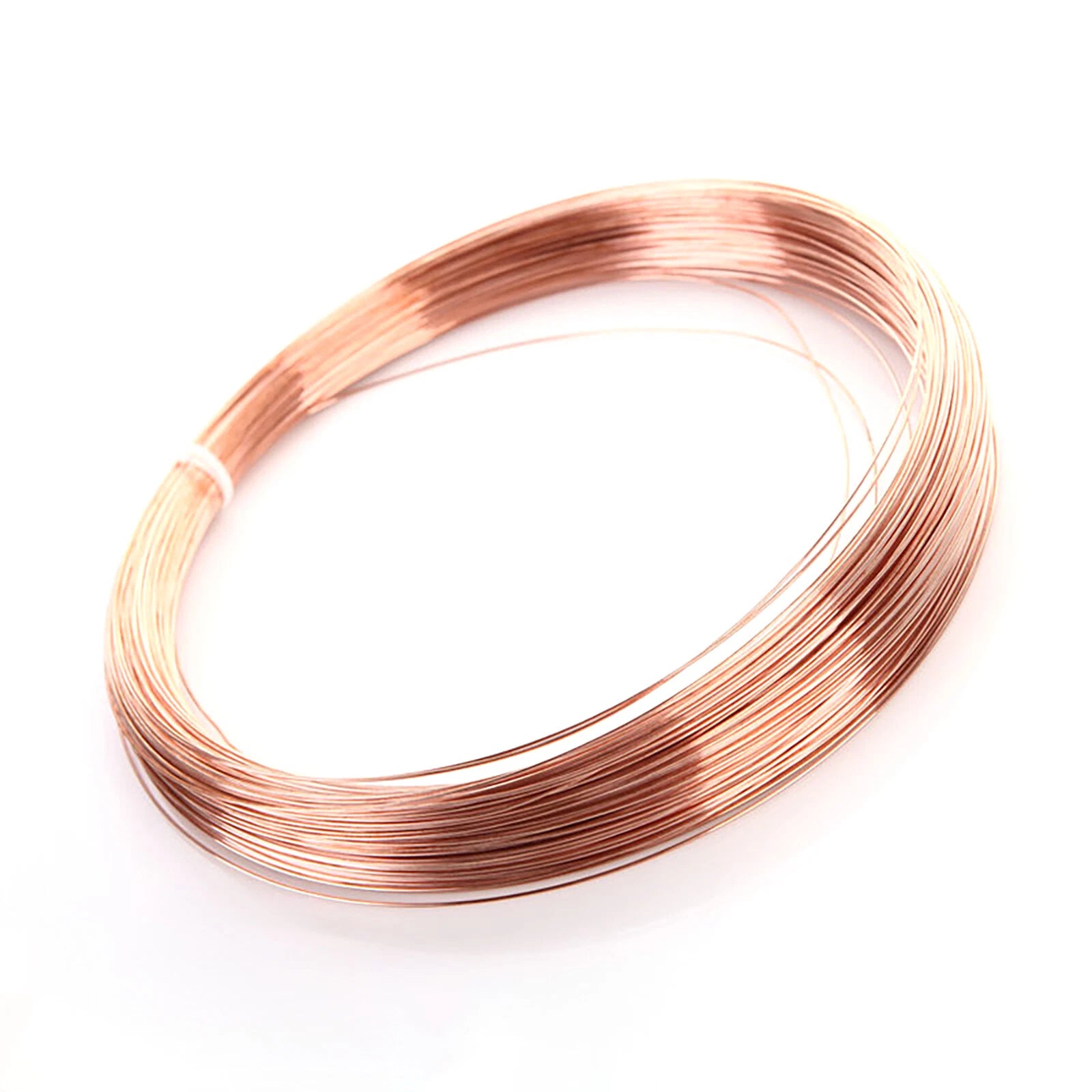
Solid 99.9% Pure Bare Copper Wire Bonsai Jewellery DIY Craft 0.4mm to 2.0mm

Keine Bewertungen

Preis:
Sonderpreis$4.56 USD
Lagerbestand:
Verfügbar (500 Stück), versandbereit

Payment & Security

Ach Direct Debit Amazon American Express Apple Pay Bancontact Diners Club Discover Google Pay iDEAL Wero Mastercard PayPal Shop Pay USDC Visa

Deine Zahlungsinformationen werden sicher verarbeitet. Wir speichern keine Kreditkartendaten und haben auch keinen Zugang zu deinen Kreditkartendaten.

Quantity Discount Promotion
🎯 BULK DISCOUNT: Buy More, Save More!
Buy 2 Items
5% OFF
Buy 4 Items
10% OFF
Buy 6 Items
15% OFF
Expert

DIY Expert Support

Get fitment advice & recommendations

Mon-Fri, 8:30AM-8PM
24-Hour Fast Ship
🚚
Arrives in 3-14 days
🌍
Global Reach
↩️
30-Day Returns
🌱 1 tree planted with every purchase

Beschreibung

99.9% Pure Bare Copper Wire — Flexible, Workable & Built for Bonsai, Jewellery & DIY Craft

When your bonsai branch won't hold its shape, your wire snaps mid-bend, or your jewellery wire leaves green marks on skin, the culprit is almost always low-purity alloy wire. Hobbyists, bonsai artists, and jewellery makers who need reliable, consistent results depend on wire that bends cleanly, holds its form, and stays true to gauge — every single time.

This solid 99.9% pure bare copper wire is available in diameters from 0.2 mm (approx. 1/128") up to 5 mm (approx. 3/16"), sold in lengths of 1, 2, 3, 5, and 10 metres. Each coil is uncoated bare copper — no enamel, no tinning — giving you direct metal-to-metal contact and the natural warm tone copper is known for.

Typical applications include bonsai branch and trunk training, hand-formed jewellery components such as rings, pendants, and ear wires, sculptural wire art, electrical grounding leads in hobby electronics, and general DIY craft binding. The range of gauges makes it equally suited to delicate filigree work (0.2–0.5 mm) and structural bonsai shaping (1.5–5 mm).

⚙️ Compatibility note: Bare copper oxidises over time when exposed to air and moisture, developing a natural patina. For applications requiring a bright finish long-term, consider sealing with a clear lacquer after forming. Not recommended for direct skin contact in high-perspiration environments without a protective coating.

✅ Key Features of These Pure Bare Copper Wires

🔬99.9% copper purity — Solid bare copper with no alloy filler, giving consistent conductivity, colour, and workability across every gauge.
📏Wide gauge range: 0.2 mm – 5 mm — 21 diameter options cover fine jewellery wire through to structural bonsai training wire (approx. AWG 32 down to AWG 6).
📐Multiple cut lengths: 1 m – 10 m — Buy exactly what your project needs; lengths of 1, 2, 3, 5, and 10 metres reduce offcut waste.
🌿Ideal for bonsai training — Soft enough to wrap without bark damage at finer gauges; stiff enough to hold branch position at 1.5 mm and above.
💍Jewellery and craft ready — Uncoated surface accepts patination, liver of sulphur, and cold connections; compatible with standard jewellery-making tools.
Electrically conductive — Suitable for hobby electronics grounding, coil winding, and low-voltage DIY wiring projects where bare copper is specified.

📐 Technical Specifications — Bare Copper Wire

Material 99.9% pure solid copper (bare, uncoated)
Surface finish Bare / bright copper (no enamel, no tin plating)
Available diameters 0.2, 0.3, 0.4, 0.5, 0.6, 0.7, 0.8, 1.0, 1.2, 1.4, 1.5, 1.6, 1.8, 2.0, 2.3, 2.5, 3.0, 3.5, 4.0, 4.5, 5.0 mm
Available lengths 1 m, 2 m, 3 m, 5 m, 10 m
Wire form Solid (not stranded)
Temper See variant options
Tensile strength See variant options
Weight per metre See variant options (varies by diameter)
Colour Bright copper (will patinate to brown/green over time without sealing)
Suitable applications Bonsai training, jewellery making, wire sculpture, hobby electronics, DIY craft
Quantity per order Single continuous length as selected

❓ Frequently Asked Questions

Which diameter should I choose for bonsai training?

A general rule is to select wire that is approximately one-third the diameter of the branch being trained. For fine twigs (under 5 mm thick), 0.5–1.0 mm wire is typically sufficient. For branches 5–15 mm thick, 1.5–2.5 mm is common. Trunk work on larger trees may require 3.0–5.0 mm. When in doubt, size up — wire that is too thin will not hold the set.

Is this wire strong enough to hold a bonsai branch in position?

Yes. Copper work-hardens as it is wrapped, which increases its rigidity after application. This makes copper wire particularly effective for bonsai compared to aluminium at equivalent gauges. Thicker gauges (2 mm and above) provide substantial holding force for heavier branches. Leave the wire on for one full growing season, then remove carefully to avoid cutting into bark.

Will bare copper wire cause skin irritation or turn skin green?

Bare copper can react with skin moisture and acids, leaving a temporary green or black mark on some people — this is copper oxide/carbonate and is harmless. For jewellery worn directly against skin, applying a thin coat of clear jewellery lacquer or Renaissance Wax to the finished piece will significantly reduce this effect. Alternatively, use this wire for structural components (frames, clasps) rather than direct-contact surfaces.

Can I use this wire for electrical or electronics projects?

Yes, bare copper wire is electrically conductive and suitable for hobby electronics applications such as grounding leads, coil winding, antenna elements, and low-voltage DIY wiring. It is not rated or certified for mains electrical wiring — for any mains-voltage application, use appropriately rated and insulated cable that meets your local electrical code.

How do I prevent the copper from oxidising or tarnishing?

Bare copper oxidises naturally when exposed to air and moisture. To slow this process: store unused wire in a sealed zip-lock bag with a small silica gel sachet; apply a clear lacquer, paste wax, or Renaissance Wax to finished pieces; or deliberately accelerate patination with liver of sulphur for an antique finish and then seal it. For bonsai wire, oxidation is generally not a concern as the wire is removed after the branch sets.

What tools do I need to work with this copper wire?

For jewellery making: round-nose pliers, flat-nose pliers, flush wire cutters, and a mandrel for forming loops and rings. For bonsai: dedicated bonsai wire cutters (concave-jaw type) for clean removal without bark damage, and your hands for wrapping — gloves are optional but recommended for thicker gauges. For sculpture: standard needle-nose pliers and side cutters work well for gauges up to 2 mm; heavier gauges may require lineman's pliers.

Is the wire sold as a straight length or a coil?

The wire is supplied as a coiled length. Shorter lengths (1–3 m) will have a natural coil memory that can be straightened by pulling gently through your fingers or over a smooth edge. Longer lengths (5–10 m) are wound in a larger coil. If you need perfectly straight wire, draw it through a draw plate or pull it firmly between two fixed points before use.

🛒 Select your Size and Length above, then add to cart.

You may also like

Recently viewed