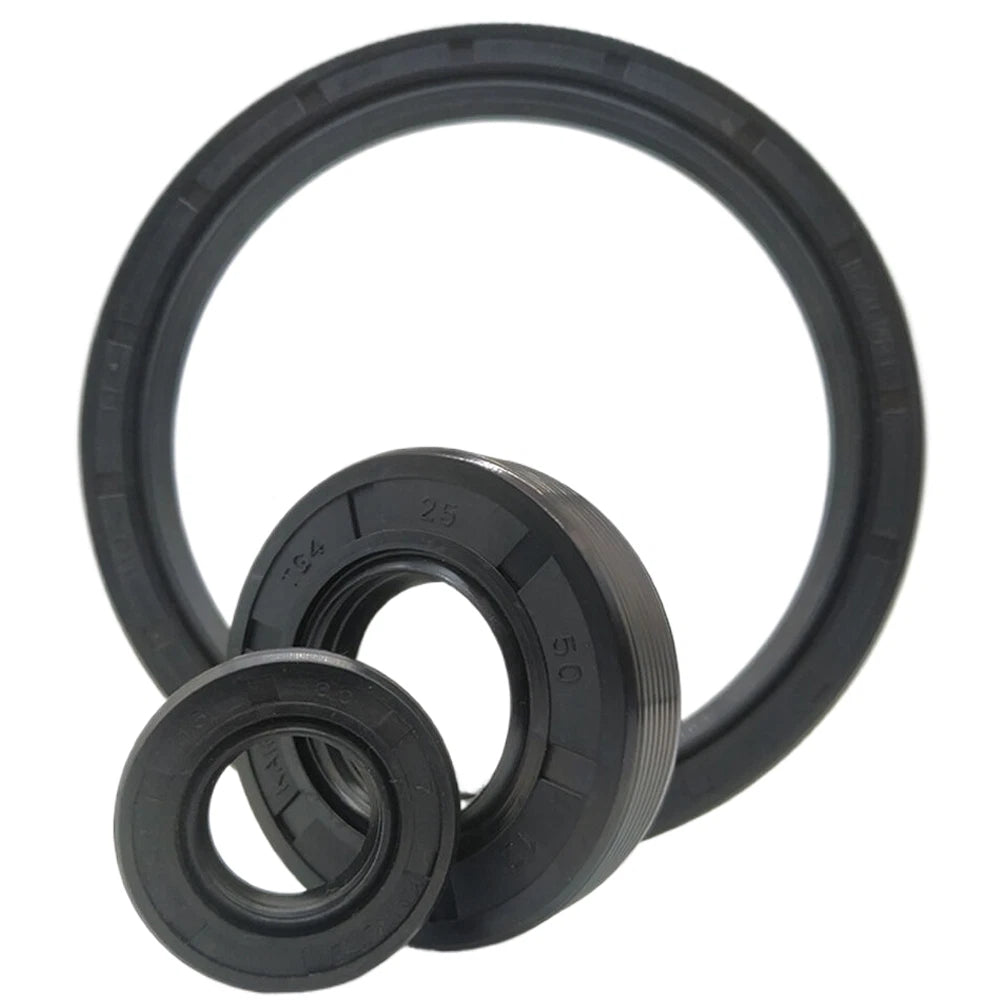
TC NBR Double Lip Rotary Shaft Oil Seal — Stop Leaks & Block Contaminants
A leaking shaft seal is one of the most common causes of gearbox oil loss, bearing failure, and costly downtime — whether you're maintaining a lawn tractor, an ATV, a hydraulic pump, or industrial rotating equipment. These TC-type NBR double lip rotary shaft oil seals are engineered to create a reliable barrier between the lubricant inside and the environment outside, giving mechanics, equipment owners, and maintenance professionals a dependable replacement part that installs in minutes.
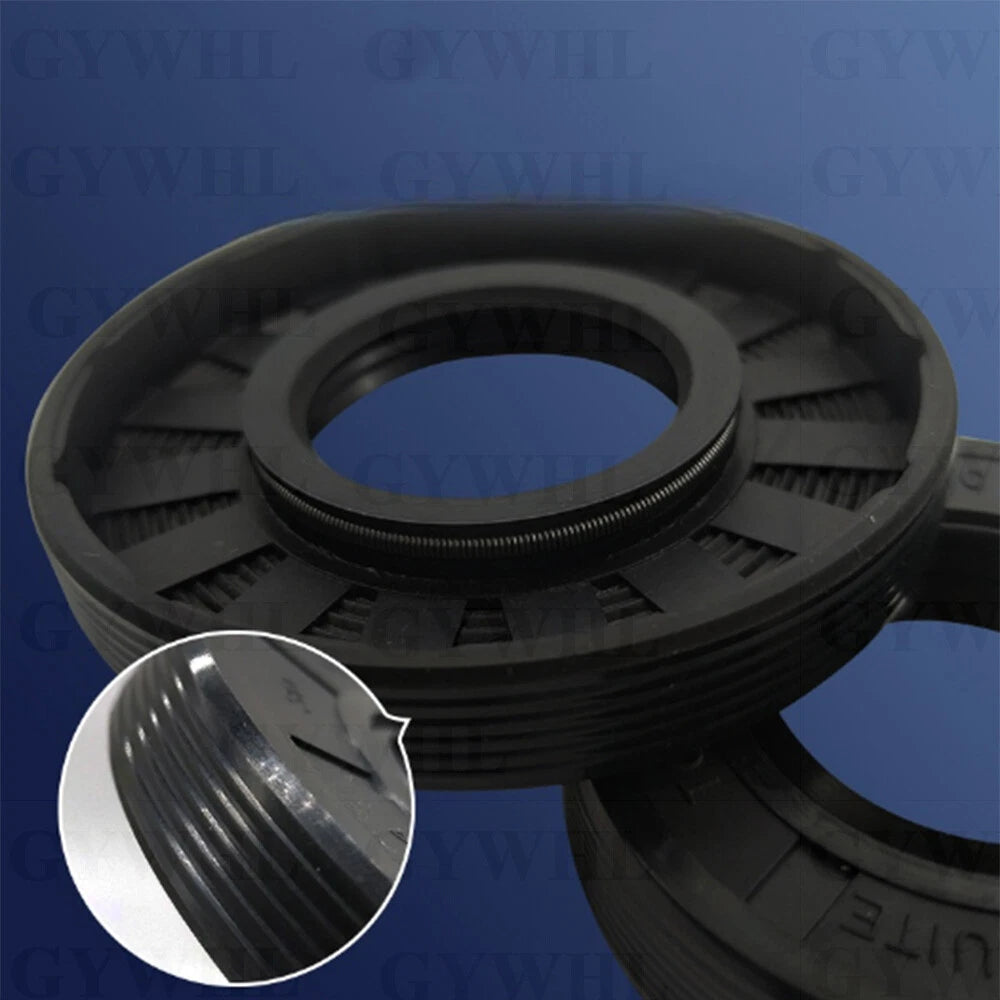
Each seal features a TC (double-lip) profile with a steel outer case for rigid housing fit and an NBR (Nitrile Butadiene Rubber) elastomer body. The inner diameter ranges from 15mm (≈0.591") to 38mm (≈1.496"), outer diameters from 25mm (≈0.984") to 55mm (≈2.165"), and thickness options of 5mm, 6mm, 7mm, 8mm, 10mm, and 12mm — available in packs of 5 or 10 pieces to suit single repairs or workshop stock.
Typical applications include rotary shaft oil seals for small engines and gearboxes, agricultural equipment axle seals, hydraulic cylinder rod seals, power tool spindle seals, and general-purpose NBR lip seals for metric-dimensioned housings. The dual-lip design makes these seals especially well-suited for environments where dust, mud, or water splash is present alongside lubricant retention requirements.
🔵
Compatibility Note: These are metric-dimensioned TC-type seals. Before ordering, measure your shaft OD (inner diameter of seal), housing bore ID (outer diameter of seal), and housing depth (thickness). All three dimensions must match. See the FAQ below for measurement guidance.
✅ Key Features of These TC NBR Double Lip Rotary Shaft Oil Seals
-
🛡️Dual-Lip TC Design — The primary lip retains lubricant while the secondary dust lip faces outward, blocking dirt, water, and debris from reaching the bearing — a meaningful advantage over single-lip seals in real-world conditions.
-
🧪NBR Nitrile Elastomer Body — Nitrile rubber resists petroleum-based oils, greases, hydraulic fluids, and fuels across a typical service range of -40°F to +250°F (-40°C to +120°C), making it the standard choice for most rotary shaft oil seal applications.
-
⚙️Steel-Reinforced Outer Case — The rigid metal outer shell provides a firm press-fit into the housing bore, maintaining concentricity and preventing the seal from spinning or walking out under vibration or thermal cycling.
-
📐Wide Size Range — 15mm to 38mm ID — With inner diameters from 15mm to 38mm and multiple thickness options (5–12mm), this range covers a broad spectrum of metric shaft seal applications without needing to source from multiple suppliers.
-
📦Pack of 5 or 10 Pieces — Order a small pack for a single repair job or stock up with a 10-piece pack for workshop inventory. Consistent batch quality means each seal in the pack meets the same dimensional tolerances.
-
🔧Drop-In Replacement Fit — Dimensioned to metric TC-type standards (also referenced as FB or TG in some catalogs), these seals cross-reference to common OEM part numbers used in European and Asian-manufactured equipment with metric shaft dimensions.
📐 Technical Specifications — TC NBR Rotary Shaft Oil Seal
| Seal Type |
TC (Double Lip) — also referenced as FB / TG |
| Elastomer Material |
NBR (Nitrile Butadiene Rubber) |
| Outer Case |
Steel-reinforced (metal outer shell) |
| Inner Diameter (Shaft Size) |
15mm – 38mm (≈0.591" – 1.496") — see variant options |
| Outer Diameter (Bore Size) |
25mm – 55mm (≈0.984" – 2.165") — see variant options |
| Thickness |
5mm, 6mm, 7mm, 8mm, 10mm, or 12mm — see variant options |
| Pack Quantity |
5 pcs or 10 pcs — see variant options |
| Lip Configuration |
Primary sealing lip (inward) + secondary dust exclusion lip (outward) |
| Typical Temperature Range |
-40°F to +250°F (-40°C to +120°C) — continuous service |
| Fluid Compatibility |
Petroleum-based oils, greases, hydraulic fluids, fuels |
| Typical Max Shaft Speed |
Generally up to 4–6 m/s under lubricated conditions — contact us to confirm |
| Pressure Rating |
Low-pressure applications (typically <0.3 bar / 4.4 psi differential) |
| Dimension Standard |
Metric (mm) |
| Country of Origin |
Contact us to confirm |
⚠️
Before You Order: Confirm all three dimensions — inner diameter (shaft OD), outer diameter (housing bore ID), and thickness — against your existing seal or equipment service manual. A seal that is even 1mm off in any dimension will not seat or seal correctly.
❓ Frequently Asked Questions
How do I choose the right size TC oil seal?
Measure three dimensions: (1) the shaft outer diameter — this is the seal's inner diameter; (2) the housing bore inner diameter — this is the seal's outer diameter; (3) the housing depth — this is the seal's thickness. Match all three to the variant you select. For example, a 20mm shaft in a 35mm bore with 7mm depth = select "20 x 35mm / 7mm." If you only have inch measurements, multiply by 25.4 to convert — e.g., 0.787" ≈ 20mm, 1.378" ≈ 35mm.
What does "TC" mean on an oil seal?
TC (also written FB or TG in some catalogs) designates a double-lip seal design. The primary lip retains lubricant; the secondary dust lip faces outward to block contaminants. This dual-barrier construction is generally preferred over single-lip (SC) seals in applications exposed to dirt, water splash, or debris — which is why TC-type seals are the most common rotary shaft oil seal type in automotive, agricultural, and industrial equipment.
What is NBR and what temperatures can it handle?
NBR (Nitrile Butadiene Rubber) is the most widely used elastomer for oil seals. It typically handles continuous temperatures from about -40°F to +250°F (-40°C to +120°C) and resists petroleum-based oils, greases, hydraulic fluids, and fuels. It is not recommended for use with brake fluid, phosphate-ester hydraulic fluids, or strong solvents — for those applications, a Viton (FKM) seal is generally more appropriate.
Can these seals be used outdoors or in wet environments?
Yes. The secondary dust lip on TC-type seals provides a degree of water and mud exclusion, making them suitable for outdoor equipment, agricultural machinery, and marine auxiliary applications. For full submersion or high-pressure water ingress, a dedicated labyrinth or V-ring seal is generally more appropriate. In most outdoor rotating equipment scenarios — lawn tractors, ATVs, tillers — TC NBR seals are the standard replacement choice.
What shaft speed and pressure can these seals handle?
TC-type NBR seals are typically rated for shaft surface speeds up to about 4–6 m/s (800–1,200 ft/min) under normal lubricated conditions, and are designed for low-pressure applications (generally under 0.3 bar / 4.4 psi differential). For higher speeds or pressures, contact us to confirm suitability before ordering.
Are these seals compatible with metric and standard (inch) housings?
All dimensions listed are metric (mm). To find the closest metric equivalent for an inch-sized housing, multiply the inch measurement by 25.4. Many metric TC seal sizes correspond closely to common inch sizes used in North American equipment — for example, a 1" shaft (25.4mm) is typically sealed with a 25mm ID seal. Contact us if you need help cross-referencing a part number or inch-dimensioned seal.
How do I install a rotary shaft oil seal without damaging it?
Clean the housing bore and lightly lubricate the outer diameter of the seal and the seal lip with the same oil or grease used in the application. Press the seal in squarely using a flat driver or seal installation tool — never hammer directly on the seal face. The primary lip should face toward the lubricant being retained (inward). Avoid nicking the lip on sharp shaft edges; use a chamfer or installation sleeve if available.
🛒 Select your inner/outer diameter, thickness, and pack quantity above, then add to cart — ships from our US warehouse.