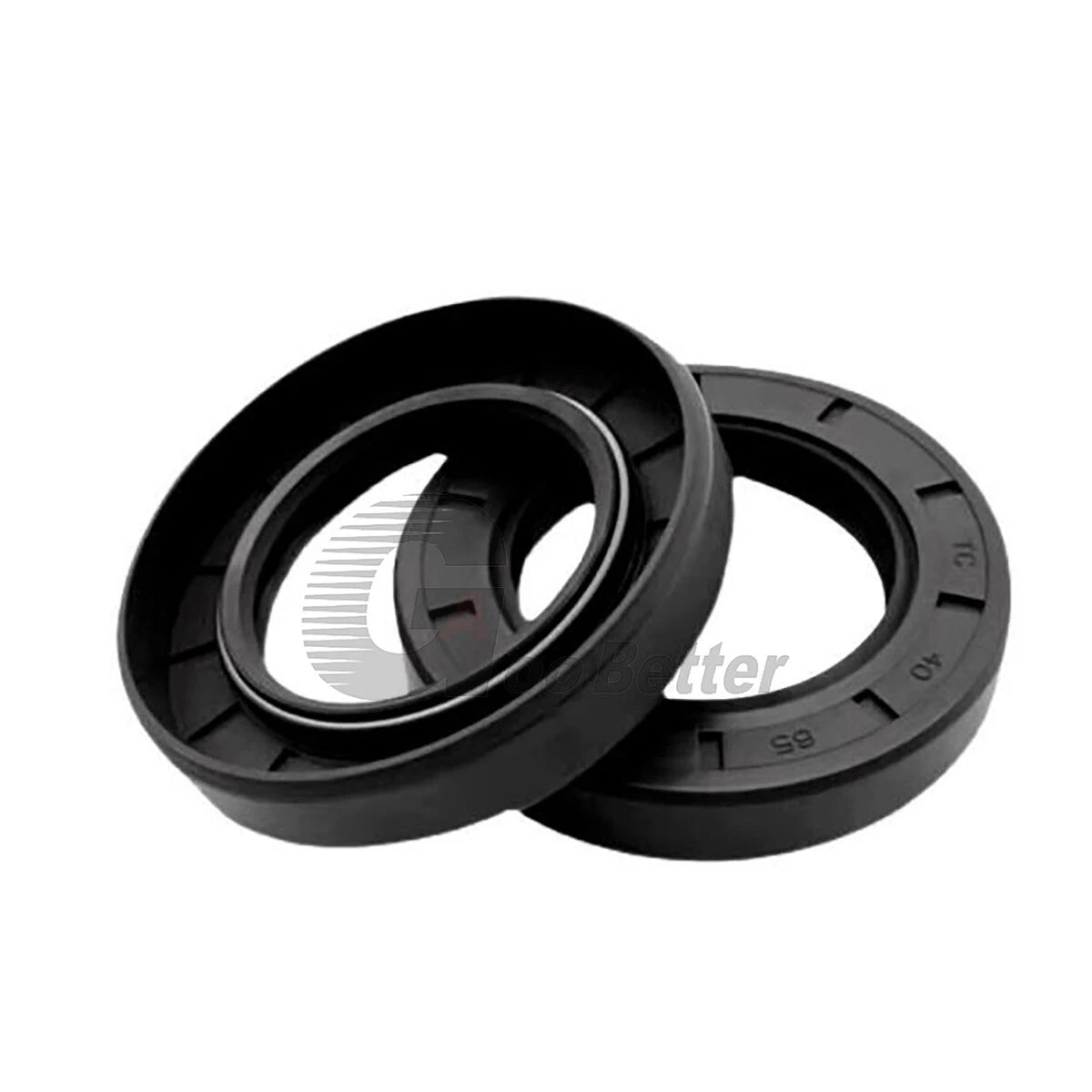
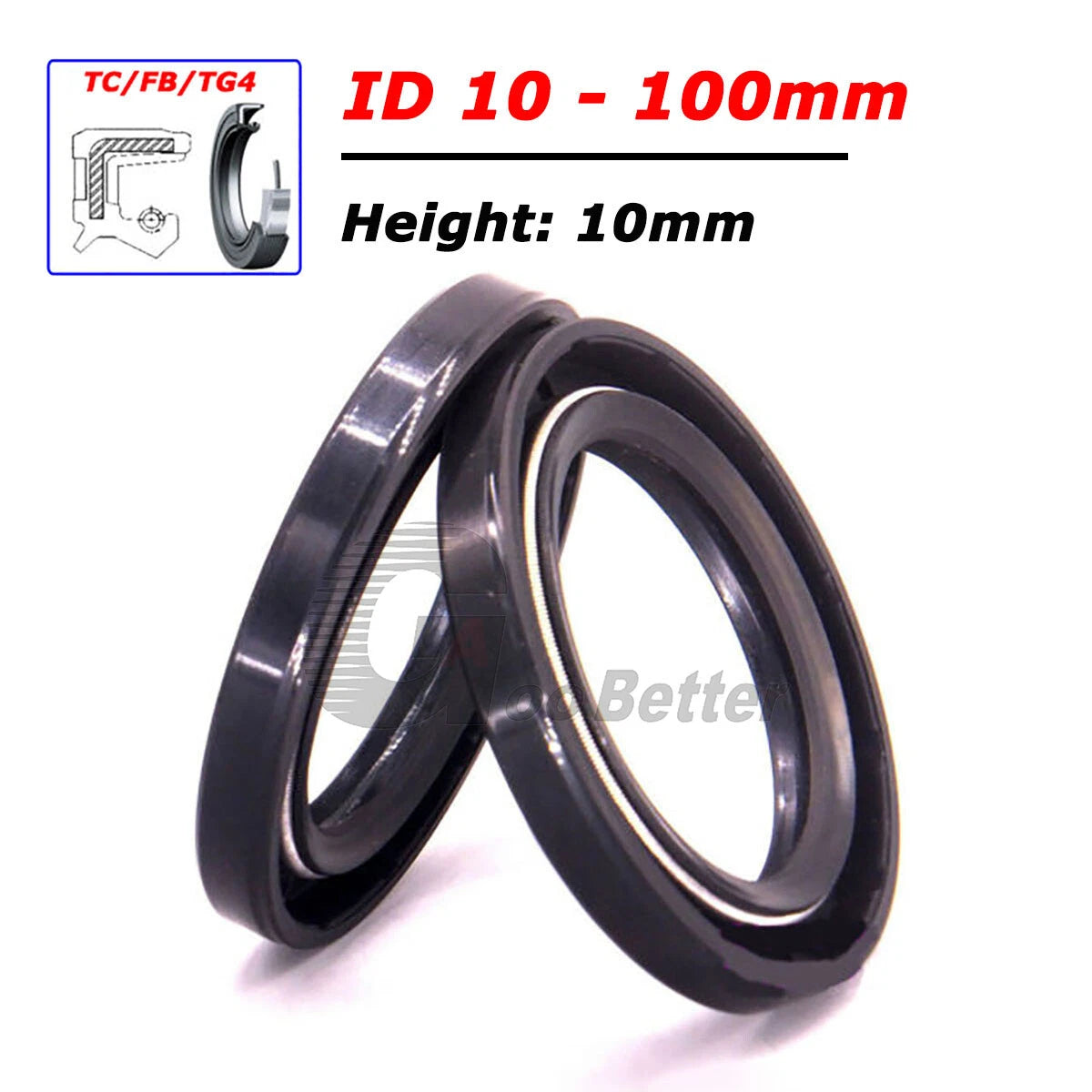
TC Skeleton NBR Oil Seal — Double Lip Rotary Shaft Sealing for ID 10–100mm Applications
When a worn or undersized shaft seal lets lubricant escape and contaminants creep in, the downstream damage to bearings, gearboxes, and motors adds up fast. Mechanics, maintenance technicians, and hands-on DIYers who need a reliable, off-the-shelf replacement turn to TC-type skeleton oil seals because the dual-lip geometry handles both grease retention and dust exclusion in a single component.
Each seal in this listing is a TC skeleton design constructed from NBR (Nitrile Butadiene Rubber) bonded to a steel spring-loaded inner skeleton. The sealing lip is reinforced by a garter spring that maintains consistent radial load against the shaft. Available sizes span an inner diameter (ID) of 10 mm (0.39 in) to 100 mm (3.94 in), an outer diameter (OD) of 25 mm (0.98 in) to 125 mm (4.92 in), and a fixed cross-section height of 10 mm (0.39 in). Choose your exact ID × OD × Height combination from the variant selector, then select 1 PCS or a 5 PCS pack.
TC skeleton oil seals are widely used in rotary shaft applications including agricultural equipment gearboxes, automotive wheel hubs and differential pinions, hydraulic pump shafts, electric motor end-caps, and industrial conveyor drive units. The NBR compound performs reliably across a broad temperature range and resists petroleum-based oils, making these seals a practical choice for standard lubrication environments.
⚙️
Compatibility note: Verify your shaft OD, housing bore ID, and seal seat depth before ordering. These seals are designed for rotary shaft applications with petroleum-based lubricants. Not recommended for use with phosphate-ester fluids or continuous exposure above 120 °C.
✅ Key Features of These TC Skeleton NBR Oil Seals
🔵
TC Double-Lip Design
Primary sealing lip retains lubricant; secondary dust lip blocks particulate ingress — two functions in one compact seal body.
🔩
Garter Spring Reinforcement
An internal garter spring maintains consistent radial contact pressure on the shaft, compensating for minor shaft runout and wear over time.
🧪
NBR Rubber Compound
Nitrile Butadiene Rubber offers solid resistance to petroleum oils, greases, and fuels across a working temperature range of approximately −40 °C to +120 °C (−40 °F to +248 °F).
🏗️
Steel Skeleton Construction
The bonded steel inner skeleton maintains dimensional stability during press-fit installation and prevents the seal from distorting under housing bore pressure.
📐
Wide Size Range — ID 10 to 100mm, H=10mm
Over 130 size combinations available in a single listing. Fixed 10 mm cross-section height suits standard seal housings across agricultural, automotive, and industrial equipment.
📦
Single Piece or 5-Pack Options
Order one seal for a targeted repair or a 5-piece pack for fleet maintenance, workshop stock, or multi-axle equipment overhauls — both options available for every size.
📐 Technical Specifications — TC Skeleton NBR Rotary Shaft Oil Seal
| Seal Type |
TC (Double Lip with Dust Lip) |
| Material |
NBR (Nitrile Butadiene Rubber) with steel skeleton |
| Inner Diameter (ID) |
10 mm – 100 mm (0.39 in – 3.94 in) |
| Outer Diameter (OD) |
25 mm – 125 mm (0.98 in – 4.92 in) |
| Height (H) |
10 mm (0.39 in) — fixed across all variants |
| Spring Type |
Garter spring (internal) |
| Operating Temperature |
Approximately −40 °C to +120 °C (−40 °F to +248 °F) |
| Compatible Lubricants |
Petroleum-based oils and greases |
| Application Type |
Rotary shaft sealing |
| Packing Options |
1 PCS / 5 PCS |
| Color / Finish |
See variant options |
| Shaft Surface Finish |
Contact us to confirm |
❓ Frequently Asked Questions
How do I choose the correct seal size?
Measure three dimensions on your existing seal or housing: the shaft outer diameter (this becomes the seal ID), the housing bore inner diameter (this becomes the seal OD), and the seal seat depth (this must be ≥ the seal height of 10 mm). Match all three to the ID × OD × Height variant in the selector above. If your shaft is metric, these measurements are already in millimeters. If imperial, convert: 1 inch = 25.4 mm.
What does "TC" mean on an oil seal?
TC is a standardized designation for a double-lip oil seal with a dust exclusion lip. The primary lip (facing the lubricant) retains oil or grease; the secondary lip (facing outward) blocks dirt, water, and debris. This makes TC seals suitable for environments where both contamination ingress and lubricant loss are concerns, such as wheel hubs, gearboxes, and agricultural drives.
Is NBR rubber suitable for my application?
NBR (Nitrile Butadiene Rubber) performs well with petroleum-based mineral oils, greases, hydraulic fluids, and fuels. It is not recommended for phosphate-ester hydraulic fluids, ketones, or strong acids. If your system uses synthetic esters or silicone-based fluids, consider a Viton (FKM) seal instead. For standard automotive, agricultural, and general industrial petroleum-oil applications, NBR is a reliable and cost-effective choice.
What is the maximum operating temperature for these seals?
NBR compound seals are rated for approximately −40 °C to +120 °C (−40 °F to +248 °F) under continuous operation. Short-term excursions slightly above 120 °C are possible but will accelerate lip wear and reduce service life. For applications with sustained temperatures above 120 °C, a Viton or PTFE-lipped seal is a more appropriate choice.
How do I install a TC skeleton oil seal correctly?
Clean the housing bore and shaft thoroughly before installation. Lightly lubricate the sealing lip with the same oil or grease used in the application. Press the seal squarely into the bore using a seal driver or a flat block — never strike the seal face directly with a hammer. The seal should sit flush with or slightly below the housing face. Protect the primary lip from sharp shaft edges or keyways during installation by using a sleeve or tape wrap.
Can I use these seals on high-speed rotating shafts?
TC skeleton seals with garter springs are designed for rotary shaft applications. Acceptable shaft surface speeds depend on the seal diameter and lip material; for NBR seals, typical recommended shaft surface speeds are up to approximately 4–8 m/s (800–1,600 ft/min) depending on the specific size and lubrication conditions. For very high-speed spindles or precision machine tool applications, consult the equipment manufacturer's seal specification before substituting.
Why should I order a 5-pack instead of a single seal?
If you are servicing multiple pieces of equipment with the same shaft size, maintaining a workshop stock, or performing a scheduled overhaul where seals are replaced as a set (e.g., both axle ends), the 5-pack reduces per-unit cost and ensures you have spares on hand for the next service interval without a separate order.
🛒 Select your size (ID × OD × Height) and packing quantity above, then add to cart.