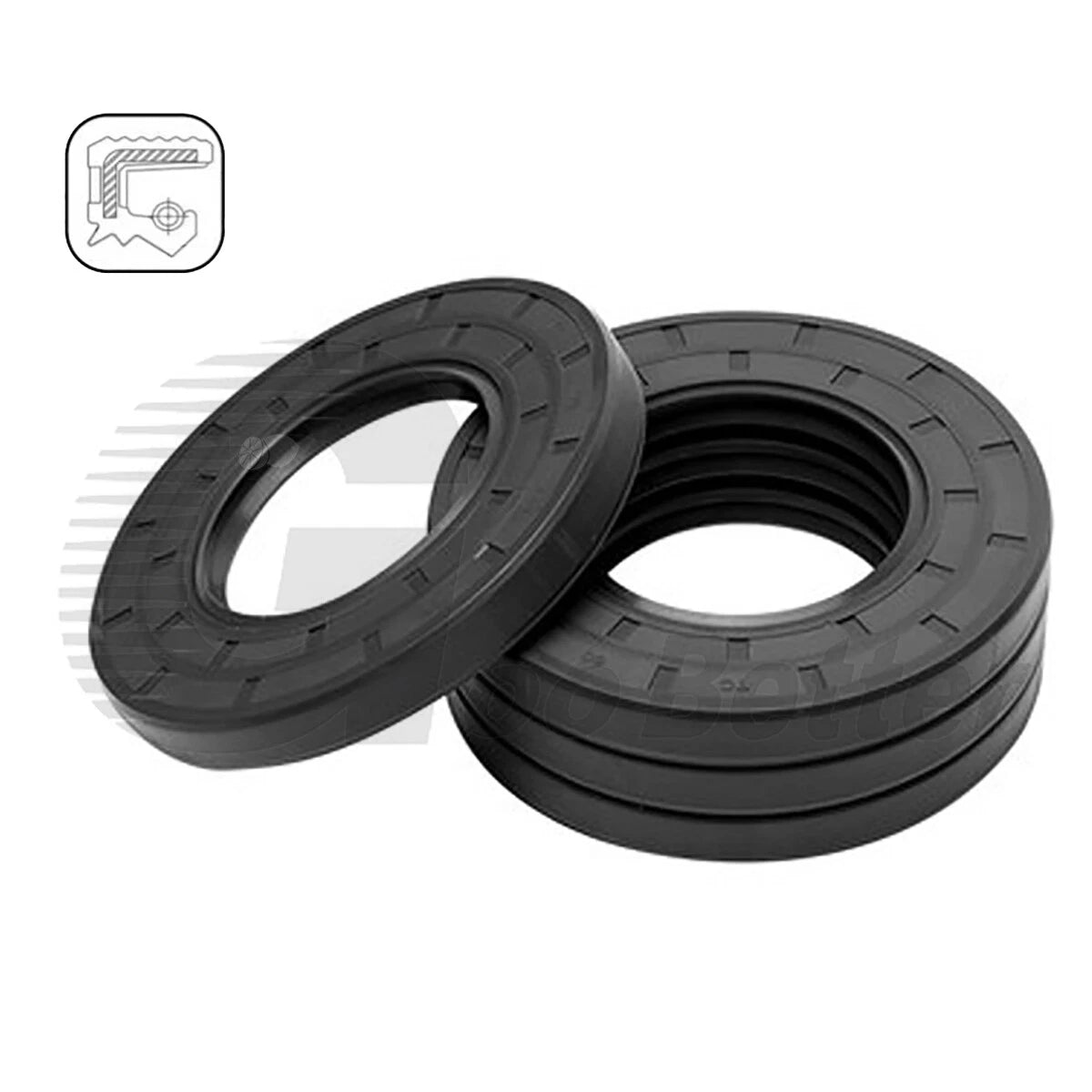
TC Skeleton Oil Seal Ring Rotary Shaft Sealing NBR Double Lip Seals ID 80mm-90mm

Keine Bewertungen

Preis:
Sonderpreis$7.41 USD
Lagerbestand:
Verfügbar (500 Stück), versandbereit

Payment & Security

Ach Direct Debit Amazon American Express Apple Pay Bancontact Diners Club Discover Google Pay iDEAL Wero Mastercard PayPal Shop Pay USDC Visa

Deine Zahlungsinformationen werden sicher verarbeitet. Wir speichern keine Kreditkartendaten und haben auch keinen Zugang zu deinen Kreditkartendaten.

Quantity Discount Promotion
🎯 BULK DISCOUNT: Buy More, Save More!
Buy 2 Items
5% OFF
Buy 4 Items
10% OFF
Buy 6 Items
15% OFF
Expert

DIY Expert Support

Get fitment advice & recommendations

Mon-Fri, 8:30AM-8PM
24-Hour Fast Ship
🚚
Arrives in 3-14 days
🌍
Global Reach
↩️
30-Day Returns
🌱 1 tree planted with every purchase

Beschreibung

TC Skeleton Oil Seal Ring — NBR Double Lip Rotary Shaft Sealing, ID 80–90mm

Mechanics, maintenance engineers, and equipment rebuilders often face the same problem: a worn or incorrectly sized shaft seal that allows oil or grease to escape, contaminating surrounding components and accelerating wear. These TC skeleton oil seal rings are designed to solve that problem with a dimensionally precise, chemically resistant seal that fits a wide range of rotating shaft applications.

Each seal is constructed with a steel skeleton inner frame overmoulded with NBR (nitrile butadiene rubber), forming a rigid yet flexible assembly. The double-lip (TC) configuration includes a primary sealing lip that contacts the shaft and a secondary dust-exclusion lip that blocks contaminants from entering the bearing cavity. Inner diameter (ID) options span 80–90mm, outer diameter (OD) ranges from 90–180mm, and lip thickness varies from 5–20mm — covering over 200 distinct size combinations. Metric dimensions are expressed as ID × OD × Thickness (e.g., 85 × 110 × 10mm ≈ 3.35″ × 4.33″ × 0.39″).

Typical use cases include agricultural gearboxes and PTO shafts, industrial pump and motor housings, hydraulic cylinder rod seals, automotive differential and transmission rebuilds, and general rotating shaft assemblies where oil retention and dust exclusion are both required. The NBR compound performs reliably across a broad temperature range and resists petroleum-based oils, hydraulic fluids, and common greases.

⚙️ Compatibility Note: Verify your shaft OD, housing bore ID, and groove depth before ordering. TC-type seals require a smooth shaft surface (typically Ra ≤ 0.8 µm) for effective sealing. Select the size that matches your housing bore (OD) and shaft diameter (ID).

✅ Key Features of These TC Skeleton Oil Seal Rings

🔩 Steel-Reinforced Skeleton Frame

An internal steel ring maintains the seal's circular shape under press-fit installation and prevents distortion during operation, ensuring consistent contact force around the full shaft circumference.

💧 NBR Double-Lip (TC) Design

The primary lip retains oil and grease; the secondary lip excludes dust, dirt, and moisture. This two-barrier system is the industry-standard TC configuration for rotating shaft applications.

🌡️ NBR Compound — Oil and Fluid Resistant

Nitrile rubber resists petroleum-based oils, hydraulic fluids, diesel fuel, and common greases. Suitable for continuous operating temperatures typically in the range of −40°C to +120°C (−40°F to +248°F).

📐 200+ Size Variants — ID 80–90mm

With inner diameters from 80mm to 90mm, outer diameters from 90mm to 180mm, and thicknesses from 5mm to 20mm, this listing covers a wide range of metric shaft seal sizes in a single product page.

🏭 Broad Application Compatibility

Suitable for agricultural equipment, industrial pumps, electric motors, hydraulic cylinders, automotive differentials and transmissions, and general rotating machinery where both oil retention and contamination exclusion are required.

🔄 Press-Fit Housing Installation

The outer OD is sized for an interference fit into a standard machined housing bore. Use a flat press tool or seal driver to seat the seal flush or to the specified depth — avoid hammering directly on the rubber lip.

📐 Technical Specifications — TC Skeleton Oil Seal Rings

Seal Type TC (Double Lip with Dust Exclusion Lip)
Inner Diameter (ID) Range 80mm – 90mm (3.15″ – 3.54″)
Outer Diameter (OD) Range 90mm – 180mm (3.54″ – 7.09″)
Thickness Range 5mm – 20mm (0.20″ – 0.79″)
Seal Material NBR (Nitrile Butadiene Rubber)
Frame / Skeleton Steel inner ring
Lip Configuration Primary sealing lip + secondary dust exclusion lip
Operating Temperature Typically −40°C to +120°C (−40°F to +248°F)
Compatible Fluids Petroleum-based oils, hydraulic fluids, greases, diesel fuel
Installation Method Press-fit into housing bore
Shaft Surface Finish Recommended Ra ≤ 0.8 µm for effective sealing
Number of Size Options 200+ variants (see variant selector above)
Packing See variant options
Weight See variant options

❓ Frequently Asked Questions

How do I find the correct seal size for my application?

Measure three dimensions on your existing seal or housing: the shaft outer diameter (this becomes the seal ID), the housing bore inner diameter (this becomes the seal OD), and the housing groove depth (this becomes the seal thickness). Match all three to the variant options listed above. If your seal is worn, measure the housing bore and shaft directly rather than the old seal, which may have deformed.

What does "TC" mean on an oil seal?

TC is a standardised designation for a double-lip rotary shaft seal with a steel skeleton frame. The first lip (primary) seals against oil or grease leakage; the second lip (secondary) acts as a dust and contamination excluder. This two-lip design makes TC seals suitable for environments where both fluid retention and ingress protection are needed simultaneously.

Is NBR rubber suitable for my fluid type?

NBR (nitrile butadiene rubber) is compatible with petroleum-based mineral oils, hydraulic fluids (HM, HV types), diesel fuel, greases, and water-glycol mixtures. It is not recommended for use with phosphate ester fluids, ketones, strong acids, or aromatic solvents. If your application uses synthetic esters or silicone oils, consider a Viton (FKM) seal instead.

What shaft surface finish is required for a good seal?

For reliable sealing, the shaft surface in the contact zone should have a ground or polished finish with a roughness of Ra 0.2–0.8 µm (8–32 µin). Surfaces that are too smooth (Ra < 0.2 µm) can prevent the hydrodynamic oil film from forming, while surfaces that are too rough (Ra > 0.8 µm) accelerate lip wear. Avoid longitudinal machining marks — the shaft should be turned or ground with a lead-free finish.

How do I install a TC oil seal without damaging it?

Clean the housing bore and lightly lubricate the seal OD with the same oil used in the application. Use a flat-faced seal driver or a piece of flat bar stock slightly smaller than the housing bore to press the seal in squarely. Apply even pressure around the circumference — never hammer directly on the rubber lip or the seal face. Press until the seal is flush with the housing face or to the depth specified in your equipment manual. Lightly lubricate the primary lip before fitting over the shaft.

Can these seals handle dynamic (rotating) and static applications?

TC skeleton oil seals are designed primarily for dynamic rotary shaft applications where the shaft rotates inside the seal. They can also function in reciprocating (linear) applications at low stroke speeds, though dedicated rod seals are generally preferred for high-cycle reciprocating duty. They are not intended for static face-seal applications.

What is the maximum shaft speed for these seals?

Maximum permissible shaft surface speed for standard NBR TC seals is typically 4–8 m/s (800–1,600 ft/min), depending on shaft diameter, surface finish, and operating temperature. At higher speeds, lip friction generates heat that can degrade the rubber compound. For high-speed applications above 8 m/s, consult the equipment manufacturer's specification or consider a PTFE-lipped seal variant.

🛒 Select your Size (ID x OD x Thickness) above, then add to cart.

You may also like

Recently viewed