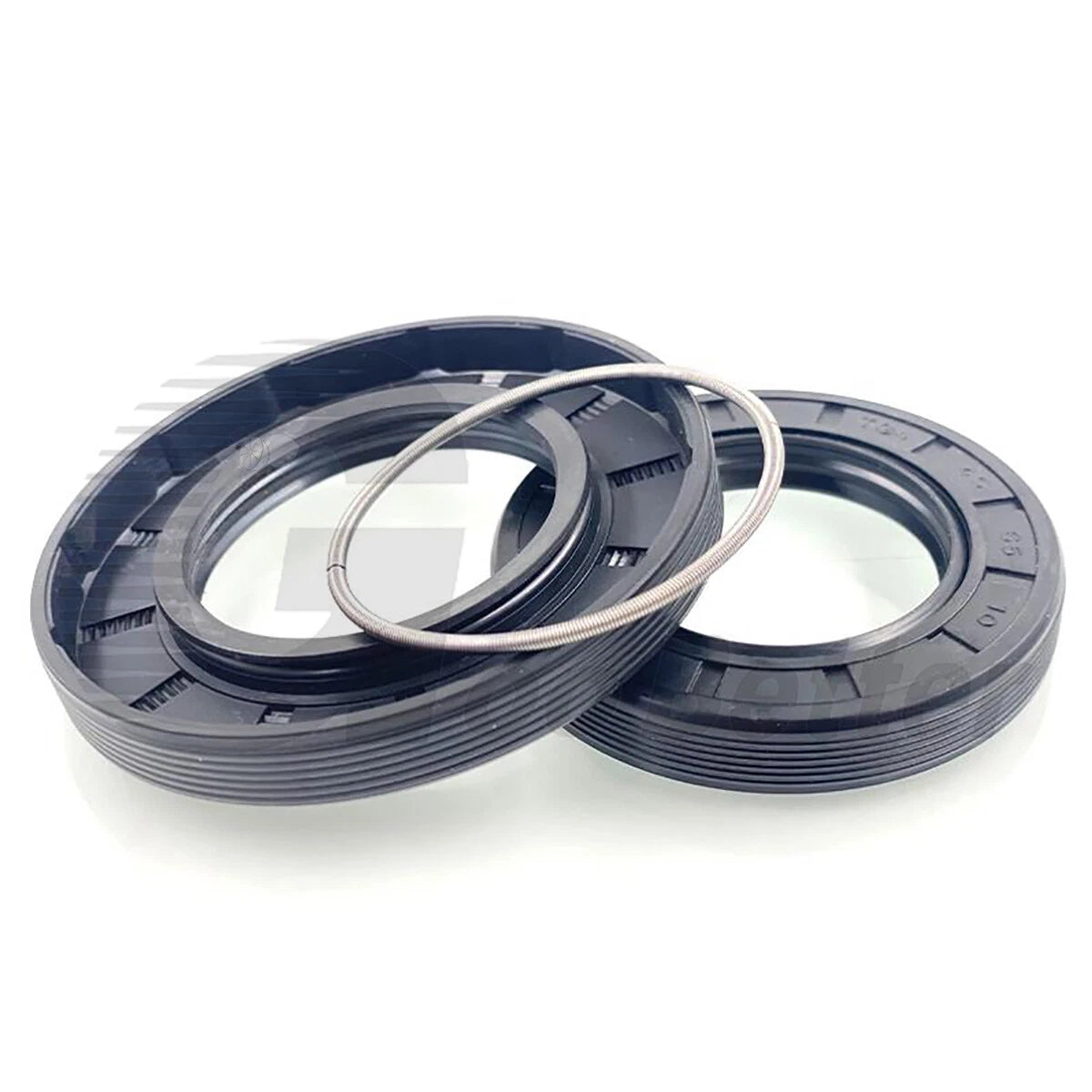
TC Skeleton Oil Seal Rings Rotary Shaft Sealing NBR Double Lip Seals ID 91-100mm

Keine Bewertungen

Preis:
Sonderpreis$8.36 USD
Lagerbestand:
Verfügbar (500 Stück), versandbereit

Payment & Security

Ach Direct Debit Amazon American Express Apple Pay Bancontact Diners Club Discover Google Pay iDEAL Wero Mastercard PayPal Shop Pay USDC Visa

Deine Zahlungsinformationen werden sicher verarbeitet. Wir speichern keine Kreditkartendaten und haben auch keinen Zugang zu deinen Kreditkartendaten.

Quantity Discount Promotion
🎯 BULK DISCOUNT: Buy More, Save More!
Buy 2 Items
5% OFF
Buy 4 Items
10% OFF
Buy 6 Items
15% OFF
Expert

DIY Expert Support

Get fitment advice & recommendations

Mon-Fri, 8:30AM-8PM
24-Hour Fast Ship
🚚
Arrives in 3-14 days
🌍
Global Reach
↩️
30-Day Returns
🌱 1 tree planted with every purchase

Beschreibung

TC Skeleton Oil Seal Rings — NBR Double Lip Rotary Shaft Sealing, ID 91–100mm

When a worn or leaking shaft seal lets oil escape into places it shouldn't — contaminating bearings, soaking brake components, or leaving puddles under equipment — the repair window is short and the cost of delay is high. Mechanics, maintenance technicians, and serious DIYers working on gearboxes, axles, pumps, and hydraulic cylinders need a seal they can trust to hold under continuous rotation and pressure. These TC skeleton oil seal rings are built for exactly that job.

Each seal follows the TC (double-lip) profile: a primary sealing lip retains lubricant under the shaft, while a secondary dust lip blocks contaminants from entering. The body is moulded from NBR (nitrile butadiene rubber), bonded to a steel skeleton that keeps the seal round and press-fit stable in the bore. Inner diameters span 91–100mm (approximately 3.58–3.94 in), outer diameters range from 100–200mm (approximately 3.94–7.87 in), and lip thicknesses run 4–16mm (approximately 0.16–0.63 in) — with over 120 size combinations available as individual pieces or multi-packs.

Typical applications include automotive rear axle and differential seals, agricultural and construction equipment gearbox shafts, industrial pump and motor output shafts, and hydraulic cylinder rod seals where a TC NBR double lip oil seal is the specified replacement type. The wide size matrix makes this listing a practical single-source solution for workshops stocking multiple shaft diameters.

⚙️ Compatibility note: Match your shaft's inner diameter (ID), bore outer diameter (OD), and housing depth (thickness) exactly before ordering. NBR compound is compatible with petroleum-based oils and greases; not recommended for use with phosphate-ester or silicone-based fluids. Verify operating temperature range (typically −40 °C to +120 °C / −40 °F to +248 °F) against your application before installation.

✅ Key Features of These TC NBR Double Lip Oil Seal Rings

  • 🔩 TC Double-Lip Profile — Primary lip seals lubricant in; secondary dust lip keeps abrasive particles and moisture out, extending bearing and lubricant service life.
  • 🧲 Steel Skeleton Reinforcement — Embedded metal carrier maintains dimensional stability during press-fit installation and resists distortion under radial load.
  • 🛡️ NBR Rubber Compound — Nitrile butadiene rubber provides resistance to petroleum oils, greases, and fuels across a wide temperature range, making it the standard material for most automotive and industrial shaft seals.
  • 📐 120+ Size Combinations — ID 91–100mm paired with OD 100–200mm and thickness 4–16mm; each variant is sold individually (1 PCS) so you order only what you need.
  • 🔄 Direct OEM-Style Replacement — TC profile and dimensional tolerances align with standard shaft seal specifications, allowing drop-in replacement without machining or adapters.
  • 🏭 Broad Application Range — Suitable for automotive axles and differentials, agricultural gearboxes, industrial pumps, hydraulic cylinders, and general rotating-shaft equipment requiring a TC-type seal.

📐 Technical Specifications — TC NBR Double Lip Oil Seal Rings

Seal Type TC (Double Lip)
Material NBR (Nitrile Butadiene Rubber) with steel skeleton
Inner Diameter (ID) Range 91–100 mm (approx. 3.58–3.94 in)
Outer Diameter (OD) Range 100–200 mm (approx. 3.94–7.87 in)
Thickness Range 4–16 mm (approx. 0.16–0.63 in)
Lip Configuration Primary sealing lip + secondary dust exclusion lip
Operating Temperature Typically −40 °C to +120 °C (−40 °F to +248 °F)
Fluid Compatibility Petroleum-based oils and greases
Installation Method Press-fit into bore
Packing Quantity See variant options
Exact Size (ID × OD × Thickness) See variant options

❓ Frequently Asked Questions

How do I find the correct size for my application?

Measure three dimensions on the old seal or the housing: inner diameter (ID — the shaft diameter the seal rides on), outer diameter (OD — the bore the seal presses into), and thickness (the depth of the housing groove). All three must match the variant you select. If the old seal is missing, measure the shaft OD directly and the bore ID with a caliper, then check your equipment's service manual for the specified thickness.

What does "TC" mean on an oil seal?

TC is an industry-standard designation for a double-lip radial shaft seal with a metal case. The first (primary) lip faces inward to retain lubricant; the second (dust) lip faces outward to exclude dirt and moisture. This two-barrier design makes TC seals the most common type for automotive axles, gearboxes, and industrial rotating shafts.

Is NBR rubber suitable for my gearbox or differential oil?

NBR (nitrile butadiene rubber) is compatible with most petroleum-based mineral oils, gear oils, ATF, and greases — the fluids used in the vast majority of automotive and industrial gearboxes and differentials. It is not recommended for phosphate-ester hydraulic fluids, silicone oils, or ketone-based solvents. If your application uses a synthetic ester or specialty fluid, confirm compatibility before installation.

What is the operating temperature range of these seals?

NBR compound typically performs reliably from −40 °C to +120 °C (−40 °F to +248 °F). Continuous operation near the upper limit accelerates rubber aging; if your application regularly exceeds 120 °C, consider a FKM (Viton) seal instead. For most automotive and standard industrial uses, NBR's temperature range is more than adequate.

How do I install a TC oil seal without damaging the lip?

Clean the bore and shaft thoroughly before installation. Apply a thin film of the same oil or grease the seal will retain to the sealing lip and the shaft surface — this prevents dry-start damage. Use a seal driver or a flat block of the correct diameter to press the seal squarely into the bore; never hammer directly on the seal face. Press until the outer face is flush with or just below the housing surface. Avoid dragging the lip over keyways or splines; use a sleeve or tape to protect the lip during installation.

Can I use these seals in hydraulic cylinder rod applications?

TC-profile seals are primarily designed for rotary shaft applications. They can function on slow-moving reciprocating rods in some hydraulic cylinders, but dedicated rod seal profiles (U-cup, wiper, or lip seal sets) are engineered for linear motion and typically provide longer service life in high-cycle hydraulic applications. For rotary hydraulic motor shafts, TC seals are the correct choice.

Why are there so many size variants — how do I avoid ordering the wrong one?

Shaft seal sizes are not interchangeable — even a 1mm difference in ID, OD, or thickness will result in leakage or an inability to seat the seal. The large size matrix exists because different equipment manufacturers specify different bore and shaft combinations. Always verify all three dimensions (ID × OD × Thickness) against your old seal markings or service manual before adding to cart. If you are unsure, contact us with your equipment make, model, and year and we will help confirm the correct size.

🛒 Select your size (ID × OD × Thickness) and quantity above, then add to cart.

You may also like

Recently viewed