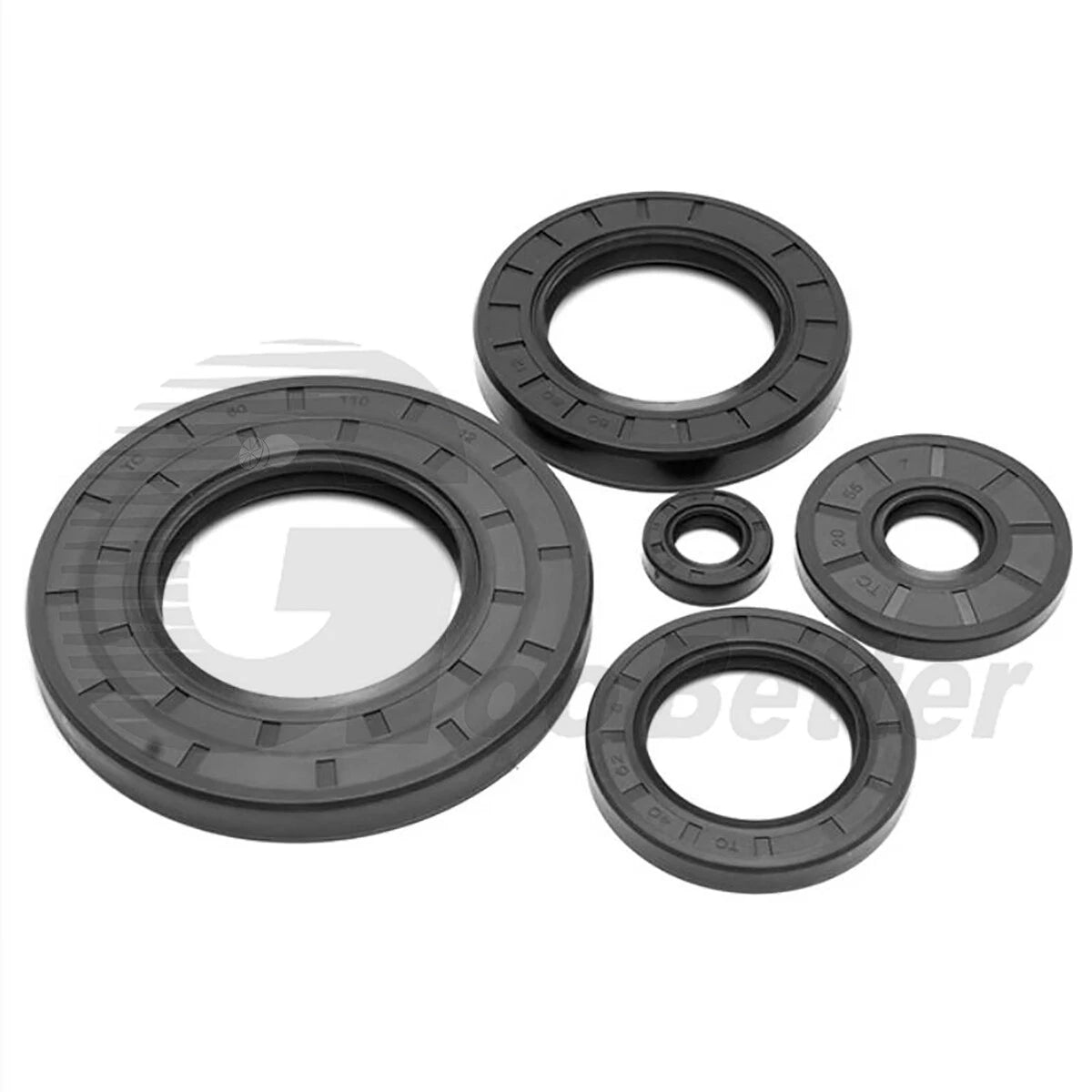
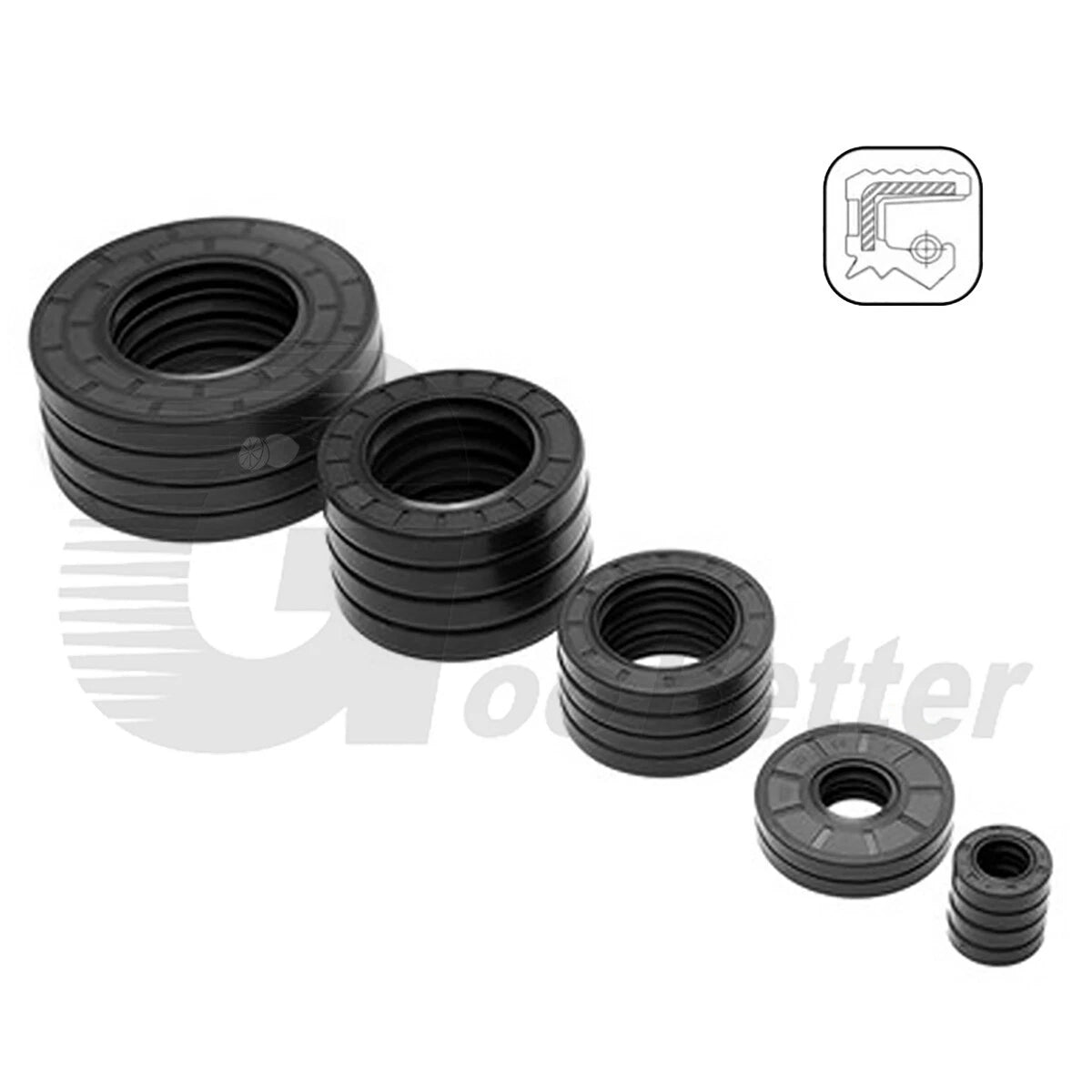
TC Skeleton Oil Seal Rings — Reliable NBR Double Lip Sealing for Rotary Shafts
When a worn or undersized shaft seal lets lubricant escape or lets contaminants in, the damage spreads fast — to bearings, gearboxes, pumps, and beyond. Mechanics, equipment technicians, and serious DIYers who need a dependable replacement turn to TC skeleton oil seal rings because the double-lip design addresses both problems at once: the primary lip retains grease or oil while the secondary dust lip blocks dirt, water, and debris from reaching the shaft.
These TC skeleton oil seal rings are constructed from NBR (nitrile butadiene rubber) bonded to a steel skeleton insert. The inner diameter (ID) spans 4.5 mm to 10.8 mm (~0.18"–0.43"), outer diameters range from 10 mm to 35 mm (~0.39"–1.38"), and thickness options run from 3 mm to 12 mm (~0.12"–0.47"). Each variant is sold in a 5-piece pack, making it practical to keep spares on hand.
Typical applications include small electric motors, agricultural equipment shaft seals, hydraulic cylinder rod seals, automotive axle and gearbox seals, and general-purpose rotary shaft sealing in industrial machinery. The NBR compound performs reliably across a broad temperature range and resists petroleum-based oils, making these TC oil seals a go-to choice for rotary shaft seal replacement projects.
⚙️
Compatibility note: Match the ID to your shaft diameter and the OD to your housing bore. Confirm thickness against your housing depth before ordering. See variant options for the full size matrix.
✅ Key Features of These TC Skeleton Oil Seal Rings
🔩
NBR Double-Lip Design
The primary lip seals lubricant in; the secondary dust lip keeps contaminants out — two functions in a single compact seal.
🏗️
Steel Skeleton Insert
An internal steel ring maintains the seal's round shape under press-fit installation and resists distortion during operation.
🌡️
NBR Rubber Compound
Nitrile rubber resists petroleum-based oils, greases, and fuels across a wide operating temperature range, typically –40 °C to +120 °C.
📐
Wide Size Matrix
ID from 4.5 mm to 10.8 mm, OD from 10 mm to 35 mm, thickness from 3 mm to 12 mm — over 200 size combinations available as variants.
📦
5-Piece Packs
Each listing ships as a 5-piece set so you have spares ready for future maintenance without over-ordering.
🔄
Direct-Replacement Fit
TC-type skeleton seals follow standard dimensional conventions, making them straightforward drop-in replacements for OEM seals of the same size.
📐 Technical Specifications — TC Skeleton Oil Seal Rings
| Seal Type |
TC (Double Lip with Dust Lip) |
| Material |
NBR (Nitrile Butadiene Rubber) + Steel Skeleton |
| Inner Diameter (ID) Range |
4.5 mm – 10.8 mm (approx. 0.18" – 0.43") |
| Outer Diameter (OD) Range |
10 mm – 35 mm (approx. 0.39" – 1.38") |
| Thickness Range |
3 mm – 12 mm (approx. 0.12" – 0.47") |
| Lip Configuration |
Primary sealing lip + secondary dust exclusion lip |
| Operating Temperature |
Typically –40 °C to +120 °C (–40 °F to +248 °F) |
| Media Compatibility |
Petroleum-based oils, greases, and fuels |
| Pack Quantity |
5 pieces per pack |
| Exact Size (ID × OD × Thickness) |
See variant options |
| Spring Type |
See variant options |
| Surface Finish |
See variant options |
❓ Frequently Asked Questions
How do I choose the right TC oil seal size?
Measure three dimensions on your existing seal or housing: the inner diameter (ID) must match your shaft diameter, the outer diameter (OD) must match your housing bore, and the thickness must fit within the housing depth. All three must align — a seal that is correct in two dimensions but wrong in the third will leak or fail to seat properly. Use calipers for accuracy.
What does "TC" mean in TC skeleton oil seal?
"TC" designates a double-lip seal with a secondary dust exclusion lip in addition to the primary sealing lip. The "skeleton" refers to the internal steel ring that gives the seal its structural rigidity. This is the most common configuration for general-purpose rotary shaft sealing.
Is NBR rubber compatible with my application?
NBR (nitrile) is compatible with petroleum-based oils, greases, hydraulic fluids, and fuels. It is not recommended for use with phosphate-ester hydraulic fluids, ketones, or strong acids. If your application involves synthetic esters or silicone oils, consider a Viton (FKM) seal instead. For standard motor oil, gear oil, or grease applications, NBR is the standard choice.
Can these seals handle high-speed rotary shafts?
TC skeleton oil seals are designed for rotary shaft applications. Acceptable shaft surface speed depends on the shaft diameter, surface finish, and lubrication. For best results, the shaft surface in the sealing zone should have a ground finish (Ra 0.2–0.8 µm) and be free of spiral machining marks. Consult the equipment manufacturer's specification if operating at high RPM.
How do I install a TC oil seal without damaging it?
Press the seal in squarely using a flat driver or seal installation tool sized to the OD — never strike the seal face directly with a hammer. Apply a thin film of clean oil or grease to the seal lip before installation. Chamfer or protect the shaft lead-in edge to avoid cutting the lip during assembly. Press until the seal face is flush with or just below the housing face.
What is the operating temperature range for these NBR seals?
NBR rubber typically performs reliably from –40 °C to +120 °C (–40 °F to +248 °F). Sustained exposure above 120 °C will accelerate rubber hardening and reduce seal life. If your application regularly exceeds this range, a high-temperature compound such as FKM (Viton) would be more appropriate.
Why buy a 5-piece pack instead of a single seal?
Seals in the same size are often replaced in pairs (e.g., both ends of a shaft) or fail again within a short interval if the root cause — shaft wear, misalignment, or contamination — is not fully resolved. Having spares on hand avoids a second sourcing delay. The 5-piece pack is also cost-effective for workshops that service multiple units of the same equipment.
🛒 Select your size (ID × OD × Thickness) and quantity above, then add to cart.