
The chain is fine...but I ordered the wrong size. Nine links of the chain I ordered equals six of the size I wanted. My error...
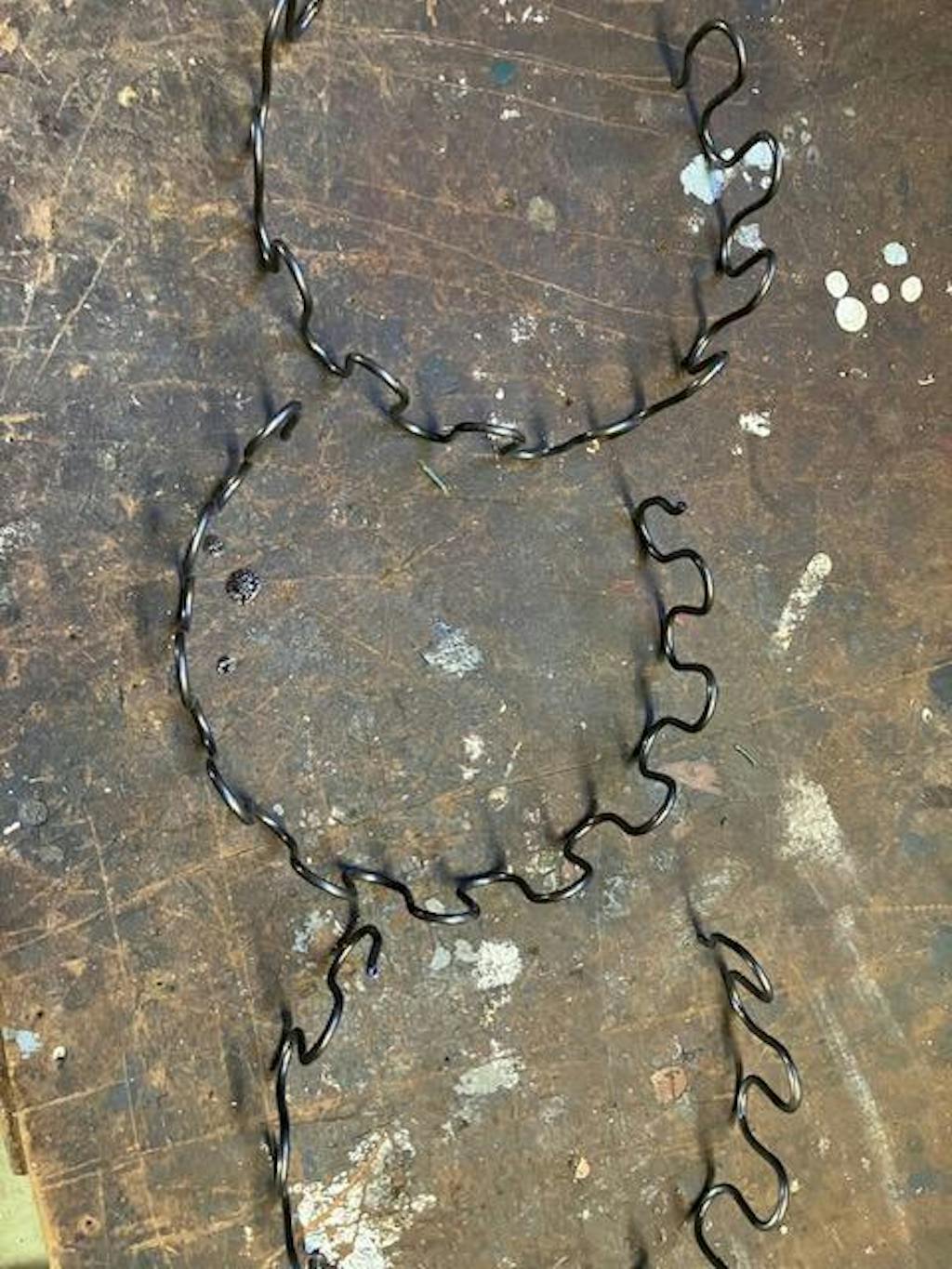
How can I straighten out the springs? I can't use them coil uo as is.
Deine Zahlungsinformationen werden sicher verarbeitet. Wir speichern keine Kreditkartendaten und haben auch keinen Zugang zu deinen Kreditkartendaten.
Get fitment advice & recommendations
When your project demands a conductor that won't let you down, thin copper foil with inconsistent dimensions or impure alloys can ruin hours of careful work. Whether you're a hobbyist building RF shielding enclosures, an electrician fabricating custom bus bars, or a craftsperson working on decorative metalwork, you need a copper sheet that delivers repeatable, measurable performance every time.
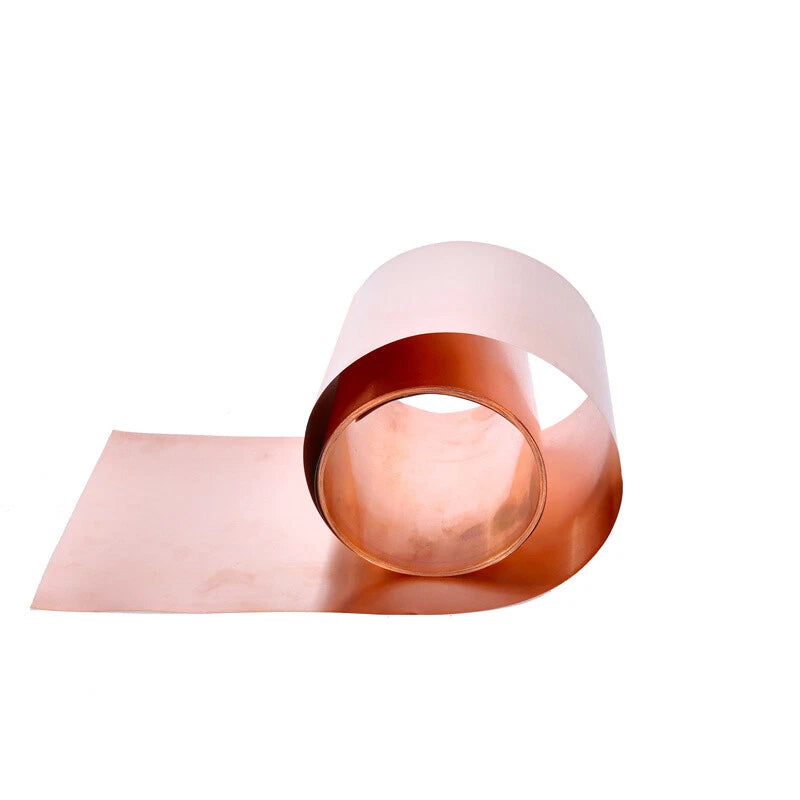
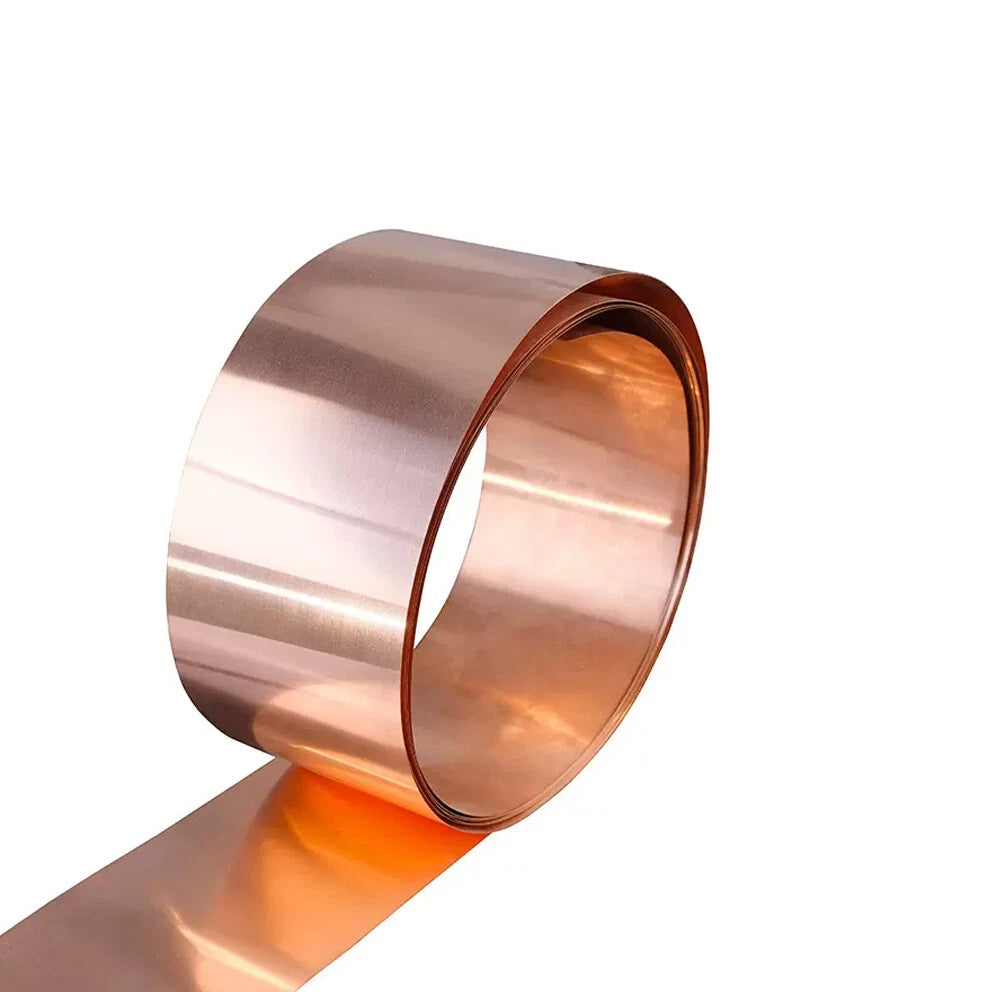
This copper sheet roll is made from 99.9% pure Cu (electrolytic grade), supplied in a continuous 1-meter roll format. Thickness ranges from 0.01 mm to 1 mm (approximately 0.0004 in to 0.039 in), and width options span 50 mm to 400 mm (approximately 2 in to 15.75 in). The surface is smooth-rolled with consistent gauge tolerance across the full length of each roll.
Typical use cases include DIY electromagnetic shielding and Faraday cage construction, custom electrical grounding straps and flexible bus bar fabrication, decorative copper inlay work for woodworking and resin casting, and heat spreader applications in electronics repair and thermal management projects.
| Material | 99.9% Pure Copper (Cu), Electrolytic Grade |
|---|---|
| Thickness Range | 0.01 mm – 1 mm (0.0004 in – 0.039 in) |
| Width Range | 50 mm – 400 mm (approx. 2 in – 15.75 in) |
| Length per Roll | 1 m (39.4 in) |
| Temper | Soft / Annealed (typical for foil gauges) |
| Surface Finish | Smooth rolled, mill finish |
| Electrical Conductivity | ≥58 MS/m (typical for 99.9% Cu) |
| Thermal Conductivity | Approx. 385–400 W/(m·K) |
| Density | Approx. 8.96 g/cm³ |
| Melting Point | Approx. 1,085 °C (1,985 °F) |
| Exact Thickness / Width | See variant options |
| Weight per Roll | See variant options |
For electromagnetic shielding (RF/EMI), thicknesses of 0.05 mm – 0.2 mm are typically sufficient for most frequency ranges. For electrical grounding straps or bus bars requiring mechanical strength, 0.3 mm – 1 mm is recommended. For decorative inlay or craft work, 0.1 mm – 0.3 mm offers a good balance of formability and durability. If you are unsure, contact us to confirm before ordering.
This product is intended for electrical, shielding, thermal, and light fabrication applications rather than load-bearing structural use. Thin foil gauges (under 0.1 mm) are flexible and best suited for wrapping, laminating, or shielding. Thicker gauges (0.5 mm – 1 mm) have meaningful rigidity and can be used for brackets, heat spreaders, and custom connectors, but should not be relied upon as primary structural members.
Pure copper naturally forms a thin oxide patina when exposed to air and moisture. This patina is self-limiting and does not significantly degrade electrical conductivity in most applications. For applications requiring a bright finish over time, a clear lacquer or anti-tarnish coating can be applied after cutting. In outdoor or high-humidity environments, consider sealing exposed edges.
Yes. 99.9% pure copper solders readily with standard rosin-core or water-soluble flux solders using a temperature-controlled iron or hot-air station. No special pre-treatment is required on freshly cut surfaces. If the surface has oxidized, a light abrasion with fine sandpaper or a flux application will restore solderability.
Yes. Thin gauges (up to approximately 0.3 mm) cut cleanly with heavy-duty scissors, rotary cutters, or tin snips. Thicker gauges (0.4 mm – 1 mm) are best cut with aviation snips, a metal shear, or a scoring-and-bending method. A straight edge and utility knife can score thinner foils for clean straight cuts. Always deburr cut edges before handling to avoid injury.
Width selection depends on the panel dimensions of your enclosure. The 50 mm and 100 mm widths are well-suited for lining small enclosures, cable wrapping, and seam taping. The 200 mm – 400 mm widths are better for covering larger panel faces or fabricating full shielding walls in a single piece, reducing the number of overlapping seams that can compromise shielding effectiveness.
This roll foil product (up to 1 mm thick) is ideal when you need flexibility, easy cutting, and a continuous roll format for wrapping or laminating. If your application requires a rigid flat plate that holds its shape under mechanical load — such as a heat sink base or a machined electrical contact — a thicker copper plate (typically 2 mm and above) would be more appropriate. For most DIY shielding, grounding, and craft applications, this roll format is the more versatile choice.