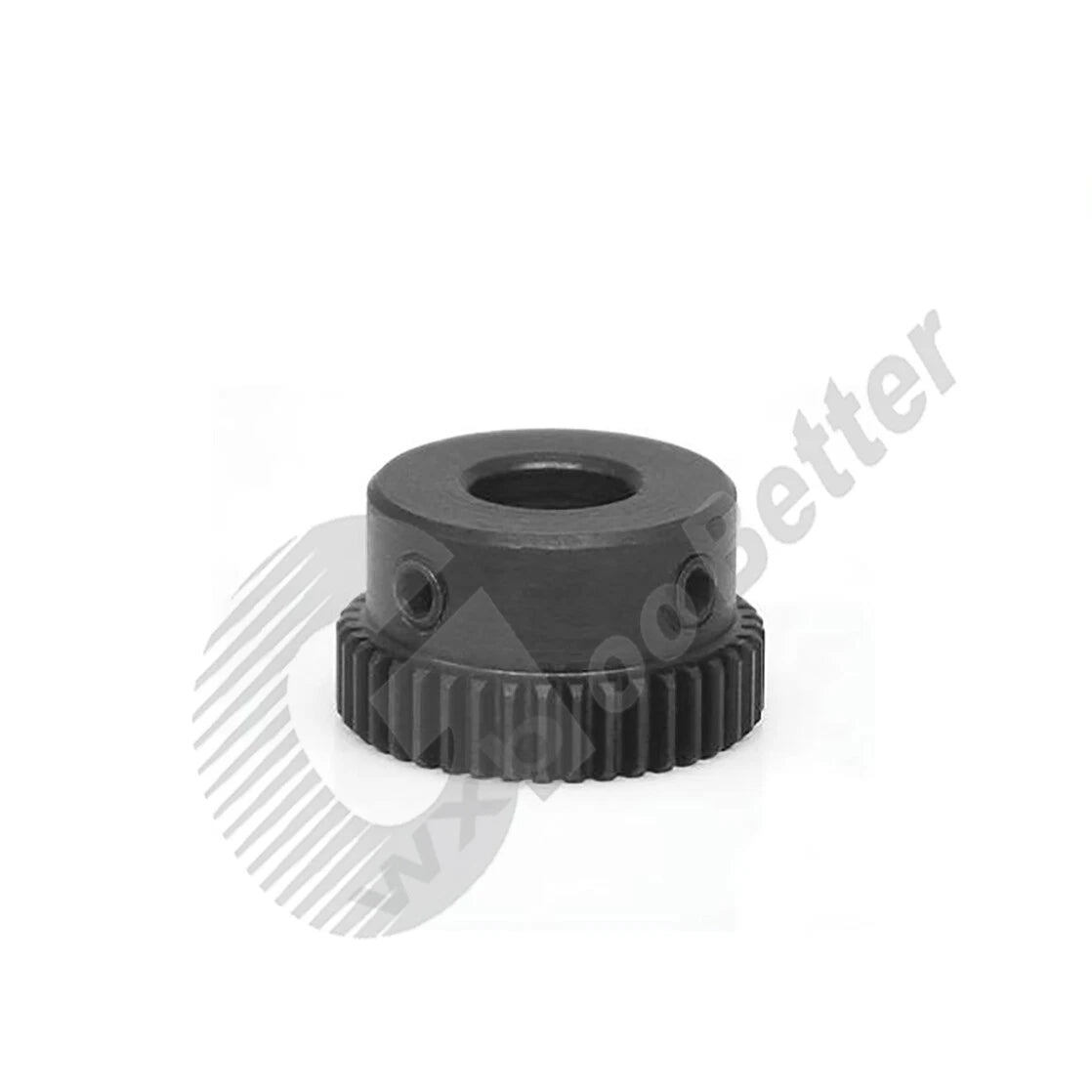
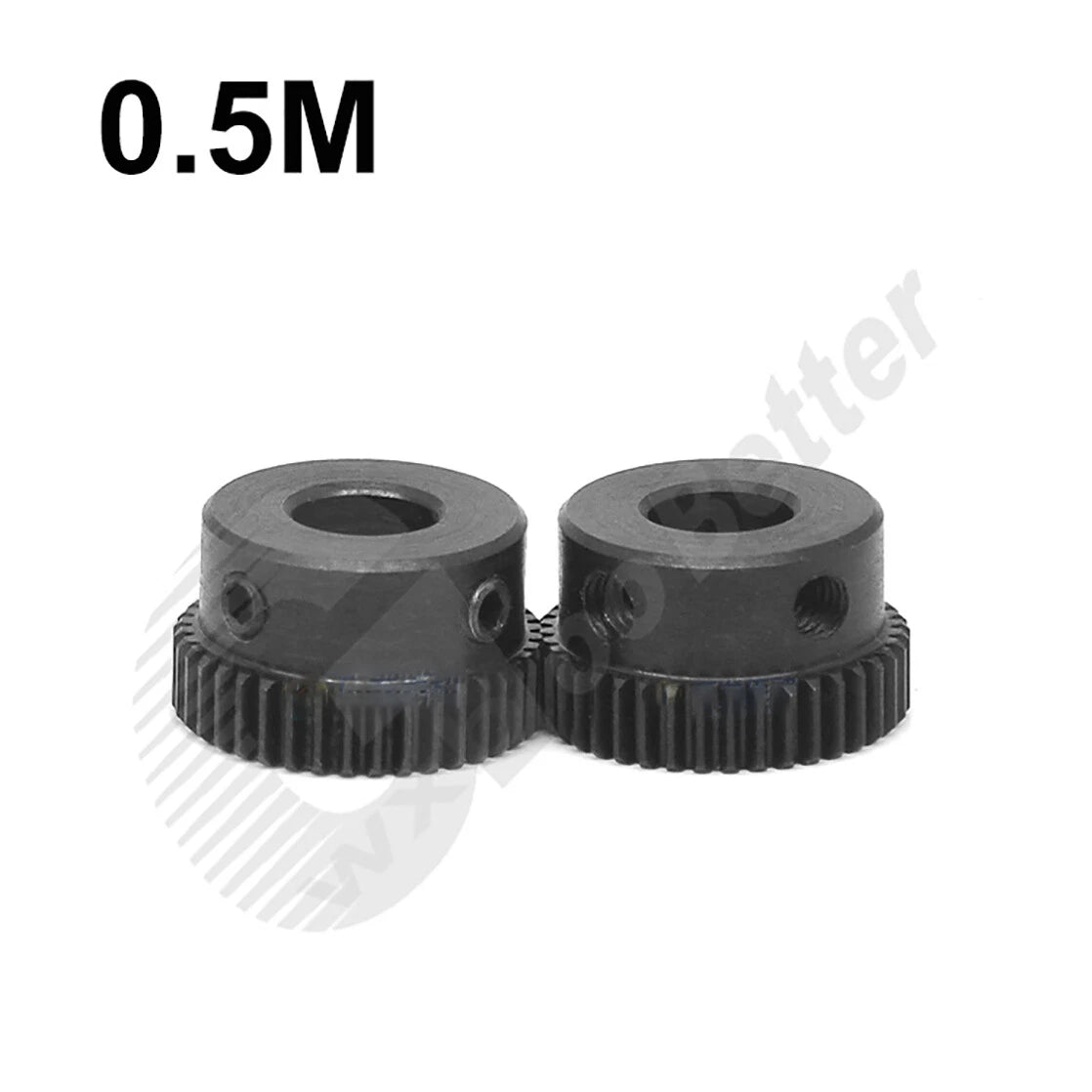
0.5 Mod 45# Steel Spur Gear — Precision Pinion Gears for DIY Automation & Robotics
When your robot arm skips a step, your CNC axis loses position, or your 3D printer extruder slips, the culprit is almost always a poorly fitted gear. Makers, hobbyists, and small-workshop engineers who need reliable, repeatable motion transmission deserve a spur gear that holds its bore tight and meshes cleanly — every cycle.
These 0.5 module spur gears are machined from 45# carbon steel for solid strength and wear resistance. Each gear ships with a set screw for secure shaft retention. The tooth count spans 20T to 60T, and bore diameters range from 4 mm (~0.157 in) to 12 mm (~0.472 in), with select sizes available in flanged configurations (F=3 mm or F=5 mm flange) to simplify axial positioning on your shaft.
Typical use cases include DIY robotic arm joint drives, compact CNC router axis gearing, 3D printer extruder and Z-axis drives, small conveyor and automation stage builds, and educational mechatronics lab assemblies requiring interchangeable 0.5 mod pinion spur gear sets.
⚙️
Compatibility: Designed for 0.5 module (Mod 0.5) gear systems. Meshes with any standard 0.5 mod mating gear or rack. Verify your shaft diameter matches the selected bore before ordering.
✅ Key Features of These 0.5 Mod Steel Spur Gears
🔩
45# Carbon Steel Construction — Machined from medium-carbon 45# steel for reliable strength, dimensional stability, and long service life in continuous-duty motion applications.
📐
Wide Tooth Count Range (20T–60T) — Twenty-three tooth-count options let you dial in the exact gear ratio your drive system needs without custom machining.
🎯
Multiple Bore Diameters (4–12 mm) — Standard bores from 4 mm to 12 mm, plus flanged variants (F=3 mm and F=5 mm), accommodate a broad range of motor and shaft sizes out of the box.
🔐
Included Set Screw — Each gear comes with a set screw for positive shaft locking, eliminating axial slip under load without additional hardware.
⚡
Standard 0.5 Module Profile — Conforms to the ISO/DIN 0.5 mod tooth profile, ensuring drop-in compatibility with any standard Mod 0.5 mating gear, rack, or pinion in your system.
🏗️
Flanged Variants for Axial Positioning — Select bore options include a 3 mm or 5 mm flange that acts as a built-in shoulder stop, simplifying gear positioning on the shaft without additional collars or spacers.
📐 Technical Specifications — 0.5 Mod Spur Gear
| Module |
0.5 (Mod 0.5) |
| Material |
45# Carbon Steel |
| Tooth Count (T) |
20T, 22T, 24T, 25T, 26T, 28T, 30T, 32T, 34T, 35T, 36T, 38T, 40T, 42T, 44T, 45T, 46T, 48T, 50T, 52T, 55T, 58T, 60T |
| Bore Diameter |
4 mm, 5 mm, 6 mm, 6.35 mm, 8 mm, 10 mm, 12 mm (see variant options for flanged sizes) |
| Flange Options |
No flange / F=3 mm / F=5 mm (see variant options) |
| Pressure Angle |
20° |
| Pitch Diameter |
See variant options |
| Outside Diameter |
See variant options |
| Face Width |
See variant options |
| Fastener Included |
Set screw (1 pc per gear) |
| Finish |
Natural steel (uncoated) |
| Weight |
See variant options |
❓ Frequently Asked Questions
How do I choose the right tooth count for my application?
Select your tooth counts based on the gear ratio you need: divide the driven gear teeth by the driver gear teeth to get the ratio. For example, a 20T driver meshing with a 60T driven gear gives a 3:1 reduction. Use a smaller tooth count on the motor shaft for speed reduction and torque multiplication, or a larger count for speed increase.
What bore diameter should I order for my motor shaft?
Measure your motor or drive shaft diameter with calipers and select the matching bore. Common motor shaft sizes are 4 mm, 5 mm, 6 mm, and 8 mm. If your shaft is 6.35 mm (1/4 inch), select the 6.35 mm bore option. The set screw locks the gear onto the shaft, so the bore should match the shaft closely — avoid selecting an oversized bore.
What does the flange (F=3mm or F=5mm) mean, and do I need it?
The flange is a raised collar on one face of the gear that acts as a built-in shoulder stop. It prevents the gear from sliding axially along the shaft without needing a separate shaft collar or spacer. Choose a flanged variant if you need precise axial positioning. If you are stacking gears or have your own spacers, the non-flanged version gives you more flexibility.
Are these gears compatible with plastic or nylon 0.5 mod gears?
Yes. These gears follow the standard 0.5 module tooth profile with a 20° pressure angle, so they mesh correctly with any other standard Mod 0.5 gear regardless of material — steel, brass, nylon, or POM. Keep in mind that pairing a steel gear with a softer plastic gear will cause the plastic gear to wear faster, which is sometimes intentional (sacrificial gear design).
How strong are 45# steel spur gears compared to other materials?
45# carbon steel (equivalent to AISI 1045) has a tensile strength of approximately 600–800 MPa in its normalized state, making it significantly stronger than brass, aluminum, nylon, or POM gears of the same size. It is well-suited for moderate-load continuous-duty applications. For very high-load or high-speed applications, consider whether heat-treated or alloy steel variants are needed.
Do these gears require lubrication?
Light lubrication is recommended for continuous-duty or higher-speed applications. A thin film of general-purpose grease or light machine oil applied to the tooth faces will reduce wear and noise. For low-speed, intermittent-duty applications such as robotics joints, dry operation is acceptable but periodic inspection is advised.
Will these gears rust or corrode over time?
45# carbon steel is not stainless and will oxidize if exposed to moisture without protection. For indoor or dry environments, the natural steel finish is adequate with periodic light oiling. For humid or outdoor environments, apply a rust-inhibiting coating or grease to exposed surfaces, or consider stainless steel alternatives if corrosion resistance is a primary requirement.
Can I use these gears in a 3D printer or CNC router?
Yes. These are a popular choice for 3D printer extruder drives, Z-axis lead screw drives, and compact CNC router axis gearing. The 0.5 module pitch is common in desktop-scale motion systems. Verify the bore matches your stepper motor shaft (typically 5 mm for NEMA 17) and that the tooth count gives you the desired steps-per-mm or gear ratio for your build.
🛒 Select your Number of Teeth and Bore Diameter above, then add to cart.