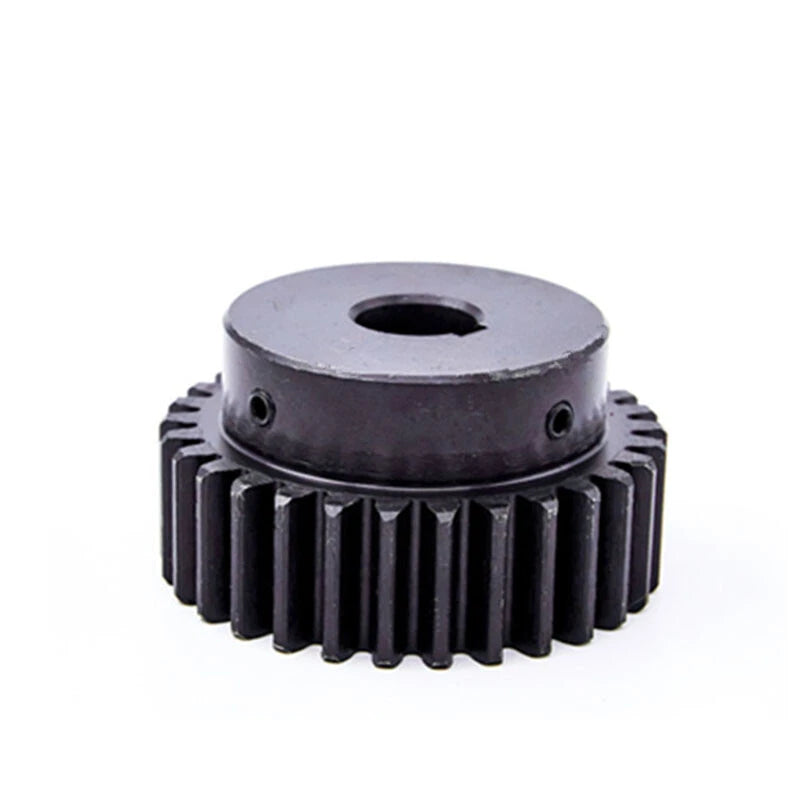
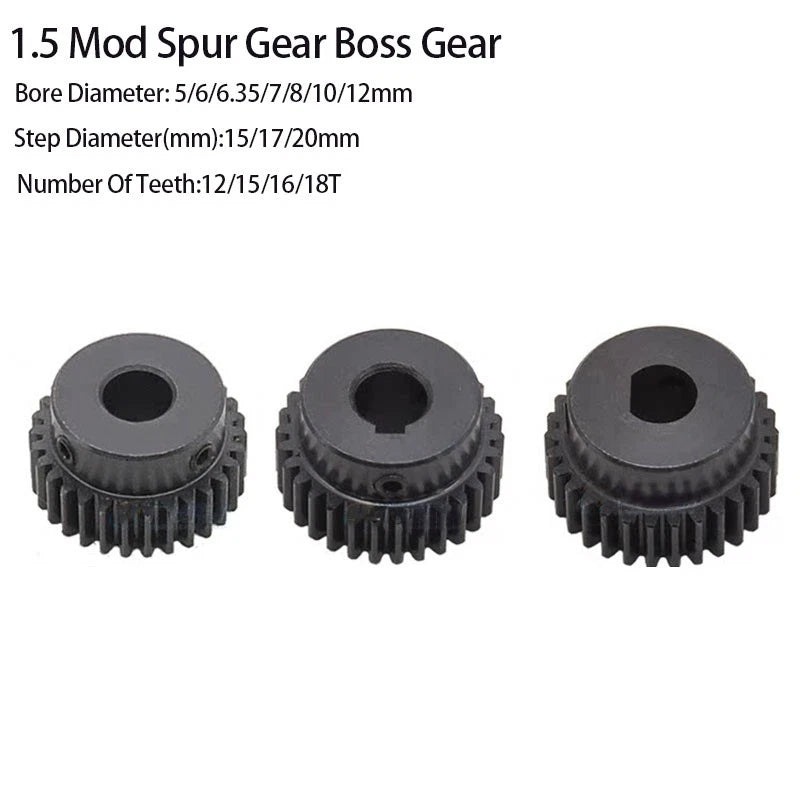
1.5 Mod Spur Gear — 45# Steel Transmission Gear for Reliable DIY Automation
When your CNC router, robotic arm, or motorized mechanism demands a gear that won't strip under load, a loose-tolerance part is the last thing you need. Makers, hobbyists, and small-workshop engineers building precision motion systems need a spur gear that fits their shaft exactly, meshes cleanly, and holds up through thousands of cycles. This 1.5 module spur gear is machined from 45# carbon steel and designed for step-motor shaft coupling in DIY automation, educational robotics, and light industrial drive trains.
Each gear is a 1.5 module (Mod 1.5) involute spur gear machined from 45# medium-carbon steel — a material known for its balance of machinability and tensile strength. Tooth counts range from 12T to 18T, bore diameters from 5 mm (0.197 in) to 12 mm (0.472 in), and step (hub) diameters of 15 mm (0.591 in), 17 mm (0.669 in), or 20 mm (0.787 in). The stepped hub design allows direct coupling to NEMA-series stepper motor shafts without additional adapters.
Typical use cases include DIY CNC axis drives where a 12T–16T pinion meshes with a rack or larger gear, open-loop stepper motor gearboxes for 3D printer extruder upgrades, and small conveyor or indexing table builds requiring a compact 1.5 mod spur gear transmission. The multi-piece packing options (1, 3, 5, or 10 pcs) make it easy to stock spares or build symmetric dual-axis systems.
⚙️
Compatible with NEMA 17 / NEMA 23 stepper motor shafts (5 mm, 6.35 mm, 8 mm) and standard metric shafts 5–12 mm. Meshes with any Mod 1.5 rack, pinion, or mating gear.
✅ Key Features of These 1.5 Mod Spur Gears
🔩
45# Carbon Steel Construction — Medium-carbon steel provides a tensile strength of approximately 600–800 MPa, resisting tooth deformation under repeated cyclic loads in motorized drive applications.
📐
Mod 1.5 Involute Tooth Profile — Standard 1.5 module pitch ensures smooth, low-noise meshing with any compatible Mod 1.5 rack or mating gear, reducing backlash in precision positioning systems.
🎯
Stepped Hub for Direct Motor Coupling — The integrated step diameter (15 mm, 17 mm, or 20 mm) aligns the gear concentrically on stepper motor shafts, eliminating the need for separate shaft collars or adapters.
📏
Wide Bore Range: 5–12 mm — Seven bore options (5, 6, 6.35, 7, 8, 10, 12 mm) cover the most common NEMA stepper and metric motor shaft diameters, making cross-project reuse straightforward.
🔢
Four Tooth Count Options: 12T / 15T / 16T / 18T — Select the tooth count to achieve your target gear ratio. Pair a 12T pinion with an 18T gear for a 1.5:1 reduction, or run matched pairs for 1:1 speed transmission.
📦
Flexible Pack Quantities: 1 / 3 / 5 / 10 Pcs — Order a single piece for prototyping or a 10-pack for production runs and spare-parts inventory, with per-unit cost decreasing at higher quantities.
📐 Technical Specifications — 1.5 Mod Spur Gear
| Module (Mod) |
1.5 |
| Pressure Angle |
20° |
| Number of Teeth |
12T / 15T / 16T / 18T |
| Bore Diameter |
5 mm / 6 mm / 6.35 mm / 7 mm / 8 mm / 10 mm / 12 mm |
| Step (Hub) Diameter |
15 mm / 17 mm / 20 mm |
| Material |
45# Carbon Steel |
| Surface Finish |
See variant options |
| Gear Face Width |
See variant options |
| Overall Height |
See variant options |
| Pitch Diameter (12T) |
18 mm (0.709 in) |
| Pitch Diameter (15T) |
22.5 mm (0.886 in) |
| Pitch Diameter (16T) |
24 mm (0.945 in) |
| Pitch Diameter (18T) |
27 mm (1.063 in) |
| Pack Quantity |
1 / 3 / 5 / 10 Pcs |
| Application |
CNC drives, stepper motor gearboxes, robotics, automation |
❓ Frequently Asked Questions
How do I choose the right tooth count for my application?
The tooth count determines your gear ratio. Divide the driven gear's tooth count by the driving gear's tooth count to get the reduction ratio. For example, a 12T pinion driving an 18T gear gives a 1.5:1 reduction — the output shaft turns at 2/3 the input speed with 1.5× the torque. For 1:1 speed transmission, use matched tooth counts on both shafts.
Which bore diameter should I select for a NEMA 17 stepper motor?
Standard NEMA 17 stepper motors have a 5 mm output shaft. Select the 5 mm bore option. NEMA 23 motors typically use an 8 mm shaft — choose the 8 mm bore. If your motor uses an imperial shaft (e.g., 1/4 inch = 6.35 mm), select the 6.35 mm bore option available in this listing.
What is the strength of 45# steel, and is it suitable for continuous-duty use?
45# carbon steel (equivalent to AISI 1045) has a typical tensile strength of 600–800 MPa and yield strength around 355–490 MPa in the normalized condition. It is well-suited for moderate-load, continuous-duty applications such as CNC axis drives and robotic joints. For very high-torque or shock-load environments, consider heat-treated variants or a larger module gear.
Are these gears corrosion-resistant for outdoor or humid environments?
45# carbon steel is not inherently corrosion-resistant. For outdoor or high-humidity applications, apply a light machine oil or grease coating after installation, or consider periodic re-lubrication. If long-term corrosion resistance is critical, a stainless steel or zinc-plated gear may be more appropriate for your build.
Will this gear mesh with a Mod 1.5 rack or a gear from a different brand?
Yes. Module (Mod) is an international standard. Any Mod 1.5 gear or rack with a 20° pressure angle will mesh correctly with these gears, regardless of brand or country of manufacture. Confirm that the mating component is also Mod 1.5 — do not mix with Mod 1.0 or Mod 2.0 parts, as they are not interchangeable.
Do I need a set screw or keyway to secure the gear on the shaft?
These gears feature a smooth bore. A set screw (grub screw) is the most common method to lock the gear to the shaft — drill and tap a radial hole in the hub if one is not pre-machined. Alternatively, use a shaft collar or thread-locking compound for light-duty applications. For high-torque applications, a keyway slot machined by a local shop provides the most secure connection.
What is the difference between the 15 mm, 17 mm, and 20 mm step diameters?
The step (hub) diameter refers to the outer diameter of the raised hub section that sits against the motor face plate or bearing housing. A larger step diameter provides more contact area and better concentricity alignment. The 15 mm step suits compact NEMA 17 mounts; the 17 mm and 20 mm steps are better matched to NEMA 23 or custom motor plates with larger pilot bores. Check your motor's pilot bore diameter before selecting.
🛒 Select your Number of Teeth, Bore Diameter, and Step Diameter & Packing Quantity above, then add to cart.