
The chain is fine...but I ordered the wrong size. Nine links of the chain I ordered equals six of the size I wanted. My error...
How can I straighten out the springs? I can't use them coil uo as is.
Your payment information is processed securely. We do not store credit card details nor have access to your credit card information.
Get fitment advice & recommendations
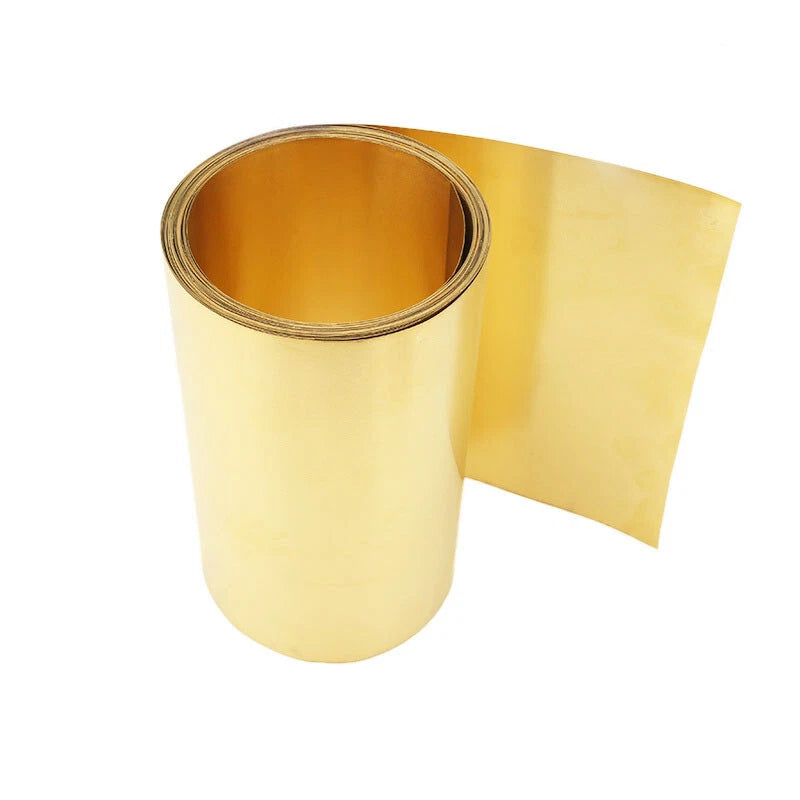
When your project demands a material that bends without breaking, seals without bulk, and conducts without compromise, finding the right brass foil strip can feel frustrating. Whether you are a hobbyist building custom enclosures, a maker shielding electronics, or a craftsperson adding decorative metal inlays, this brass metal thin sheet foil plate strip is engineered to meet your exact specifications.
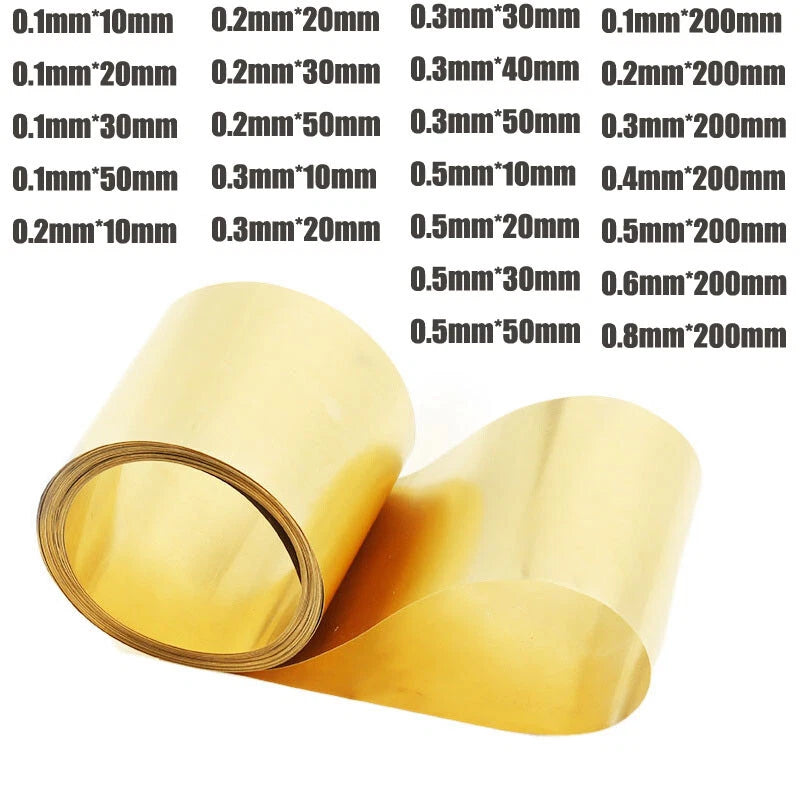
Each strip is composed of brass alloy (copper-zinc), offering a warm golden tone with natural corrosion resistance. Thickness options range from 0.1 mm to 0.5 mm (approximately 0.004 in to 0.020 in), and widths span 10 mm to 50 mm (approximately 0.39 in to 1.97 in). Each piece is supplied in a 1-meter (approximately 39.4 in) length, available in quantities of 1, 3, or 5 pieces per order.
Typical use cases include EMI/RF shielding tape for electronics enclosures, decorative inlay strips for woodworking and furniture, flexible gasket material for plumbing and HVAC joints, and thin shim stock for precision mechanical fitting. Long-tail applications such as "thin brass strip for model making" and "flexible brass foil for craft projects" are well served by this versatile product.
| Material | Brass alloy (copper-zinc) |
|---|---|
| Thickness Range | 0.1 mm – 0.5 mm (0.004 in – 0.020 in) |
| Width Range | 10 mm – 50 mm (0.39 in – 1.97 in) |
| Length per Piece | 1 m (approx. 39.4 in) |
| Available Quantities | 1 Pcs / 3 Pcs / 5 Pcs |
| Surface Finish | See variant options |
| Tensile Strength | See variant options |
| Hardness | See variant options |
| Conductivity | Electrically conductive (brass alloy) |
| Corrosion Resistance | Good — natural brass oxide layer |
| Application | Shielding, crafting, shim stock, inlay, gasket |
For decorative inlays and light craft work, 0.1 mm or 0.2 mm offers easy cutting and forming. For structural shims, gaskets, or EMI shielding that needs to hold shape under pressure, 0.3 mm or 0.5 mm provides greater rigidity. If you are unsure, start with 0.2 mm as a versatile middle ground.
Yes. Brass alloy has good compressive strength for thin shim stock applications. The 0.3 mm and 0.5 mm variants are particularly suited for precision mechanical fitting where a non-compressible, corrosion-resistant shim is needed. For heavy load-bearing applications, consult your engineering specifications before selecting gauge.
Brass naturally develops a patina over time when exposed to air and moisture, which is a surface oxidation layer that does not compromise structural integrity. For applications requiring a bright finish, a clear lacquer or metal sealant can be applied after cutting. For indoor decorative use, the natural tarnish is often considered aesthetically desirable.
Yes. Brass is solderable with standard rosin-core or acid-core solder and appropriate flux. Clean the surface with isopropyl alcohol before soldering to remove any surface oils. This makes it suitable for electronics grounding straps, RF shielding seams, and conductive bridging applications.
For 0.1 mm and 0.2 mm thickness, a sharp hobby knife or scissors can make clean cuts. For 0.3 mm to 0.5 mm, tin snips or metal shears are recommended for straight cuts. A metal ruler and cutting mat will help achieve precise, burr-free edges. Deburr cut edges with fine sandpaper (400–600 grit) if needed.
Order 1 piece if you are testing the size for a prototype or single repair. Choose 3 pieces for small batch projects or to have spares on hand. The 5-piece pack offers the best per-unit value for ongoing projects, production runs, or workshop stock. All packs contain 1-meter lengths of the same selected size.
Yes. Brass is an electrically conductive material and is commonly used for EMI shielding in enclosures, cable wrapping, and grounding applications. For effective shielding, ensure continuous electrical contact at seams and ground the strip to your enclosure chassis. Thinner gauges (0.1–0.2 mm) are easier to wrap around irregular surfaces.





