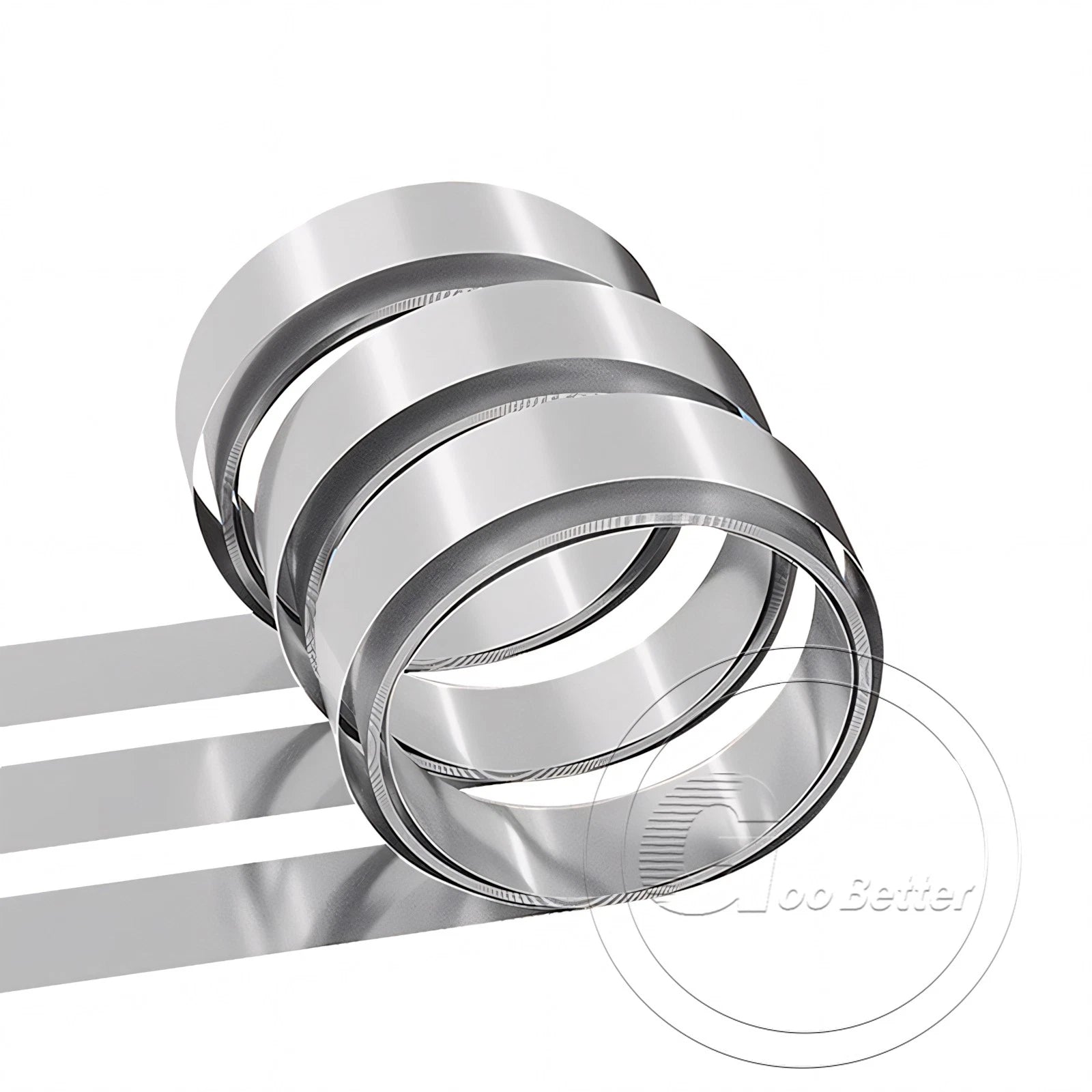
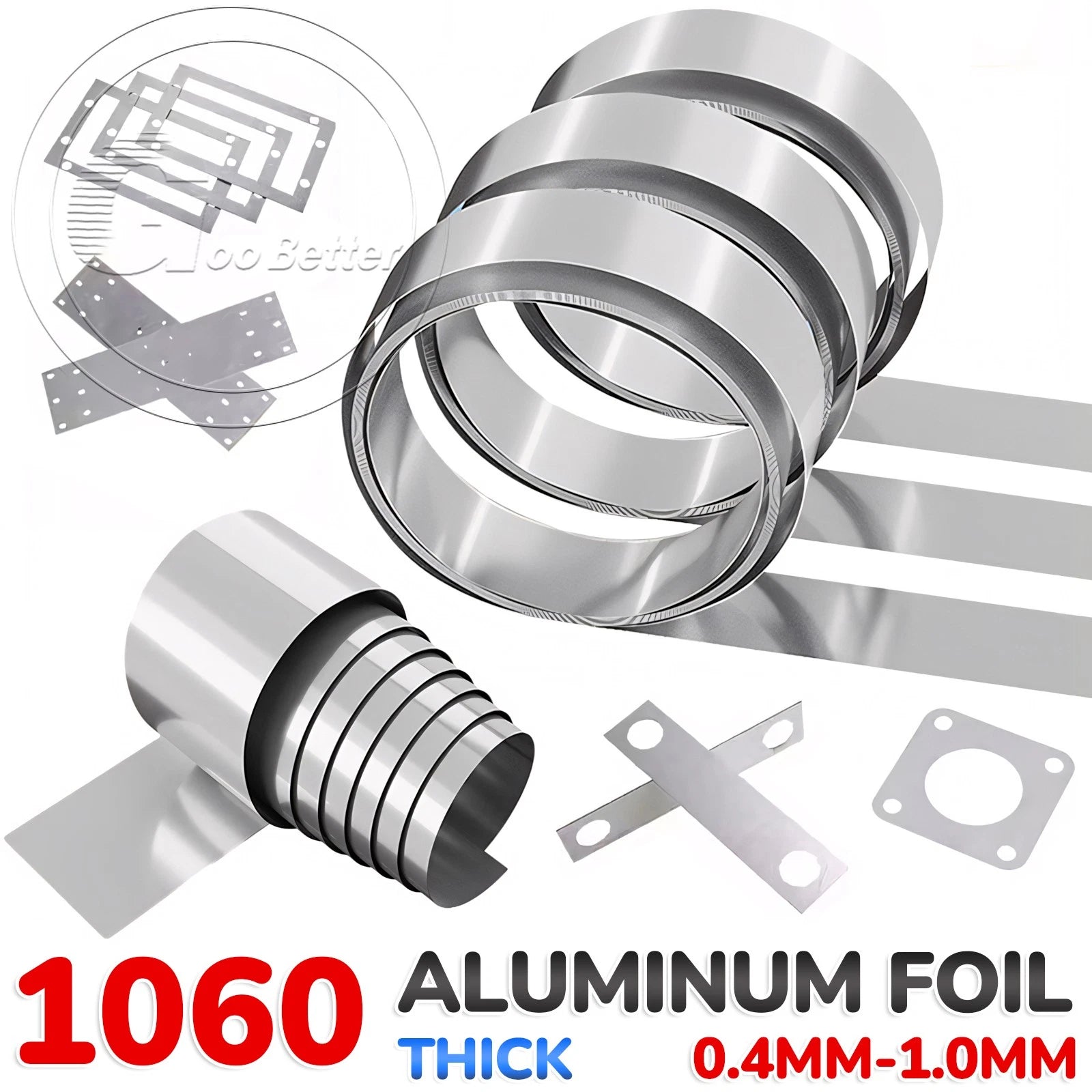
1060 Aluminum Foil Sheet Strip — Precision-Cut Flat Plate for Thermal, Shielding & DIY Projects
When your project demands a thin, workable metal that won't rust, warp, or fight back, standard sheet metal often falls short. Hobbyists, makers, and small-shop fabricators who need exact widths and thicknesses for heat spreaders, RF shielding, gaskets, or decorative inlays frequently struggle to find 1060 aluminum foil strip cut to usable dimensions without ordering bulk coil stock. This listing solves that problem directly.
Each piece is a 1060-grade pure aluminum flat strip, available in thicknesses from 0.4mm to 1.0mm (~0.016" to 0.039") and widths from 5mm to 300mm (~0.20" to 11.81"), sold in 1-meter or 3-meter lengths. The 1060 alloy contains a minimum of 99.6% aluminum, giving it excellent electrical conductivity, thermal conductivity, and corrosion resistance with a soft, easily formed temper.
Typical use cases include DIY thermal interface shims between heatsinks and components, electromagnetic shielding tape backing, craft and model-making inlays, battery tab stock for small electronics repair, and flexible gasket material for low-pressure sealing applications where a conformable metal layer is needed.
⚠️
Compatibility note: 1060 aluminum is a commercially pure, soft-temper alloy. It is not a structural alloy — do not use as a load-bearing component. Verify thickness and width against your variant selection before ordering.
✅ Key Features of These 1060 Aluminum Foil Strips
🔩
99.6%+ Pure 1060 Aluminum
Near-pure alloy delivers low electrical resistivity (~0.028 Ω·mm²/m) and thermal conductivity (~220 W/m·K), making it effective for heat-spreading and conductive shielding applications.
📐
Wide Size Matrix
Thickness options from 0.4mm to 1.0mm; width options from 5mm to 300mm; length options of 1 m or 3 m — select the exact combination you need from the variant dropdowns above.
✂️
Easily Cut and Formed
Soft O-temper character allows clean cutting with scissors or a utility knife for thinner gauges, and bending by hand or with simple tooling without cracking.
🛡️
Natural Corrosion Resistance
The native aluminum oxide layer forms immediately on the surface, protecting the strip from moisture and mild chemical exposure without any additional coating required.
⚡
Electrically Conductive
Suitable for use as bus bar stock, battery tab material, or grounding straps in low-current DIY electronics where a flexible, solderable (with flux) metal strip is needed.
📦
Flat-Packed, Ready to Use
Strips are supplied flat, not coiled, minimizing set and springback so they lie flush against surfaces straight out of the package — important for thermal interface and shielding applications.
📐 Technical Specifications — 1060 Aluminum Foil Strip
| Alloy Grade |
1060 (99.6% min. aluminum) |
| Temper |
O (soft / annealed) |
| Thickness Range |
0.4mm – 1.0mm (0.016" – 0.039") |
| Width Range |
5mm – 300mm (0.20" – 11.81") |
| Available Lengths |
1 Meter / 3 Meter |
| Surface Finish |
Mill finish (bare aluminum) |
| Thermal Conductivity |
Typically ~220 W/m·K for 1060 alloy |
| Electrical Resistivity |
Typically ~0.028 Ω·mm²/m for 1060 alloy |
| Density |
~2.71 g/cm³ |
| Exact Thickness & Width |
See variant options |
| Weight per Piece |
See variant options |
❓ Frequently Asked Questions
How do I choose the right thickness for my project?
For thermal interface shims between a heatsink and a flat surface, 0.4mm–0.5mm is typically sufficient and conforms well under clamping pressure. For RF or EMI shielding enclosures where the strip needs to hold a bent shape, 0.6mm–0.8mm offers better rigidity. For structural gaskets or spacers that must resist compression, 1.0mm is the most appropriate choice. When in doubt, start with 0.5mm — it balances formability and stiffness for most DIY applications.
Is 1060 aluminum strong enough for structural use?
No. 1060 is a commercially pure, soft-temper alloy with a tensile strength of approximately 55–95 MPa depending on temper — significantly lower than structural alloys like 6061-T6 (~310 MPa). It is intended for applications where formability, conductivity, and corrosion resistance matter more than strength, such as shielding, thermal management, and decorative inlays. Do not use it as a load-bearing bracket or fastener.
Will this aluminum strip corrode or oxidize over time?
1060 aluminum forms a thin, stable aluminum oxide layer on its surface almost immediately upon exposure to air. This layer is self-healing and protects the underlying metal from further oxidation and mild chemical attack. In typical indoor environments, the strip will remain visually clean for years. In humid or salt-spray environments, surface dulling may occur but structural integrity is generally maintained. Anodizing or clear-coating can be applied if appearance is critical.
Can I solder or weld this aluminum strip?
Standard tin-lead or lead-free solder does not bond well to aluminum without special aluminum-compatible flux or solder paste. For electronics applications such as battery tab bonding, use aluminum-specific flux and solder, or consider spot welding. TIG or MIG welding with 1100 or 4043 filler rod is feasible for thicker gauges (0.8mm+). Thinner gauges (0.4mm–0.5mm) are more challenging to weld without burn-through and may be better joined with conductive adhesive or mechanical fastening.
What width should I choose for EMI/RF shielding?
For shielding a PCB edge or wrapping a cable, widths of 10mm–30mm are common. For lining the interior walls of a small enclosure, measure the panel height and select the closest width that covers it in one pass to minimize seams. Overlapping seams by at least 5mm and ensuring electrical contact between strips improves shielding effectiveness. For frequencies above 1 GHz, thinner strips (0.4mm–0.5mm) are adequate since skin depth at those frequencies is well under 0.1mm.
How do I cut the strip cleanly without burrs?
For widths up to about 30mm and thicknesses up to 0.6mm, sharp scissors or aviation snips produce clean cuts with minimal burring. For wider strips or thicker gauges, a metal-cutting guillotine shear or a utility knife scored against a steel rule gives the cleanest edge. A fine-tooth file or 400-grit sandpaper can deburr any rough edges in seconds. Avoid using a rotary tool or angle grinder on thin foil — the heat and vibration can distort the strip.
Can I order a custom size not listed in the variants?
The available sizes are defined by the Thickness × Width and Length variant options shown on this page. If you need a combination not listed, or a length longer than 3 meters, please use the Contact Us link to describe your requirement. We can advise on the closest available option or discuss custom cutting for larger orders.
🛒 Select your Thickness × Width and Length above, then add to cart.