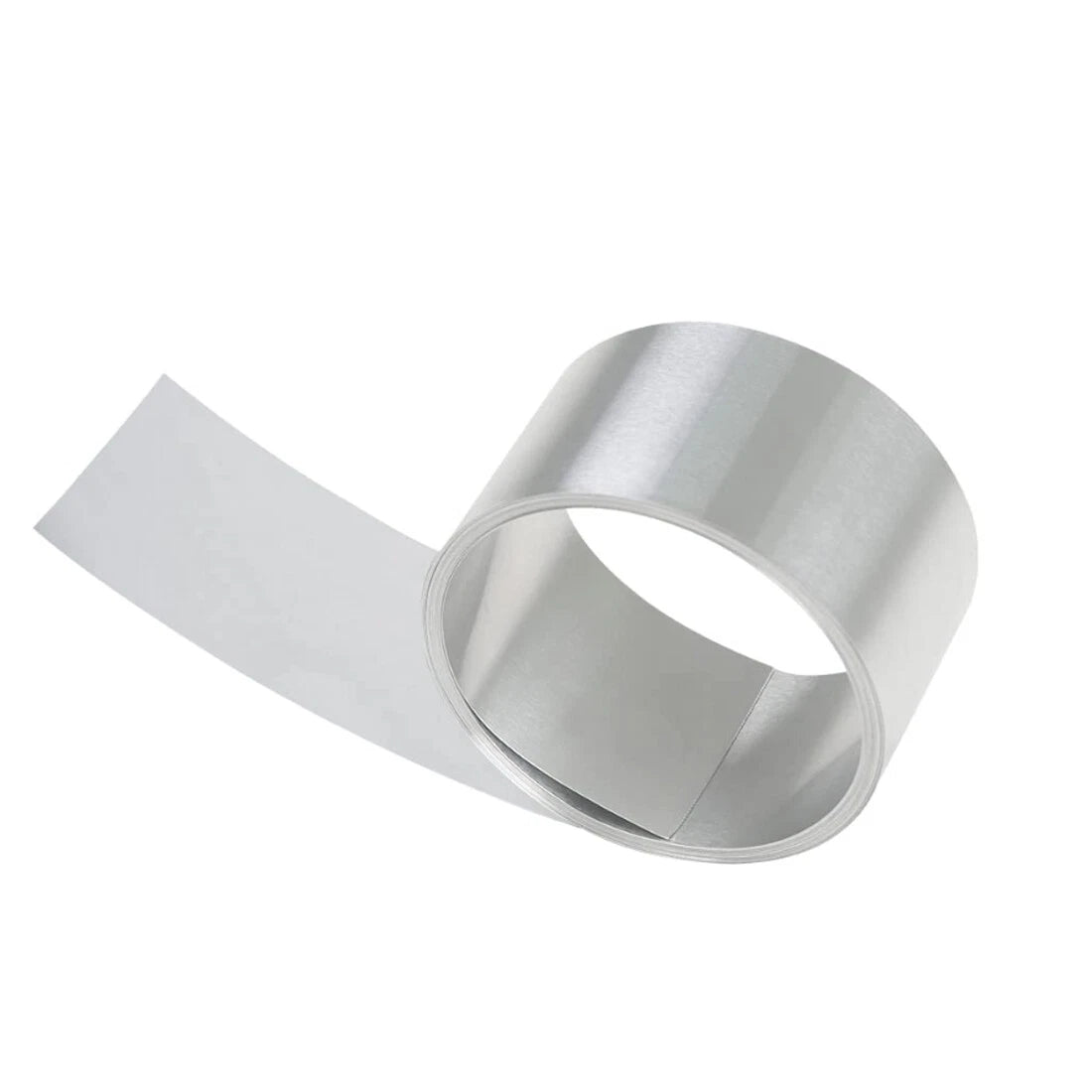
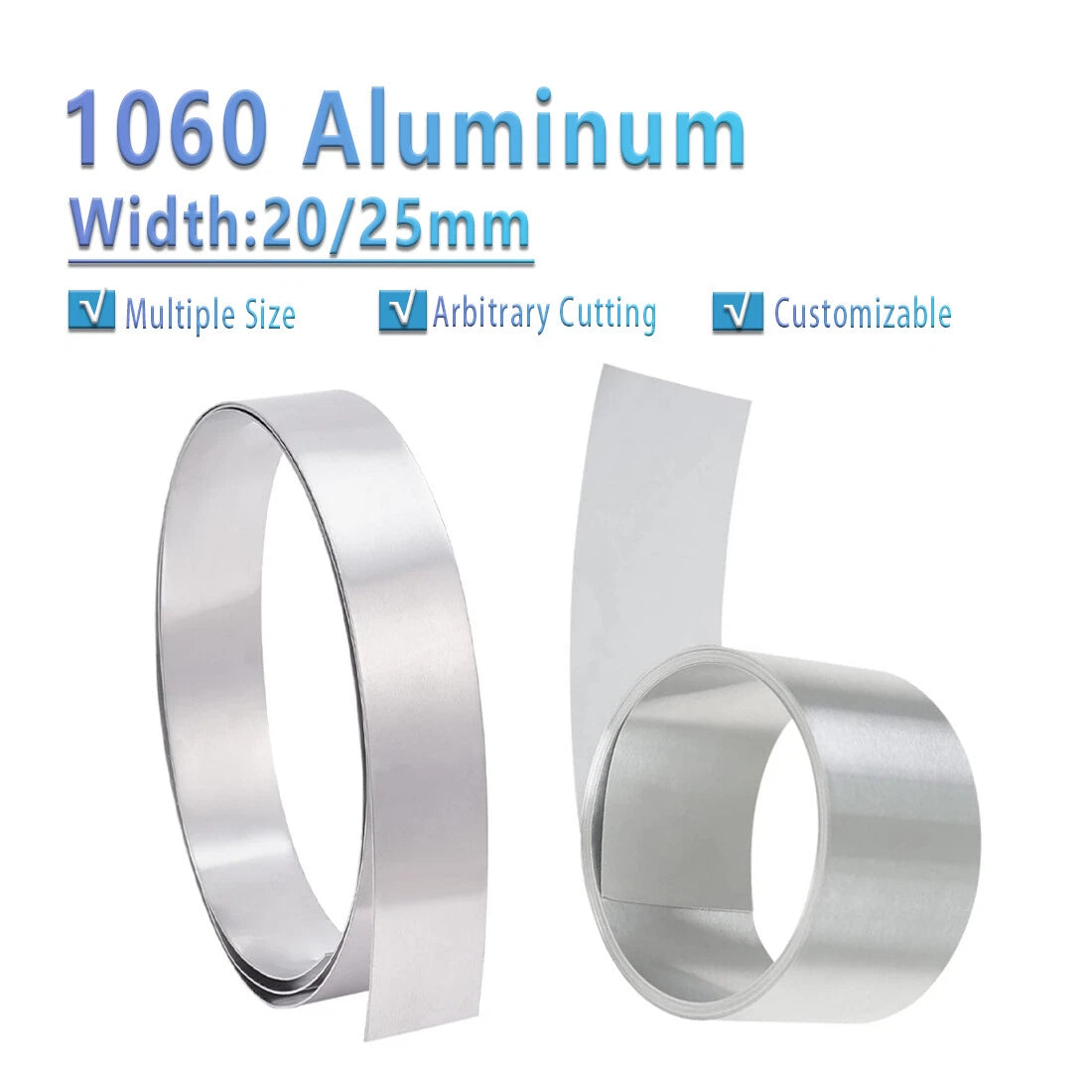
1060 Aluminum Sheet Strip Pure Al Thin Foil Plate Thick 0.05-3mm Width 20/25mm

No reviews

Price:
Sale price$29.24 USD
Stock:
In stock (500 units), ready to be shipped

Payment & Security

Ach Direct Debit Amazon American Express Apple Pay Bancontact Diners Club Discover Google Pay iDEAL Wero Mastercard PayPal Shop Pay USDC Visa

Your payment information is processed securely. We do not store credit card details nor have access to your credit card information.

Quantity Discount Promotion
🎯 BULK DISCOUNT: Buy More, Save More!
Buy 2 Items
5% OFF
Buy 4 Items
10% OFF
Buy 6 Items
15% OFF
Expert

DIY Expert Support

Get fitment advice & recommendations

Mon-Fri, 8:30AM-8PM
24-Hour Fast Ship
🚚
Arrives in 3-14 days
🌍
Global Reach
↩️
30-Day Returns
🌱 1 tree planted with every purchase

Description

1060 Aluminum Sheet Strip — Pure Al Thin Foil Plate for Precision DIY and Industrial Use

When your project demands a lightweight, corrosion-resistant metal that can be cut, bent, and shaped without specialized tooling, standard hardware store stock rarely delivers the exact thickness you need. This 1060 aluminum sheet strip is stocked in 15 thickness options from 0.05 mm to 3 mm and two widths — 20 mm and 25 mm — so hobbyists, makers, and small-shop fabricators can order exactly the gauge their application requires, without paying for material they'll discard.

Each roll is made from 1060-grade pure aluminum (≥99.6% Al), supplied in 5-metre lengths. Thickness options span 0.05 mm, 0.1 mm, 0.15 mm, 0.2 mm, 0.25 mm, 0.3 mm, 0.4 mm, 0.5 mm, 0.6 mm, 0.8 mm, 1 mm, 1.2 mm, 1.5 mm, 2 mm, and 3 mm. Width is available in 20 mm (~0.79 in) or 25 mm (~0.98 in). The foil and thin-gauge variants (0.05–0.3 mm) are flexible enough to conform to curved surfaces; heavier gauges (1–3 mm) hold shape under moderate mechanical load.

Typical use cases include EMI/RF shielding strips in electronics enclosures, heat-sink backing tape for LED strips, decorative inlay banding in woodworking, gasket blanks for low-pressure fluid systems, and shimming or spacing in mechanical assemblies. The consistent mill finish and tight dimensional tolerance make these strips a reliable choice for aluminum foil plate projects where fit and finish matter.

⚙️ Compatibility: Suitable for general fabrication, electronics shielding, thermal management, and decorative applications. Compatible with standard aluminum adhesives, rivets, and mechanical fasteners. Not rated for structural load-bearing use.

✅ Key Features of These 1060 Aluminum Sheet Strips

  • 🔩 15 Thickness Options: From ultra-thin 0.05 mm foil to rigid 3 mm plate — select the exact gauge your project requires without over-ordering.
  • 📏 Two Width Choices: 20 mm (~0.79 in) and 25 mm (~0.98 in) widths cover the most common strip-format applications in electronics and fabrication.
  • 🧪 1060-Grade Pure Aluminum (≥99.6% Al): High purity delivers excellent electrical conductivity, thermal transfer, and natural corrosion resistance without surface treatment.
  • 📦 5-Metre Roll per Order: Each variant ships as a continuous 5 m roll, minimizing joins and waste for longer runs.
  • ✂️ Easy to Cut and Form: Thin gauges (≤0.5 mm) cut cleanly with scissors or a craft knife; heavier gauges score and snap or cut with tin snips — no specialist machinery needed.
  • 🌡️ Good Thermal and Electrical Performance: 1060 aluminum offers thermal conductivity of approximately 222 W/(m·K) and electrical resistivity of approximately 2.8 µΩ·cm, making it suitable for heat-spreading and shielding tasks.

📐 Technical Specifications — 1060 Aluminum Sheet Strip

Material / Alloy 1060 Pure Aluminum (≥99.6% Al)
Temper O (annealed / soft)
Thickness Range 0.05 mm – 3 mm (see variant options)
Width Options 20 mm (~0.79 in) / 25 mm (~0.98 in)
Length per Roll 5 Metres (~16.4 ft)
Surface Finish Mill finish (uncoated)
Thermal Conductivity ~222 W/(m·K)
Electrical Resistivity ~2.8 µΩ·cm
Density ~2.71 g/cm³
Tensile Strength (O temper) Typically 55–95 MPa
Weight per Roll See variant options
Corrosion Resistance Good — natural oxide layer forms on exposure to air
Weldability Excellent (TIG/MIG compatible)
Machinability Good — cuts, bends, and forms without specialist tooling at thin gauges

❓ Frequently Asked Questions

Which thickness should I choose for EMI or RF shielding?

For most low-frequency EMI shielding applications, a thickness of 0.1 mm to 0.3 mm provides adequate attenuation while remaining flexible enough to wrap around enclosures or line cavities. For higher-frequency RF shielding where skin depth is a factor, even 0.05 mm can be effective. Thicker gauges (0.5 mm+) are better suited when the strip also needs to serve a structural or heat-spreading role.

Is 1060 aluminum strong enough for mechanical shimming or spacer applications?

1060 aluminum in the O (annealed) temper has a tensile strength of typically 55–95 MPa, which is adequate for light-duty shimming, spacing, and gasket applications where compressive loads are moderate. It is not recommended for structural load-bearing joints or high-vibration environments without additional support. For higher-strength requirements, consider 6061 or 5052 alloy instead.

Will this aluminum strip corrode or rust over time?

1060 pure aluminum does not rust. When exposed to air, it forms a thin, stable aluminum oxide layer that acts as a natural barrier against further oxidation. This makes it suitable for use in humid environments, outdoor enclosures, and applications where long-term appearance matters. For aggressive chemical environments (strong acids or alkalis), additional anodizing or coating is advisable.

Can I solder or weld this aluminum strip?

1060 aluminum is not suitable for conventional tin-lead soldering without special aluminum flux and solder. It is, however, excellent for TIG and MIG welding using 1100 or 4043 filler wire. For joining thin foil gauges (≤0.3 mm) without welding, aluminum-compatible conductive adhesive tape or mechanical crimping is a practical alternative.

How do I cut the thicker gauges (1 mm – 3 mm) cleanly?

For gauges up to 0.5 mm, sharp scissors or a craft knife and steel ruler work well. For 0.6 mm to 1.5 mm, aviation tin snips or a rotary cutter on a cutting mat give clean edges. For 2 mm and 3 mm strips, a fine-tooth hacksaw, jigsaw with a metal blade, or a bench shear will produce the cleanest cut. Deburr edges with fine sandpaper (320–400 grit) after cutting.

Is the 20 mm or 25 mm width better for LED strip heat-spreading?

Standard 8 mm and 10 mm LED strips fit comfortably within the 20 mm width, leaving margin on each side for adhesive or mechanical attachment. The 25 mm width is better suited for 12 mm or wider LED strips, or when you want additional thermal mass on either side of the strip. For heat-spreading, a thickness of 0.5 mm to 1 mm balances thermal conductivity with ease of handling.

How much does a 5-metre roll weigh?

Weight depends on the thickness and width selected. As a reference: a 5 m × 20 mm × 0.1 mm roll weighs approximately 2.7 g, while a 5 m × 25 mm × 3 mm roll weighs approximately 1,017 g (~1 kg). Use the formula: Weight (g) = 5000 mm × width (mm) × thickness (mm) × 0.00271 g/mm³ to estimate the weight of your chosen variant.

🛒 Select your Thick x Width and Length above, then add to cart.

You may also like

Recently viewed