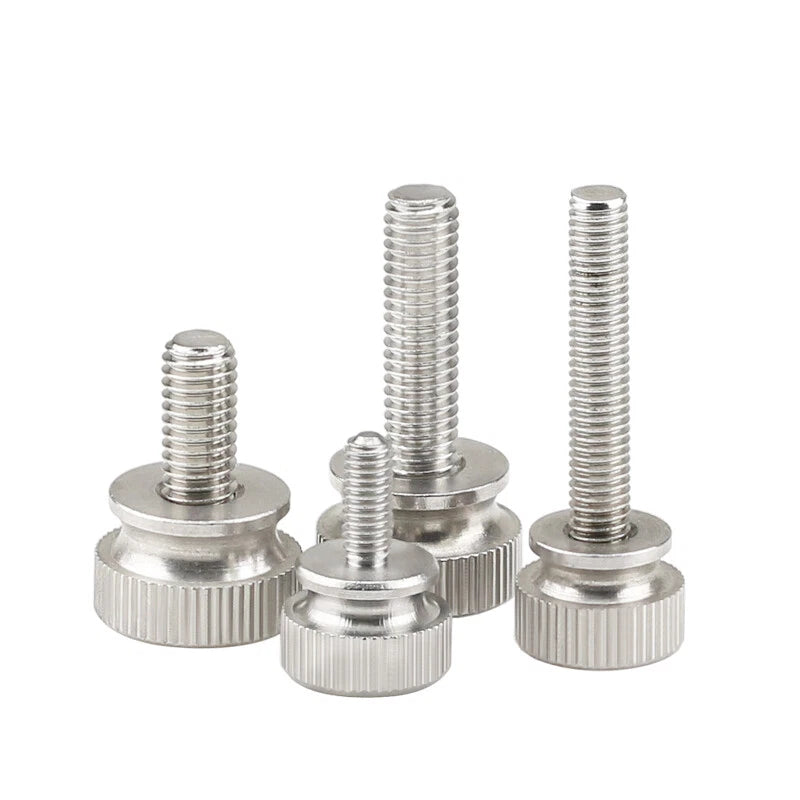
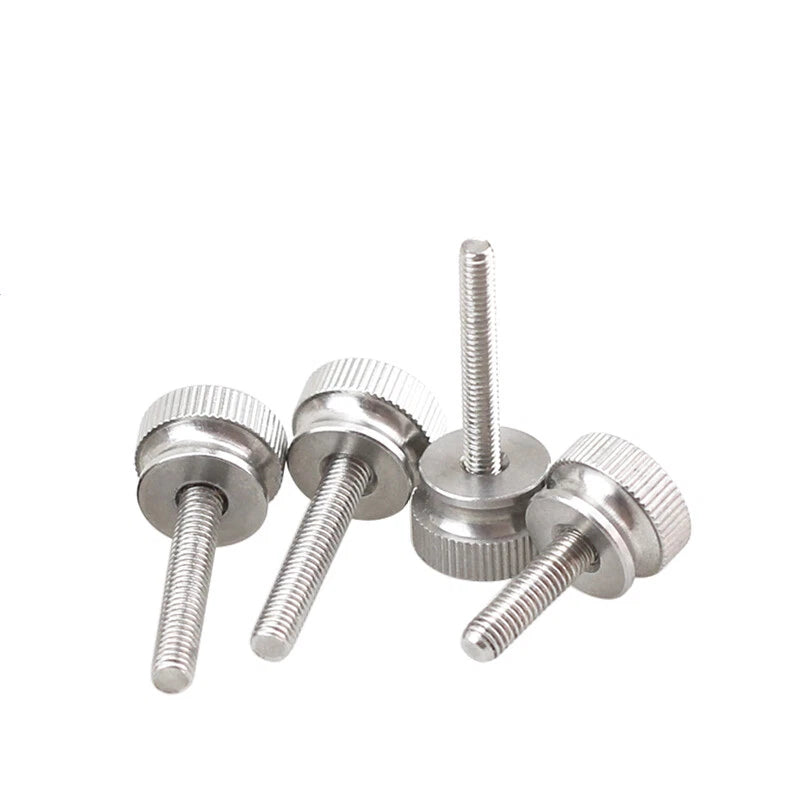
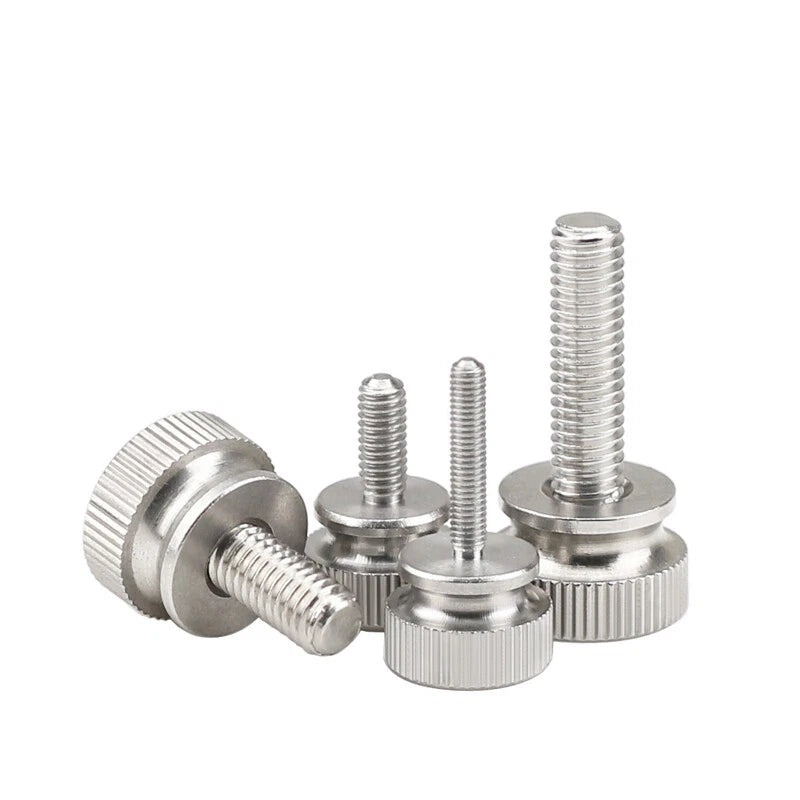
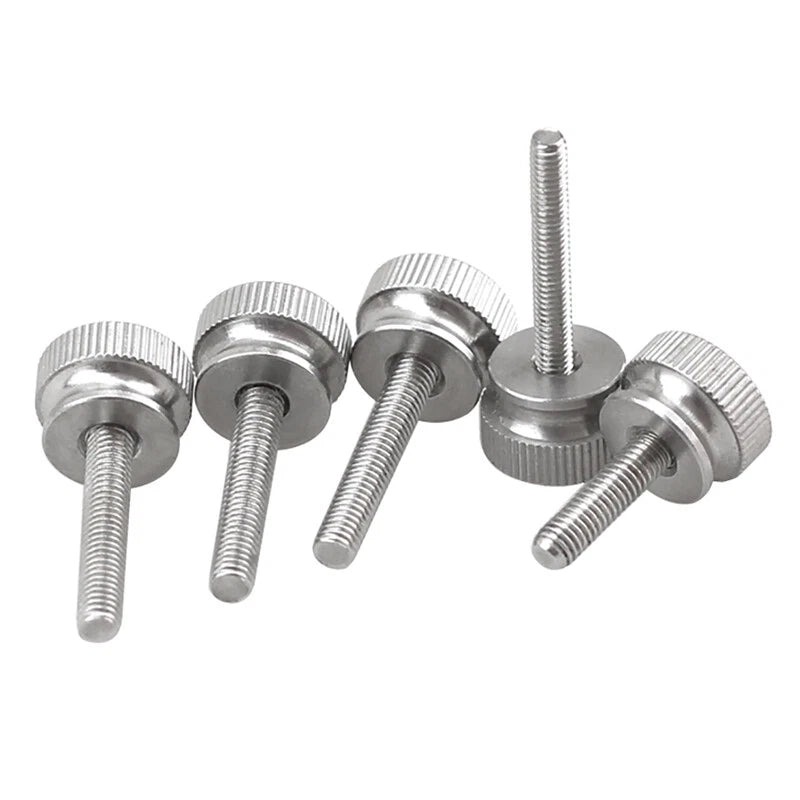
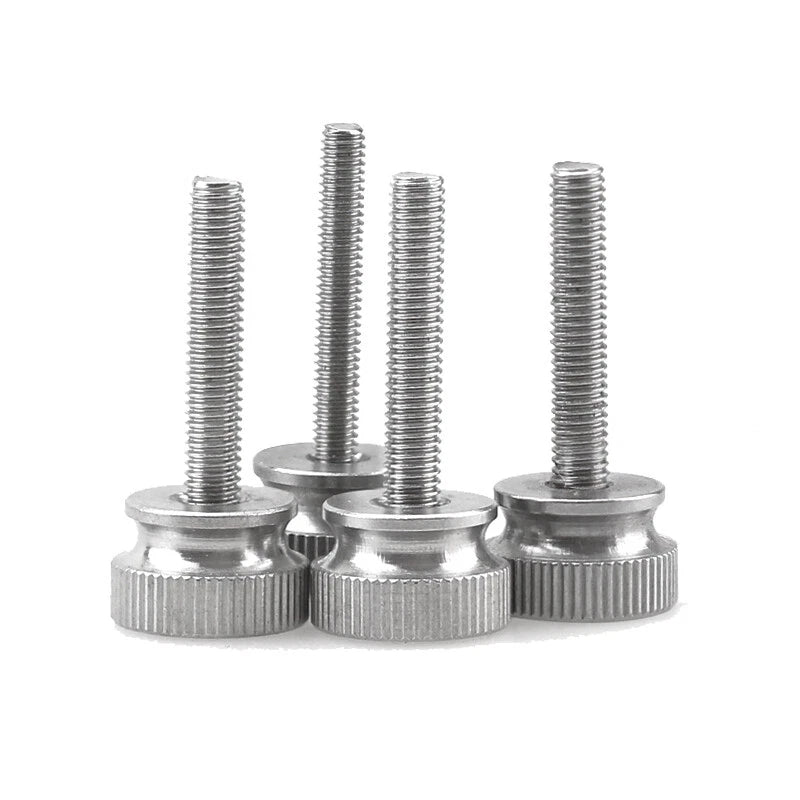
304 Stainless Steel Knurled Thumb Screws Ø M3 M4 M5 M6 Hand Grip Knob Bolts New

No reviews

Price:
Sale price$7.06 USD
Stock:
In stock (500 units), ready to be shipped

Payment & Security

Ach Direct Debit Amazon American Express Apple Pay Bancontact Diners Club Discover Google Pay iDEAL Wero Mastercard PayPal Shop Pay USDC Visa

Your payment information is processed securely. We do not store credit card details nor have access to your credit card information.

Quantity Discount Promotion
🎯 BULK DISCOUNT: Buy More, Save More!
Buy 2 Items
5% OFF
Buy 4 Items
10% OFF
Buy 6 Items
15% OFF
Expert

DIY Expert Support

Get fitment advice & recommendations

Mon-Fri, 8:30AM-8PM
24-Hour Fast Ship
🚚
Arrives in 3-14 days
🌍
Global Reach
↩️
30-Day Returns
🌱 1 tree planted with every purchase

Description

304 Stainless Steel Knurled Thumb Screws — Tool-Free Fastening for M3 to M6 Applications

When a project demands frequent adjustments without reaching for a screwdriver, standard hex bolts become a bottleneck. Makers, engineers, and hobbyists working on enclosures, jigs, camera rigs, and 3D printer frames need a fastener they can tighten and release bare-handed — reliably, every time.

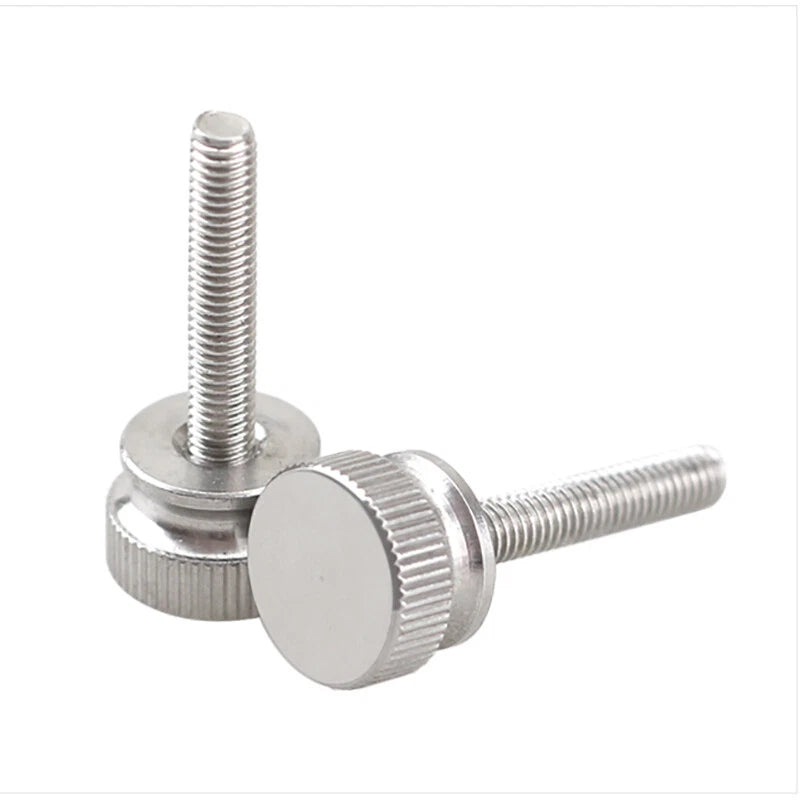
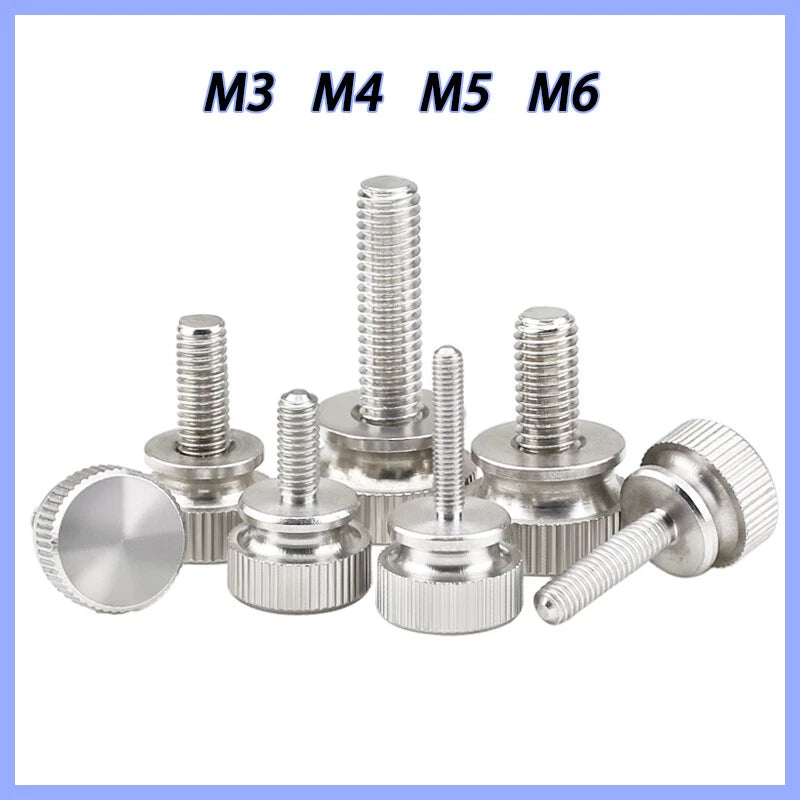
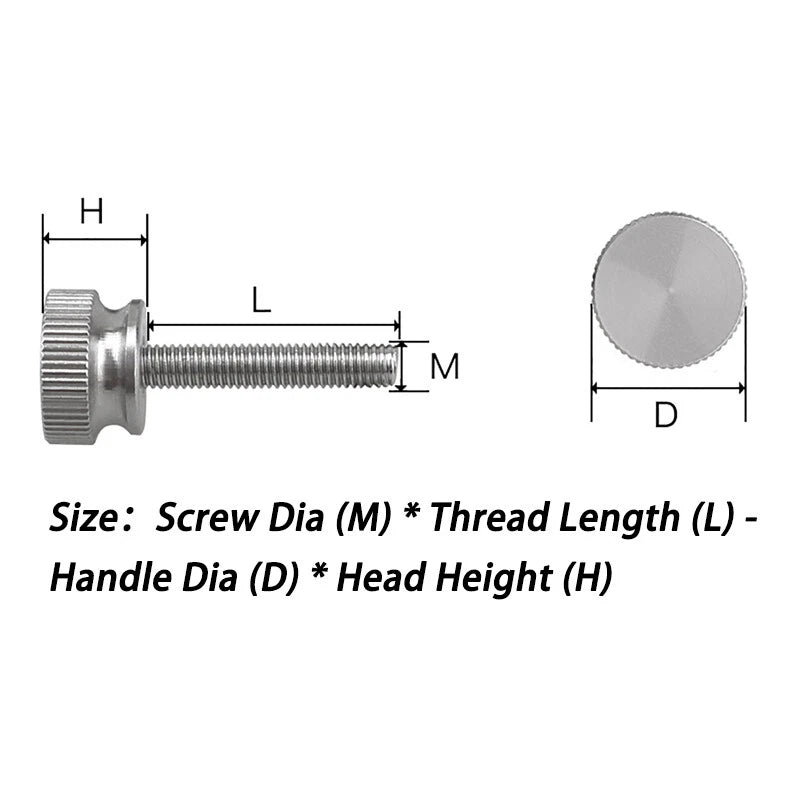
These 304 stainless steel knurled thumb screws are machined with a knurled flange head for a secure finger grip. Each screw consists of a cylindrical knurled head and a fully threaded shank. Thread diameters span M3, M4, M5, and M6; shank lengths range from 6 mm to 62 mm (approximately 0.24 in to 2.44 in); flange outer diameters are either 13 mm (~0.51 in) or 16 mm (~0.63 in) with a head height of 9 mm or 10 mm respectively. Material is 304 stainless steel throughout.

Typical use cases for these knurled thumb screws include tool-free panel fastening on electronic enclosures, quick-release clamping on woodworking jigs, adjustment knobs on optical and camera equipment, and hand-tightened access covers on 3D printers and CNC machines. The corrosion resistance of 304 stainless makes them equally suited to outdoor fixtures and humid workshop environments.

🔩 Compatibility: Standard metric threads — fits any M3, M4, M5, or M6 threaded hole or insert. Confirm thread pitch matches your application before ordering (standard coarse pitch for each diameter).

✅ Key Features of These Knurled Thumb Screws

🔩304 Stainless Steel Construction — Resists rust and oxidation in damp, outdoor, and light-chemical environments without surface coatings that can wear off.
Knurled Flange Head for Finger Grip — The circumferential knurl pattern provides tactile purchase for confident hand-tightening, even with slightly oily or gloved hands.
📐Wide Size Range: M3 to M6 — Eight thread diameters and lengths from 6 mm to 62 mm let you match the fastener to the exact load and clearance of your assembly.
⚙️Two Flange Diameter Options — 13 mm flange (9 mm tall) for compact clearances; 16 mm flange (10 mm tall) for greater bearing surface and easier grip in larger panels.
📦Flexible Quantity Packs — Available in 1, 4, 10, 20, or 50-piece quantities so you can order exactly what a single project needs or stock up for recurring builds.
🔄Fully Threaded Shank — Thread runs the full length of the shank, maximising engagement depth and allowing use in thin materials where partial threading would leave insufficient grip.

📐 Technical Specifications — Knurled Thumb Screws

Material 304 Stainless Steel
Thread Standard Metric (ISO coarse pitch)
Thread Diameter M3, M4, M5, M6
Shank Length (L) 6 mm – 62 mm (approx. 0.24 in – 2.44 in)
Flange Outer Diameter (D) 13 mm or 16 mm
Head Height (H) 9 mm (D13) / 10 mm (D16)
Head Style Knurled flange (cylindrical)
Drive Style Hand-tightened (no tool required)
Surface Finish Natural stainless (no coating)
Thread Engagement Fully threaded shank
Available Quantities 1, 4, 10, 20, 50 pcs
Tensile Strength (typical 304 SS) See variant options

❓ Frequently Asked Questions

How do I choose the right shank length for my application?

Measure the total thickness of the material(s) being clamped, then add at least 1× the thread diameter for minimum engagement depth. For example, clamping 8 mm of panel with an M4 screw requires at least 4 mm of thread engagement, so a 12 mm shank is the shortest safe choice. Longer shanks give more adjustment range but may protrude on the far side.

What is the difference between the 13 mm and 16 mm flange options?

The 13 mm flange (9 mm tall) is designed for compact assemblies where clearance around the fastener is limited — common in electronics enclosures and small jigs. The 16 mm flange (10 mm tall) provides a larger bearing surface and a more comfortable grip, making it better suited to panels that are adjusted frequently or by users wearing gloves.

Are these screws corrosion-resistant enough for outdoor use?

304 stainless steel offers good resistance to atmospheric corrosion, fresh water, and many mild chemicals. It performs well in most outdoor environments. For marine or coastal environments with prolonged salt-spray exposure, 316 stainless steel is generally recommended instead. These screws are not coated, so the corrosion resistance comes from the alloy itself and will not degrade over time.

What thread pitch do these thumb screws use?

These screws use standard ISO metric coarse pitch: M3×0.5, M4×0.7, M5×0.8, and M6×1.0. This matches the most common tapped holes and threaded inserts used in metalworking, 3D printing, and general fabrication. If your application uses fine-pitch threads, please confirm compatibility before ordering.

Can I use these in plastic or aluminium panels?

Yes. These thumb screws work with any material that has a matching metric threaded hole or insert — including aluminium, steel, brass, and engineering plastics such as acetal and nylon. For soft plastics, consider using a threaded brass insert to prevent thread stripping under repeated tightening cycles.

How much torque can I apply by hand?

Hand-applied torque varies by user and knurl grip, but typical finger-tightening on a 13–16 mm diameter head produces roughly 0.3–1.0 N·m depending on thread size. This is sufficient for panel retention and light clamping. For applications requiring a specific preload, use a torque wrench with a socket adapter and do not rely solely on hand tightening.

Which size should I choose for a 3D printer or CNC machine access panel?

M3×6 mm or M3×8 mm with a 13 mm flange is the most common choice for 3D printer panels (e.g., Voron, RatRig enclosures) where M3 heat-set inserts are standard. For CNC machine covers with M5 or M6 tapped holes, the 16 mm flange variants provide a more secure grip when the panel is removed and replaced frequently during tool changes.

🛒 Select your Size (M×L–D×H) and Quantity above, then add to cart.

You may also like

Recently viewed