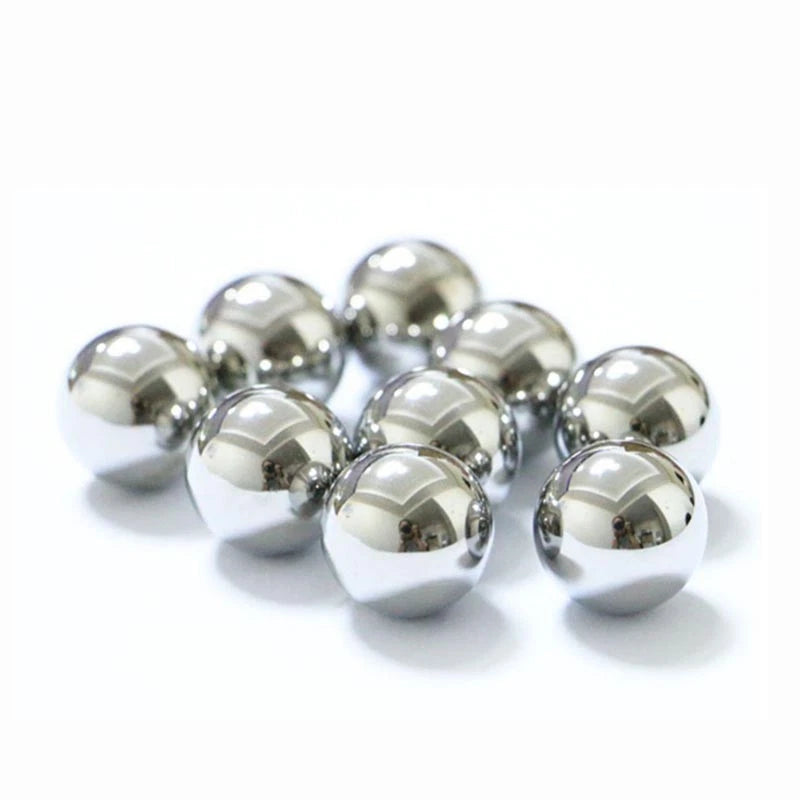
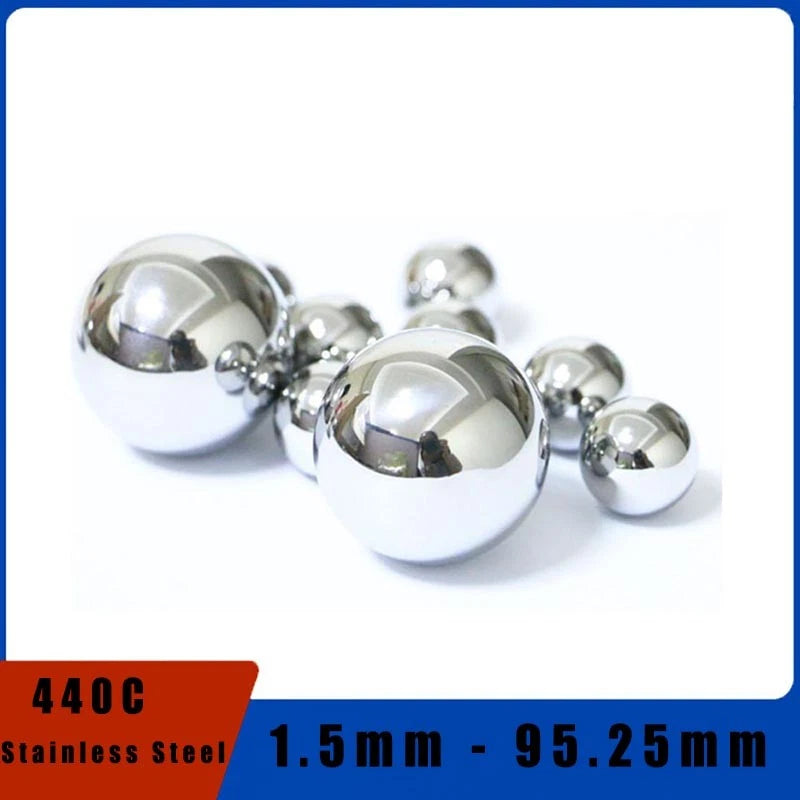
440C Stainless Steel Bearing Balls Grade 10 — Precision Rolling Elements for Demanding Applications
When worn or undersized balls cause vibration, noise, or premature bearing failure, the root cause is almost always dimensional inconsistency or inadequate corrosion resistance. Engineers, machinists, and serious DIYers who need 440C stainless steel bearing balls that hold tight tolerances across the full size range will find exactly what they need here — available from 1.5 mm (0.059 in) up to 95.25 mm (3.750 in) in a single listing.
Each ball is manufactured from 440C martensitic stainless steel, hardened and ground to ABEC / ISO Grade 10 tolerances. The spherical form deviation is held to ≤0.25 µm at Grade 10, delivering a surface finish that supports low-friction, low-noise operation. Diameters span the full metric and inch series — including fractional inch sizes such as 1/16", 3/32", 5/32", 7/32", 9/32", 11/32", 3/8", 7/16", 1/2", 9/16", 5/8", 11/16", 3/4", 1", 1-1/16", 1-1/8", 1-3/16", 1-1/4", 1-3/8", 1-1/2", 2", 2-1/4", 2-3/4", and 3-3/4" — alongside standard metric sizes.
Typical use cases include replacement balls in deep-groove and angular-contact bearings for pumps, conveyors, and machine tool spindles; check-valve seats in fluid-handling systems exposed to mild acids or salt spray; precision pivot points in optical and measuring instruments; and load-distributing elements in linear guides and ball screws used in CNC and 3D-printing equipment.
✅ Key Features of These 440C Stainless Steel Bearing Balls
🔩440C Martensitic Stainless Steel — Rockwell hardness typically 58–62 HRC after heat treatment, providing resistance to surface fatigue and deformation under cyclic load.
📏Grade 10 Dimensional Accuracy — Spherical form deviation ≤0.25 µm; diameter tolerance held to ±0.013 mm or tighter depending on size, ensuring drop-in fit in standard bearing races.
🌊Corrosion Resistance — 440C alloy contains 16–18% chromium, forming a passive oxide layer that resists moisture, mild acids, and salt environments — suitable for food-adjacent, marine, and outdoor machinery.
🎯Wide Size Range — 1.5 mm to 95.25 mm — Covers both metric and fractional-inch series in a single product listing, eliminating the need to source from multiple suppliers for mixed-unit assemblies.
📦Flexible Pack Sizes — Available in 1, 10, 20, 50, 100, 200, 500, and 1000-piece packs, supporting both single-unit repair and production-volume restocking without minimum order constraints.
✨Smooth Ground Finish — Surface roughness Ra ≤0.025 µm (Grade 10 spec), reducing rolling friction and heat generation in high-speed bearing assemblies.
🛒 Select your Diameter and Pack Size above, then add to cart.