The chain is fine...but I ordered the wrong size. Nine links of the chain I ordered equals six of the size I wanted. My error...
How can I straighten out the springs? I can't use them coil uo as is.
Your payment information is processed securely. We do not store credit card details nor have access to your credit card information.
Get fitment advice & recommendations
When axial loads cause premature wear, misalignment, or noisy operation in rotating assemblies, the right thrust bearing makes the difference. Engineers, maintenance technicians, and DIY builders working on gearboxes, machine tool spindles, automotive steering columns, and hydraulic pump shafts rely on dimensionally accurate thrust ball bearings to keep assemblies running true under one-directional axial force.
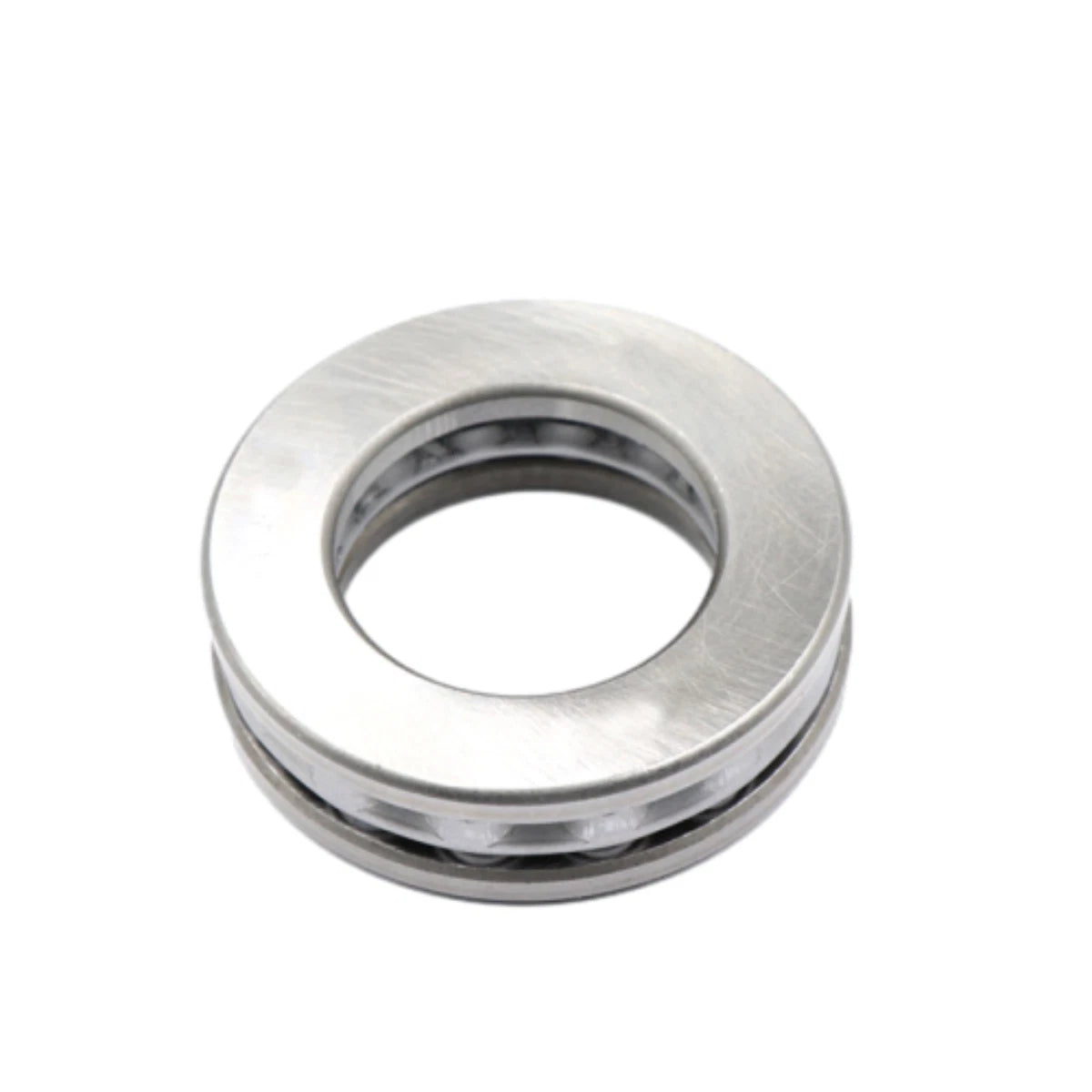
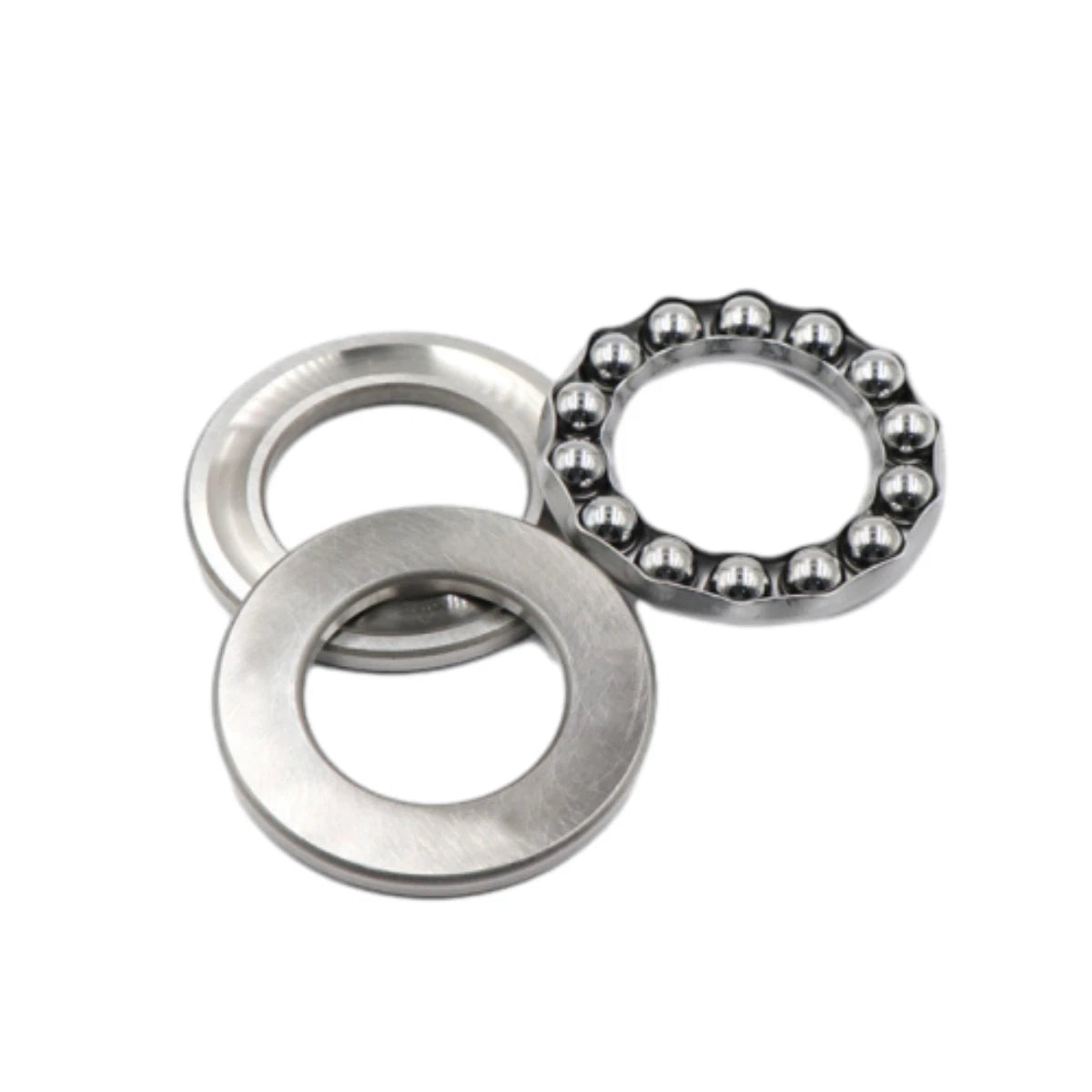
These 51100–51414 series thrust ball bearings follow the ISO/DIN standard 3-part construction: a shaft washer (tight-fit ring), a housing washer (loose-fit ring), and a ball-and-cage assembly seated between them. Available in inner diameter (bore) sizes from 10 mm (0.39 in) to 150 mm (5.91 in), with outer diameters from 24 mm to 190 mm and thickness ranging from 9 mm to 60 mm. The steel cage retains the balls evenly around the raceway, distributing axial load across all rolling elements.
Typical applications include lathe and milling machine spindle thrust faces, automotive clutch release mechanisms, agricultural equipment pivot points, and conveyor drive shaft end-thrust management — anywhere a compact, single-direction axial load bearing is needed in a confined radial envelope.
| Bearing Series | 51100–51414 (ISO/DIN Standard) |
|---|---|
| Bearing Type | Single-Direction Thrust Ball Bearing |
| Construction | 3-Part: Shaft Washer + Housing Washer + Ball & Cage Assembly |
| Inner Diameter (Bore) | 10 mm – 150 mm (0.39 in – 5.91 in) |
| Outer Diameter | 24 mm – 190 mm (see variant options) |
| Thickness | 9 mm – 60 mm (see variant options) |
| Material — Raceways | Hardened bearing steel |
| Cage Material | Steel |
| Load Direction | Axial (single direction) |
| Lubrication | See variant options (grease-lubricated unless otherwise noted) |
| Operating Temperature | Typically –20°C to +120°C (–4°F to +248°F) |
| Pack Quantity | See variant options (1 pc standard; multi-pack available) |
Match the inner diameter (I.D.) to your shaft diameter and the outer diameter (O.D.) to the available housing bore. Then confirm the thickness fits within your axial clearance envelope. Cross-reference the 51100–51414 series designation: for example, a 51205 bearing has a 25 mm bore, 47 mm O.D., and 15 mm thickness. Always verify all three dimensions against your assembly drawing before ordering.
No. Single-direction thrust ball bearings are designed exclusively for axial (thrust) loads acting in one direction. They cannot support radial loads on their own. If your application involves combined radial and axial loading, pair this bearing with a separate deep groove or angular contact radial bearing to handle the radial component.
These bearings are typically supplied without pre-packed grease (open design) and should be lubricated with a lithium-based grease (NLGI Grade 2) or a suitable mineral oil before installation. Relubrication intervals depend on operating speed, temperature, and load — consult your machinery's maintenance schedule. For high-speed applications, oil lubrication is generally preferred over grease.
Standard 51100–51414 series bearings use hardened carbon steel raceways and are not inherently corrosion-resistant. For outdoor, washdown, or humid environments, apply a compatible anti-corrosion grease and consider adding a protective shield or seal arrangement around the bearing housing. If continuous exposure to moisture or chemicals is expected, contact us to confirm suitability or discuss stainless steel alternatives.
The shaft washer (tight-fit ring, smaller bore) seats against the rotating shaft with a light interference or transition fit. The housing washer (loose-fit ring, larger bore) seats in the stationary housing with a clearance fit, allowing it to self-align slightly. The ball-and-cage assembly sits between the two washers. Never press on the wrong ring — always apply installation force through the ring being fitted. Ensure the shaft and housing seats are clean, burr-free, and within dimensional tolerance before assembly.
Within the 51100–51414 series, the designation number encodes the bore size: the last two digits (multiplied by 5) give the bore in mm for sizes above 04 (e.g., 51205 = 25 mm bore). The 511xx sub-series covers smaller bore sizes (typically 10–35 mm) with relatively compact O.D. and thin cross-sections, while the 514xx sub-series covers larger bores (up to 70 mm in standard catalogues) with proportionally larger O.D. and greater thickness to handle higher axial loads. Select based on your bore size and the axial load capacity required.
Yes — vertical shaft applications are one of the most common use cases for single-direction thrust ball bearings. In a vertical orientation, the bearing supports the weight of the rotating assembly (downward axial load). Ensure the shaft washer is on the rotating element and the housing washer is on the stationary support structure. Adequate lubrication retention is important in vertical installations; a grease-filled housing cap or oil bath arrangement is recommended to prevent lubricant migration away from the raceways.