The chain is fine...but I ordered the wrong size. Nine links of the chain I ordered equals six of the size I wanted. My error...
How can I straighten out the springs? I can't use them coil uo as is.
Your payment information is processed securely. We do not store credit card details nor have access to your credit card information.
Get fitment advice & recommendations
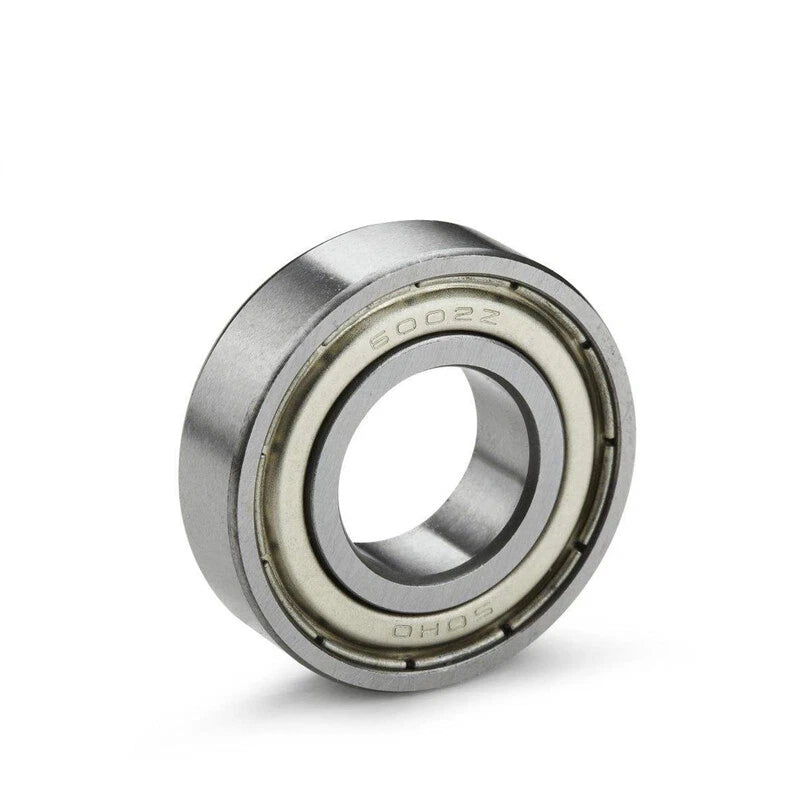
When a worn or undersized bearing causes shaft wobble, excess heat, or premature motor failure, finding the right replacement quickly matters. Engineers, maintenance technicians, and DIY builders working on motors, pumps, conveyors, and power tools rely on dimensionally accurate, double-shielded deep groove ball bearings to restore smooth rotation and extend service intervals.
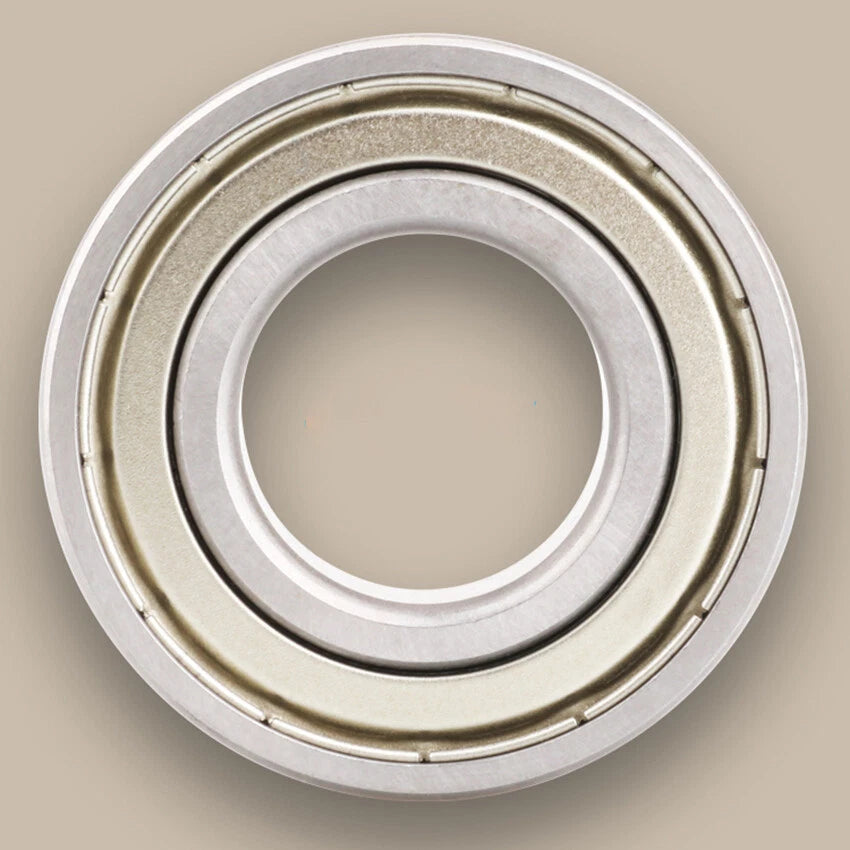
These deep groove ball bearings cover the 6000-ZZ through 6008-ZZ series, with bore diameters from 10 mm (0.394 in) to 40 mm (1.575 in) and outer diameters from 26 mm (1.024 in) to 68 mm (2.677 in). Each bearing features an iron double-shield (ZZ) enclosure that retains grease and blocks particulate ingress. Thickness ranges from 8 mm to 15 mm depending on the selected size.
Typical applications include electric motor shaft support, skateboard and inline skate wheel axles, small agricultural equipment, 3D printer carriage rails, and light industrial conveyor rollers — anywhere a compact, low-friction radial bearing is needed for deep groove ball bearing replacement or new builds.
| Bearing Series | 6000-ZZ to 6008-ZZ |
|---|---|
| Bore (I.D.) Range | 10 mm – 40 mm (0.394 in – 1.575 in) |
| Outer Diameter (O.D.) Range | 26 mm – 68 mm (1.024 in – 2.677 in) |
| Width (Thickness) Range | 8 mm – 15 mm (0.315 in – 0.591 in) |
| Sealing Type | ZZ — Iron double-shield (non-contact) |
| Bearing Type | Deep groove ball bearing |
| Shield Material | Iron (steel) |
| Lubrication | Factory-applied grease (sealed) |
| Load Direction | Radial + moderate axial (both directions) |
| Dimensional Standard | ISO 15 metric series |
| Available Sizes | See variant options |
| Available Quantities | 1 / 2 / 5 / 10 pcs |
| Operating Temperature | Typically –20°C to +120°C (–4°F to +248°F) |
Measure your shaft's outer diameter — this becomes the bearing bore (I.D.). Then confirm the housing inner diameter matches the bearing O.D., and verify the available axial space accommodates the bearing width. Cross-reference these three dimensions against the variant options (e.g., 20×42×12 mm for a 6004-ZZ) to select the correct size.
ZZ indicates iron (steel) double-shield sealing on both sides of the bearing. The shields are non-contact, meaning they do not rub against the inner ring, which keeps friction low. They retain grease inside the bearing and block coarse contaminants from entering the raceway. For environments with liquid splash or fine dust, a rubber-sealed (2RS) variant may offer better ingress protection.
Yes, but with limitations. Deep groove ball bearings are primarily designed for radial loads. They can accommodate moderate axial loads in both directions — typically up to 20–30% of the dynamic radial load rating — making them suitable for applications like fan motors and light gearboxes. For predominantly axial loads, a dedicated thrust bearing is recommended.
The iron shields and steel races provide standard corrosion resistance suitable for dry or lightly oiled indoor environments. They are not rated for continuous water immersion or highly corrosive chemical exposure. For wet or marine environments, consider stainless steel bearings (e.g., 6000-2RS stainless) instead.
These bearings follow ISO 15 metric dimensional standards, making them interchangeable with any OEM or aftermarket housing designed for the 6000-series metric bore. As long as your equipment specifies a 6000-ZZ through 6008-ZZ bearing (or equivalent), these will fit. Always verify bore, O.D., and width against your equipment's service manual before installation.
No. These bearings come pre-greased from the factory and are sealed by the ZZ iron shields, so no additional lubrication is required before installation. Avoid washing the bearing with solvents, as this can remove the factory grease. If the application demands relubrication over time, the shields can be carefully removed, grease replenished, and shields reinstalled.
For a single repair or prototype build, 1 or 2 pcs is sufficient. If you are servicing a machine with multiple bearing points of the same size, or building a batch of assemblies, the 5-pcs or 10-pcs packs offer a lower per-unit cost. Maintenance teams often stock 5–10 pcs of commonly used sizes to reduce downtime during scheduled service intervals.