The chain is fine...but I ordered the wrong size. Nine links of the chain I ordered equals six of the size I wanted. My error...
How can I straighten out the springs? I can't use them coil uo as is.
Your payment information is processed securely. We do not store credit card details nor have access to your credit card information.
Get fitment advice & recommendations
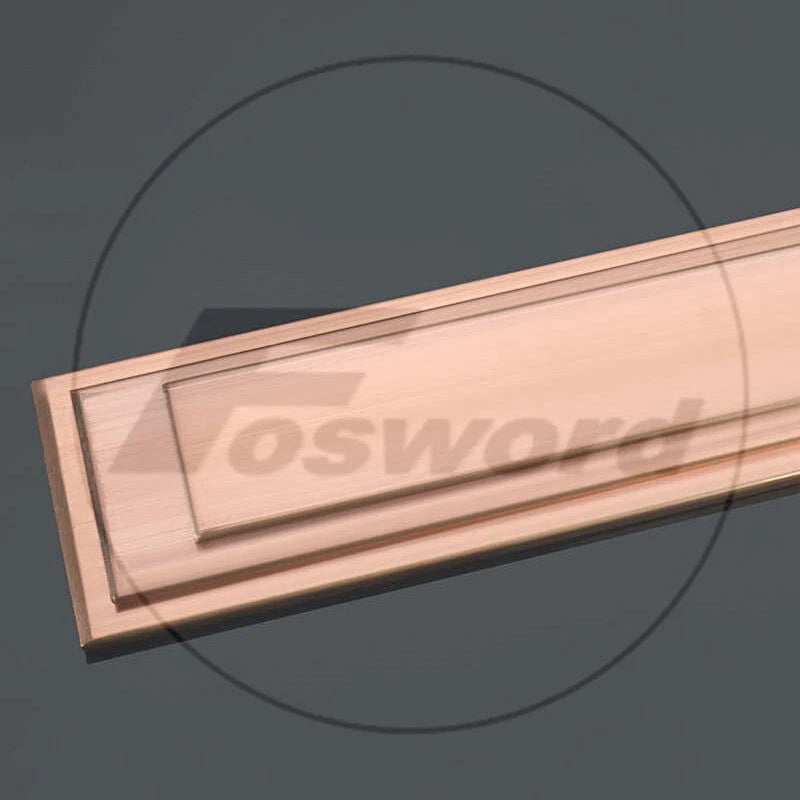
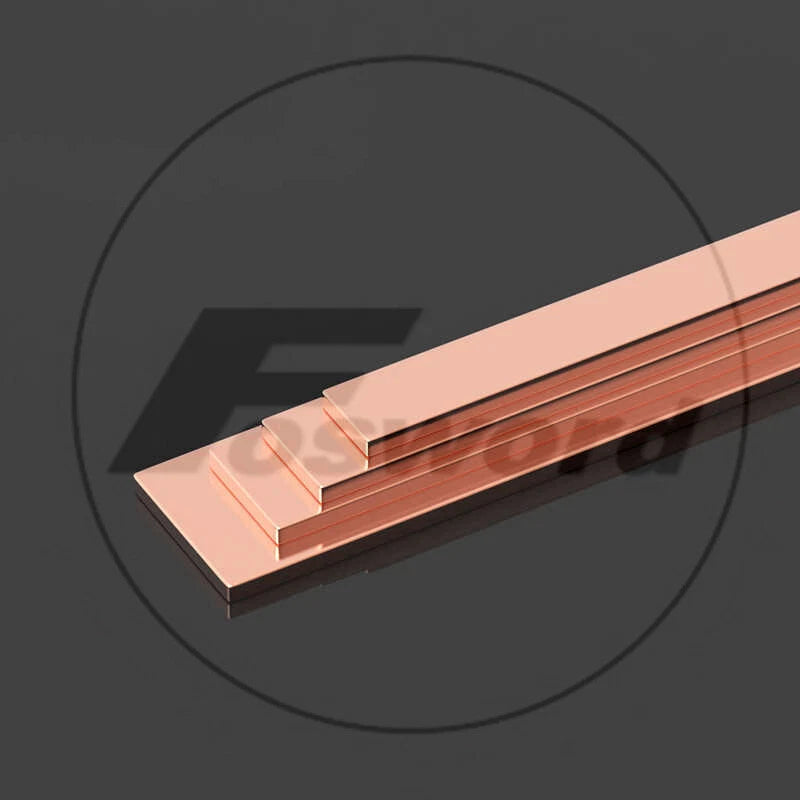
When a project demands reliable conductivity and zero compromise on material purity, sourcing the right pure copper flat bar becomes the first critical decision. Electricians, fabricators, and hobbyists working on busbars, grounding straps, heat sinks, or custom metalwork often struggle to find stock that matches both their dimensional and purity requirements in a single listing.
These copper flat bars are drawn from 99.9% pure electrolytic copper (Cu), offering a cross-section that ranges from 5 mm × 5 mm up to 60 mm × 60 mm (approximately 0.20" × 0.20" to 2.36" × 2.36"), with lengths available in 100 mm (3.94"), 200 mm (7.87"), and 300 mm (11.81"). Each piece is cut to a rectangular profile with consistent width and thickness tolerances suitable for precision applications.
Typical use cases include electrical busbar fabrication for panel boards, grounding conductors in renewable energy installations, thermal interface strips in heat-dissipation assemblies, and decorative or structural copper inlays in woodworking and metalworking projects. The flat bar profile also suits DIY coil winding, transformer shunts, and custom RF shielding strips.
Drawn from C11000-equivalent electrolytic tough pitch copper, delivering electrical conductivity of approximately 100% IACS — the benchmark for copper conductors in electrical and electronic applications.
Width × thickness combinations span from 5 mm × 5 mm to 60 mm × 60 mm, with lengths of 100 mm, 200 mm, and 300 mm. Select the exact cross-section your busbar slot, heat sink groove, or fabrication drawing specifies.
Copper's thermal conductivity of approximately 385–400 W/(m·K) makes these bars effective as heat spreaders, thermal bridges, and conductive inserts in cooling assemblies where aluminum is insufficient.
Annealed or half-hard temper allows drilling, milling, bending, and soldering without cracking. Suitable for custom shaping on a bench vise, drill press, or CNC router with standard tooling.
Bare copper develops a stable patina over time that slows further oxidation. For outdoor or high-humidity applications, tin plating or lacquer coating after fabrication is recommended to maintain surface conductivity.
Each variant is priced per individual piece (1 pcs), allowing you to order exactly the quantity your project requires without committing to bulk packs or full-length stock.
| Material | 99.9% Pure Copper (Cu), Electrolytic Grade |
|---|---|
| Alloy Equivalent | C11000 / ETP Copper (typical) |
| Width Range | 5 mm – 60 mm (0.20" – 2.36") |
| Thickness Range | 5 mm – 120 mm (0.20" – 4.72") |
| Available Lengths | 100 mm / 200 mm / 300 mm |
| Profile | Rectangular flat bar (solid cross-section) |
| Surface Finish | Bare / bright drawn (uncoated, unplated) |
| Electrical Conductivity | Approximately 100% IACS |
| Thermal Conductivity | Approximately 385–400 W/(m·K) |
| Temper | See variant options |
| Quantity per Order | 1 piece (sold individually) |
| Size Option Format | Width × Thickness (mm) |
Match the cross-sectional area (width × thickness in mm²) to your current-carrying requirement. A common rule of thumb for copper busbars is 1 mm² per 1–2 A of continuous current at moderate ambient temperatures. For example, a 10 mm × 10 mm bar (100 mm²) can typically handle 100–200 A depending on ventilation and installation conditions. Always consult your local electrical code and derate for enclosure temperature.
99.9% pure copper (electrolytic grade) offers the highest electrical and thermal conductivity of any common copper product — approximately 100% IACS. Brass (copper-zinc alloy) and bronze (copper-tin alloy) trade conductivity for hardness or corrosion resistance, typically achieving only 25–40% IACS. For electrical busbars, grounding conductors, or heat spreaders, pure copper is the correct choice.
Bare copper oxidizes in air, forming a thin copper oxide layer that slows further corrosion. In dry indoor environments this patina is stable and does not significantly affect conductivity at connection points if surfaces are properly torqued. In outdoor, marine, or high-humidity environments, apply a tin plating, lacquer, or anti-oxidant compound after fabrication to maintain long-term surface conductivity.
Yes. 99.9% electrolytic copper solders readily with standard rosin-core or acid-core solder and a suitable flux. Silver brazing is also effective for higher-strength joints. TIG welding with a copper filler rod is possible but requires pre-heating due to copper's high thermal conductivity. Avoid MIG welding without specialized equipment, as copper's conductivity dissipates heat rapidly and makes fusion difficult.
Yes, provided the lug or connector is rated for the same cross-sectional dimensions. Verify the connector's barrel bore matches the flat bar width and thickness, or use a flat-to-round adapter. Tin-plated copper lugs are preferred for long-term connections to prevent galvanic oxidation at the joint interface.
Copper cuts cleanly with a hacksaw, angle grinder with a metal-cutting disc, or a cold saw. For precision cuts, a milling machine or band saw with a bi-metal blade works well. Use cutting fluid or lubricant to prevent work-hardening and extend tool life. Deburr cut edges with a file or deburring tool before installation to avoid sharp edges and ensure flush contact surfaces.
Order the next length up from your required dimension and cut to size. For example, if you need 150 mm, order the 200 mm length and trim 50 mm. Copper cuts easily with standard metalworking tools, so ordering slightly longer stock and cutting to your exact requirement is the most practical approach.