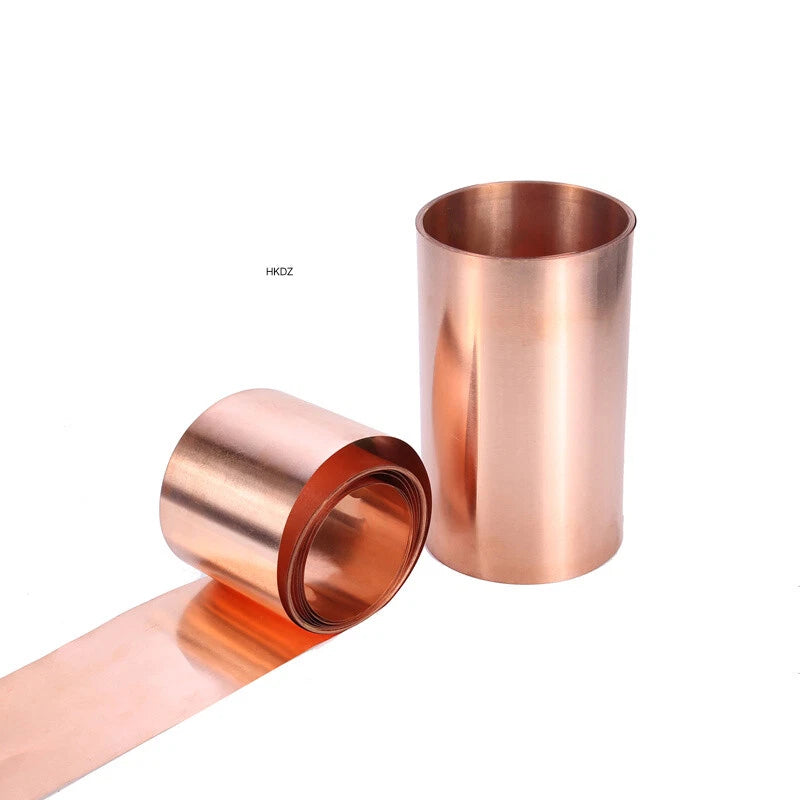
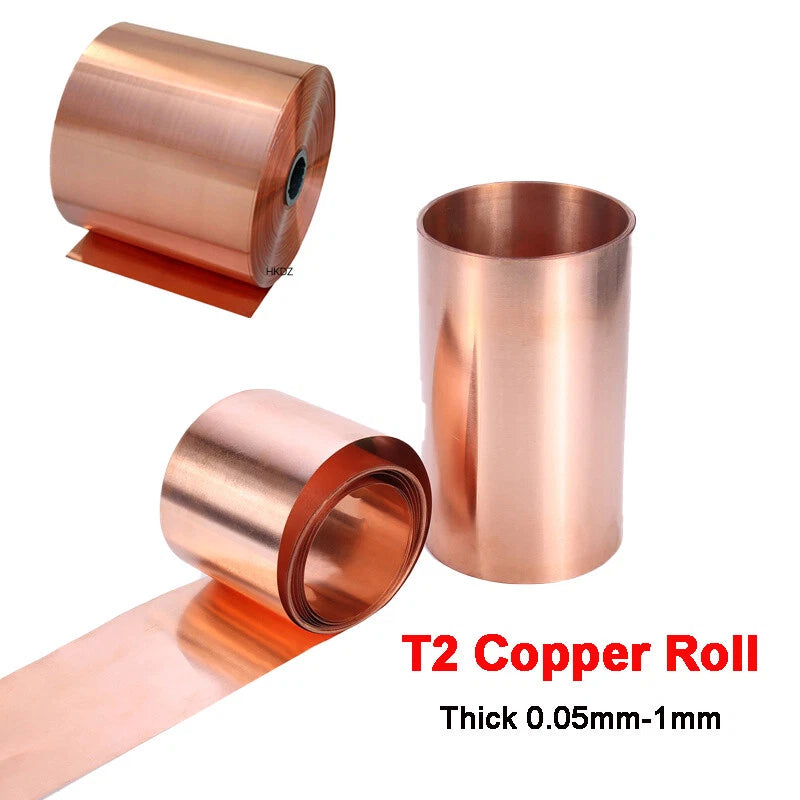
99.9% Pure T2 Copper Sheet Foil Strip — Precision-Cut for DIY, Shielding & Fabrication
When your project demands a conductor that won't let you down — whether you're building an EMI shield, crafting a decorative inlay, or fabricating a custom electrical bus bar — finding a copper strip that combines exact thickness, consistent width, and reliable purity in one listing is rarely straightforward. This T2 copper foil roll is stocked specifically for makers, hobbyists, and small-workshop fabricators who need a material they can trust without ordering industrial minimums.
Each roll is made from 99.9% pure T2 electrolytic copper, delivering excellent electrical conductivity (≥57 MS/m) and thermal conductivity. Available in thicknesses from 0.05 mm (≈0.002 in) up to 1 mm (≈0.039 in), widths from 10 mm (≈0.39 in) to 120 mm (≈4.72 in), and lengths of 1 M, 2 M, 3 M, or 5 M — giving you a precise cut rather than a full industrial coil.
Typical use cases include RF and EMI shielding tape for electronics enclosures, copper foil inlays for woodworking and resin art, thin shim stock for mechanical gap-filling, grounding straps in electrical panels, and decorative metalwork for jewelry or architectural accents. The soft-annealed temper makes it easy to cut with scissors or a craft knife and to bend without cracking.
⚡
Compatible with: Electronics shielding projects · Woodworking inlay & resin casting · Electrical grounding & bus bars · Jewelry & metalcraft · Mechanical shim applications
✅ Key Features of These T2 Copper Foil Strips
🔬
99.9% Pure T2 Electrolytic Copper
Meets T2 grade purity standards for consistent conductivity and corrosion resistance across all variants.
📏
Wide Thickness Range: 0.05 mm – 1 mm
From ultra-thin foil for shielding tape to structural 1 mm strip for bus bars — select the exact gauge your project requires.
↔️
Multiple Width Options: 10 mm – 120 mm
Narrow strips for trace repairs and wide sheets for panel shielding, all cut to consistent width tolerances.
🔄
Soft-Annealed Temper for Easy Forming
The annealed state allows bending, rolling, and cutting without cracking — ideal for hand-forming in a workshop or at a bench.
✂️
Pre-Cut Lengths: 1 M, 2 M, 3 M, 5 M
Order exactly what you need — no waste from oversized coils. Lengths are measured and cut before dispatch.
🛡️
Natural Oxidation Resistance
Copper's inherent surface chemistry slows oxidation in typical indoor environments, maintaining conductivity over time without additional coating.
📐 Technical Specifications — T2 Copper Foil Strip
| Material |
T2 Electrolytic Copper (99.9% Cu min.) |
| Temper |
Soft-annealed (O temper) |
| Thickness Range |
0.05 mm – 1 mm (0.002 in – 0.039 in) |
| Width Range |
10 mm – 120 mm (0.39 in – 4.72 in) |
| Available Lengths |
1 M / 2 M / 3 M / 5 M |
| Electrical Conductivity |
≥57 MS/m (IACS ≥98%) |
| Tensile Strength (annealed) |
Typically 200–280 MPa |
| Surface Finish |
Bright rolled, bare copper |
| Thickness Tolerance |
See variant options |
| Width Tolerance |
See variant options |
| Color |
Reddish-orange (natural copper) |
❓ Frequently Asked Questions
How do I choose the right thickness for my project?
For EMI/RF shielding tape and foil wrapping, 0.05 mm – 0.1 mm is typically sufficient. For decorative inlays and resin art, 0.1 mm – 0.3 mm offers a good balance of flexibility and visibility. For mechanical shims and structural bus bars, 0.5 mm – 1 mm provides the rigidity needed. If you're unsure, start with 0.1 mm or 0.2 mm — the most versatile range for general workshop use.
Is this copper suitable for electrical grounding and bus bar applications?
Yes. T2 grade copper at 99.9% purity delivers ≥98% IACS conductivity, making it appropriate for grounding straps, bonding jumpers, and low-voltage bus bars in hobby and light-commercial electrical work. For high-current industrial applications, consult a licensed electrician to confirm the cross-sectional area meets your load requirements.
Will the copper surface oxidize or tarnish over time?
Bare copper will develop a patina (darkening to brown, then eventually green verdigris) when exposed to air and humidity over time. In dry indoor environments this process is slow and does not significantly affect conductivity for most applications. If a bright finish is required long-term, apply a clear lacquer or store unused strips in a sealed bag with a desiccant packet.
Can I cut this copper foil with ordinary tools?
For thicknesses up to 0.3 mm, sharp scissors or a craft knife and steel ruler work well. For 0.5 mm – 1 mm strips, tin snips or a guillotine-style sheet metal cutter will give cleaner edges. Always deburr cut edges with fine sandpaper (400–600 grit) before handling to avoid cuts.
Is this the same copper used in PCB traces and electronics?
PCB copper foil is typically electrolytic copper of similar purity (99.9%+), so the material composition is comparable. However, PCB foil is bonded to a substrate and treated for adhesion. This product is bare rolled copper strip — suitable for hand-soldering, wrapping, and shielding, but not a direct replacement for laminated PCB copper without additional adhesive or bonding steps.
What width should I choose for EMI shielding a cable or enclosure seam?
For shielding individual cables, 10 mm – 20 mm width is usually sufficient to wrap around the cable with overlap. For sealing enclosure seams or panel gaps, match the width to the gap dimension plus at least 5 mm overlap on each side. Wider strips (50 mm – 120 mm) are better suited for lining the interior walls of enclosures or creating flat shielding panels.
Can I solder directly to this copper strip?
Yes. T2 copper solders readily with standard rosin-core or no-clean solder and a temperature-controlled iron (typically 300–370 °C). Lightly sand or clean the surface with isopropyl alcohol before soldering to remove any oxidation layer for a stronger joint. Avoid acid-core flux on electronics applications.
🛒 Select your Thickness, Width, and Length above, then add to cart.