The chain is fine...but I ordered the wrong size. Nine links of the chain I ordered equals six of the size I wanted. My error...
How can I straighten out the springs? I can't use them coil uo as is.
Your payment information is processed securely. We do not store credit card details nor have access to your credit card information.
Get fitment advice & recommendations
When a worn or undersized bearing causes vibration, noise, or premature failure in a precision assembly, the root cause is almost always material grade and dimensional tolerance. Engineers, machinists, and serious DIYers who need a reliable rolling element — whether for a spindle rebuild, a custom linear slide, or a valve seat — require a ball that holds its geometry under load and resists the corrosive environments that destroy carbon-steel alternatives.
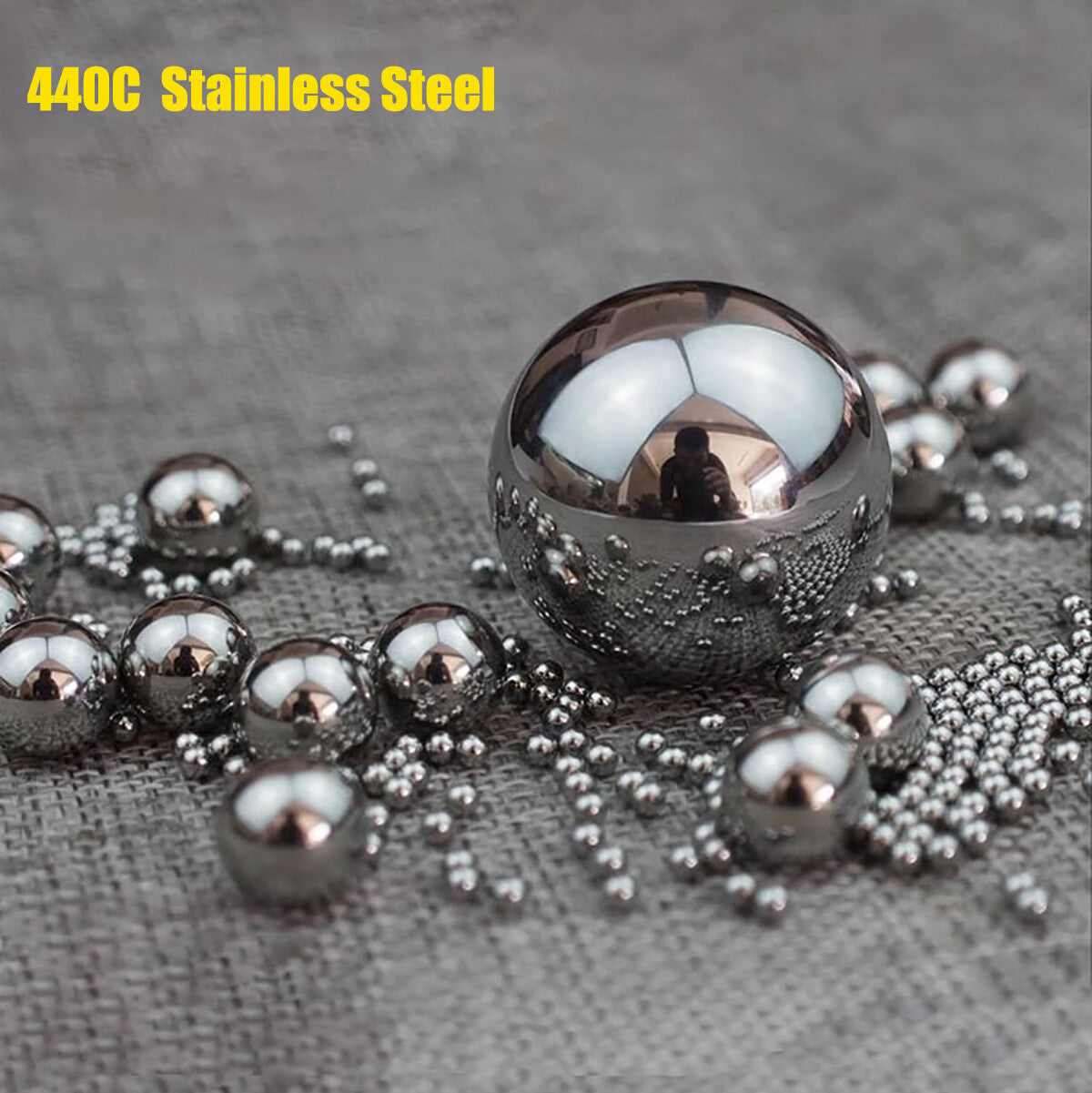
These ball bearings are manufactured from AISI 440C martensitic stainless steel and finished to G10 precision grade. Available diameters span 1.0 mm through 30 mm (approximately 0.039 in – 1.181 in), with both metric and fractional inch sizes in the range. Each ball is through-hardened for consistent surface hardness, then ground and lapped to achieve the tight sphericity and surface finish tolerances that G10 demands.
Typical use cases include replacement rolling elements in miniature instrument bearings and skateboard/inline-skate bearings, load-distributing balls in ball-screw and linear-rail assemblies, check-valve and flow-control seats in fluid-handling systems, and precision spacers or transfer balls in jig and fixture work. The corrosion resistance of 440C also makes these balls well-suited for food-processing equipment, marine hardware, and laboratory instruments where moisture or mild chemicals are present.
| Material | AISI 440C Martensitic Stainless Steel |
|---|---|
| Precision Grade | G10 (ISO 3290) |
| Diameter Range | 1.0 mm – 30 mm (0.039 in – 1.181 in) |
| Available Metric Sizes | 1.0, 1.2, 1.5, 2, 2.5, 3, 3.5, 4, 4.5, 5, 6, 7, 7.5, 8, 9, 10, 12, 13, 13.5, 14, 15, 16, 18, 19.05, 20, 21.431, 22.225, 23.019, 24, 25, 25.4, 26.988, 28, 28.575, 29, 30 mm |
| Available Fractional Inch Sizes | 1/16", 3/32", 1/8", 5/32", 3/16", 7/32", 1/4", 17/64", 9/32", 5/16", 11/32", 3/8", 13/32", 7/16", 1/2", 9/16", 15/64", 5/8", 11/16", 21/32", 3/4", 27/32", 7/8", 29/32", 13/16", 17/16", 9/8" |
| Surface Finish | Ground and lapped to G10 sphericity tolerance |
| Hardness (typical) | 58–62 HRC |
| Pack Quantities | 1, 2, 5, 10, 20, 50, 100, 200, 500 PCS (varies by diameter) |
| Application | Bearings, ball screws, check valves, linear slides, instrument assemblies |
| Corrosion Resistance | Suitable for moisture, mild acid, and salt-spray environments |
| Variant Options | See variant options |
Measure the inner diameter of the bearing raceway or housing bore with a micrometer or digital caliper. The ball diameter should match the OEM specification listed on the bearing's data sheet or stamped on the housing. If you are replacing worn balls in an existing bearing, measure a undamaged ball from the same set. For fractional-inch bearings, cross-reference the inch size to the metric equivalent shown in the variant name (e.g., 1/4" = 6.35 mm).
G10 is a precision grade defined by ISO 3290, specifying maximum allowable deviation from a perfect sphere (sphericity) and surface roughness. G10 balls have a maximum sphericity deviation of 0.25 µm and a surface roughness (Ra) of typically 0.025 µm or better. This level of precision reduces vibration, noise, and uneven load distribution in rolling-contact applications. For most repair and DIY applications, G10 exceeds the minimum requirement; for ultra-precision spindles, G5 or G3 may be specified instead.
AISI 440C and AISI 52100 chrome steel achieve similar hardness levels (58–65 HRC) and comparable compressive strength under rolling contact. The key difference is corrosion resistance: 440C contains approximately 17% chromium, giving it meaningful stainless properties, while 52100 will rust rapidly in humid or wet environments. For dry, clean, indoor applications, 52100 may offer marginally higher fatigue life; for any application involving moisture, chemicals, or food contact, 440C is the appropriate choice.
Yes. G10 precision grade is broadly compatible with ABEC-1 through ABEC-7 bearing classes of the same nominal diameter. The G10 sphericity tolerance is tighter than what ABEC-1 requires and comparable to ABEC-5/7 requirements for rolling elements. Always verify the nominal ball diameter against your bearing's specification sheet before ordering, as some manufacturers use non-standard ball diameters even in standard-sized housings.
AISI 440C stainless steel is widely used in food-processing equipment, marine hardware, and laboratory instruments due to its corrosion resistance. It performs well against atmospheric moisture, fresh water, mild acids, and salt spray. However, 440C is not fully immune to corrosion in highly aggressive environments such as concentrated chloride solutions or strong oxidizing acids. For those conditions, consider 316 stainless or ceramic balls. For typical food-grade or marine applications, 440C is a practical and cost-effective choice.
For a single bearing repair, a 1–10 PCS pack is typically sufficient — most standard bearings contain 7–12 balls per row. For a small production run or to maintain a service stock, 50–100 PCS packs offer a better per-unit cost. For high-volume manufacturing or OEM assembly, 200–500 PCS packs provide the lowest per-piece price. Select the diameter first, then choose the quantity tier that matches your consumption rate to avoid unnecessary inventory carrying costs.
Ball bearings generally perform best with a thin film of appropriate lubricant. For most rolling-element bearing applications, apply a light coat of bearing grease (NLGI Grade 2 is common) or a low-viscosity oil before assembly. In check-valve or flow-control applications, the process fluid itself often provides sufficient lubrication. Avoid over-greasing, which can increase drag and operating temperature. If the application is in a clean-room or food-grade environment, use an NSF H1-rated lubricant.