Ball Caster Ball Transfer Unit Ball Bearing Castor Conveyor Roller Wheel Various

No reviews

Price:
Sale price$3.66 USD
Stock:
In stock (500 units), ready to be shipped

Payment & Security

Ach Direct Debit Amazon American Express Apple Pay Bancontact BLIK Diners Club Discover EPS Google Pay iDEAL Wero JCB Maestro Mastercard Multibanco MobilePay PayPal Przelewy24 Shop Pay Twint Union Pay USDC Visa

Your payment information is processed securely. We do not store credit card details nor have access to your credit card information.

Quantity Discount Promotion
🎯 BULK DISCOUNT: Buy More, Save More!
Buy 2 Items
5% OFF
Buy 4 Items
10% OFF
Buy 6 Items
15% OFF
Expert

DIY Expert Support

Get fitment advice & recommendations

Mon-Fri, 8:30AM-8PM
24-Hour Fast Ship
🚚
Arrives in 3-14 days
🌍
Global Reach
↩️
30-Day Returns
🌱 1 tree planted with every purchase

Description

Ball Transfer Units Built for Smooth, Multi-Directional Load Movement

When a fixed-direction caster just won't cut it — whether you're routing parts along an assembly table, staging heavy totes on a packing bench, or building a gravity conveyor — a ball transfer unit gives you the 360° freedom of movement that keeps workflows moving. Fabricators, warehouse operators, and DIY builders alike rely on these ball casters to eliminate manual repositioning and reduce friction-related fatigue on the line.

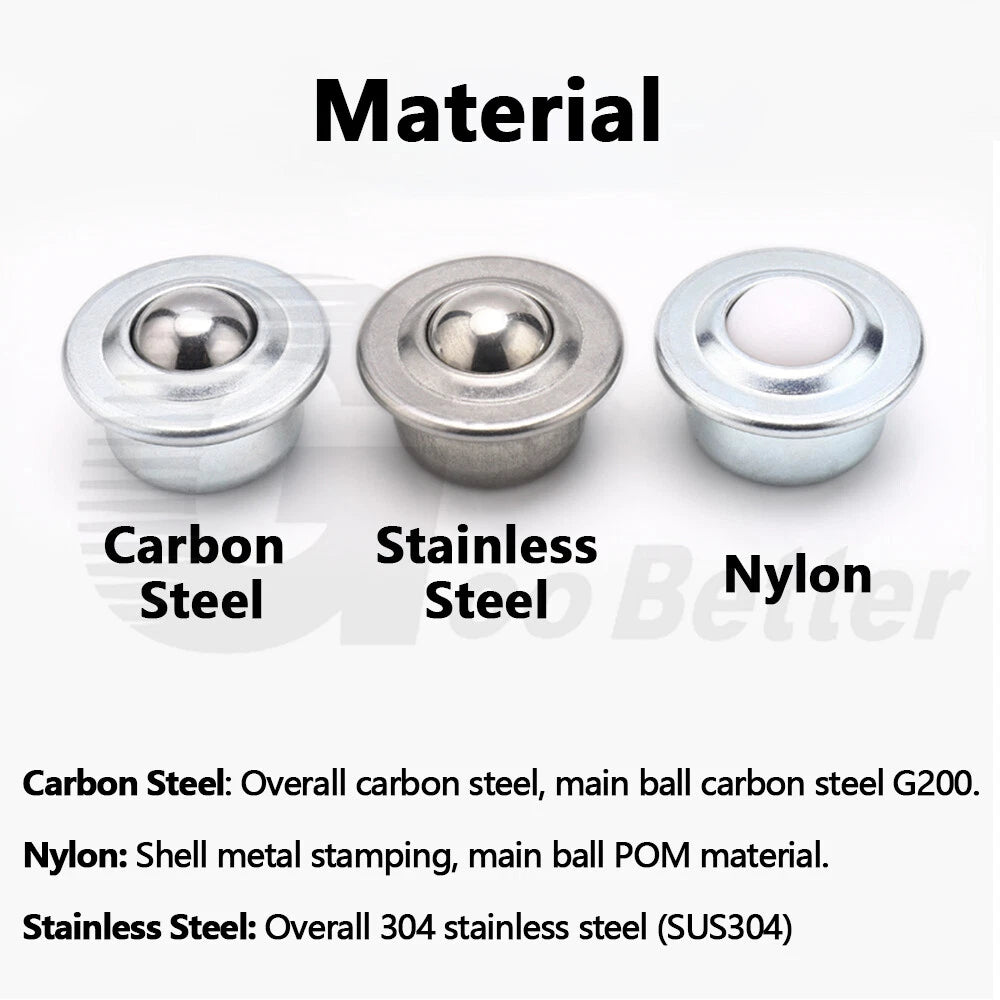
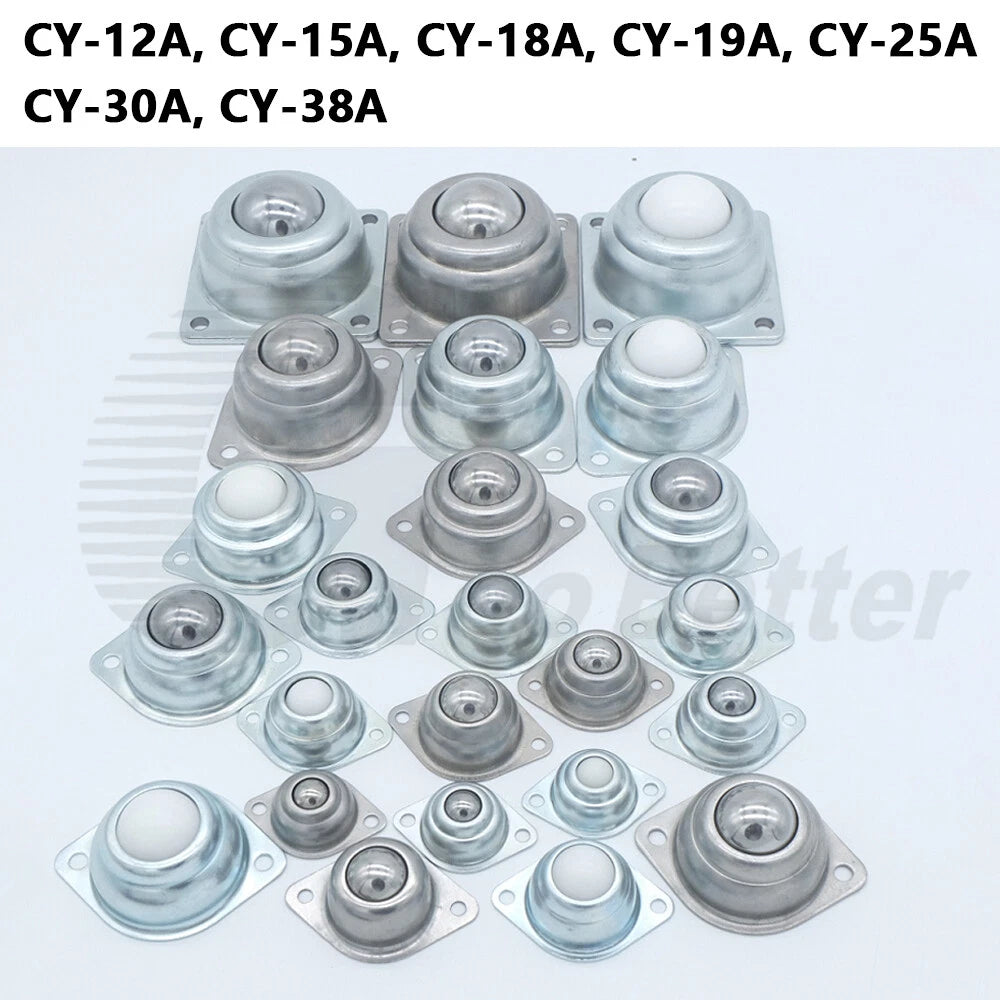
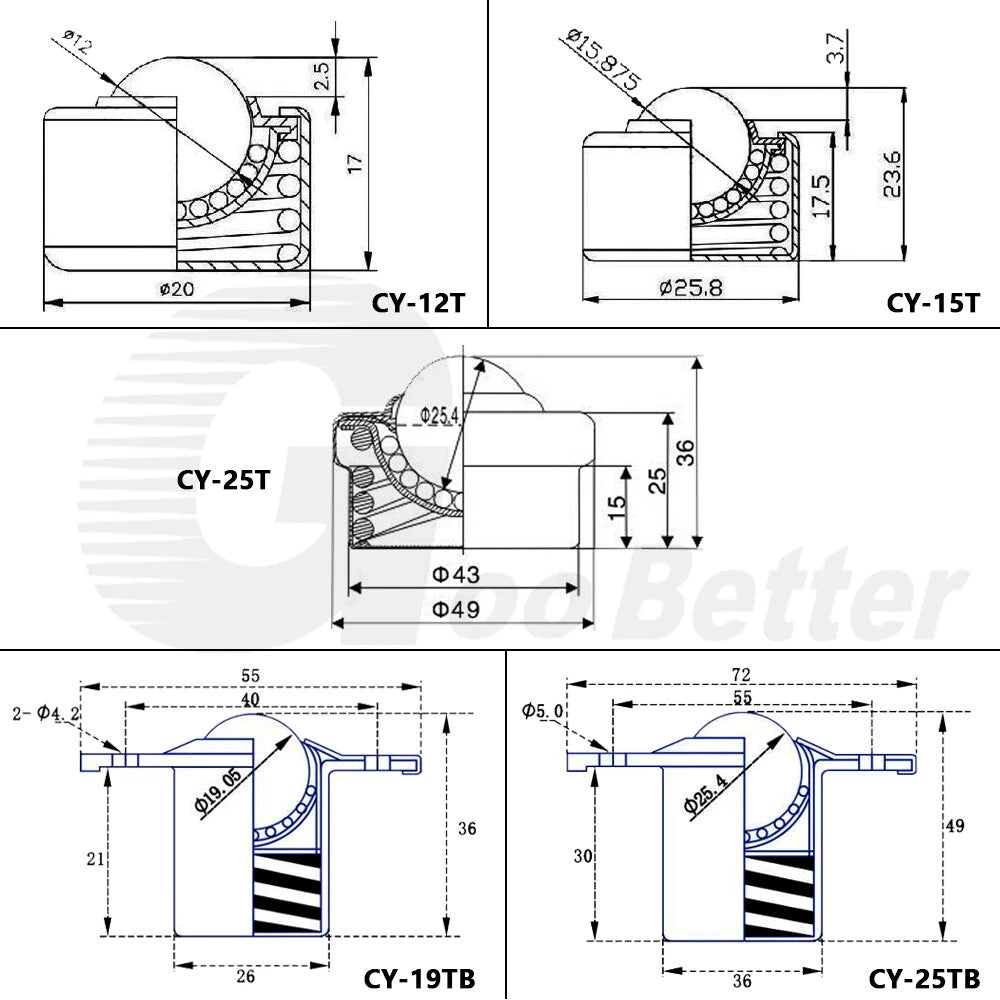
Each ball transfer unit consists of a hardened load-bearing ball seated in a precision-formed housing, supported by a ring of smaller recirculating balls beneath. Available in carbon steel, nylon, and stainless steel housings, with models ranging from CY-8H (8 mm / 0.31 in ball diameter) up to CY-40F (40 mm / 1.57 in ball diameter). Housing styles include flanged (H), angle-mount (A), bolt-down (B), dome (D), flat-top (F), and tee-base (T / TB) configurations to suit varied mounting surfaces.

Typical use cases include gravity-fed conveyor roller tables for carton sorting, ball transfer tables for sheet metal or glass panel positioning, and under-bench slide systems for tool drawers and equipment staging. Long-tail applications: ball caster for conveyor line, 360 degree swivel transfer unit, multi-directional roller bearing caster for workbench.

🔧 Compatibility: Fits standard mounting holes for flanged, threaded-stem, and bolt-down installations. Verify housing style and ball diameter against your table or frame spec before ordering.
  • ⚙️ Multi-Directional 360° Movement

    The recirculating ball design allows loads to glide in any horizontal direction with minimal effort — no pivoting, no re-alignment needed.

  • 🔩 Three Material Options

    Carbon steel for general-duty indoor use, nylon for lightweight or noise-sensitive environments, and stainless steel for corrosion-exposed or washdown applications.

  • 📐 Wide Size Range — CY-8H to CY-40F

    Ball diameters from 8 mm (0.31 in) to 40 mm (1.57 in) cover light parcel handling through heavy panel or sheet stock transfer.

  • 🏗️ Multiple Mounting Styles

    Flanged (H), angle (A), bolt-down (B), dome (D), flat-top (F), and tee-base (T/TB) housings let you match the unit to your frame or table surface without custom fabrication.

  • 🛡️ Hardened Load Ball

    The main transfer ball is hardened for wear resistance, maintaining smooth rolling performance under repeated cycling and sustained static loads.

  • 🔄 Drop-In Replacement Sizing

    Model codes follow industry-standard CY-series dimensions, making these units straightforward replacements for worn units on existing conveyor or transfer table frames.

✅ Key Features of These Ball Transfer Units

📐 Technical Specifications — Ball Transfer Units

Product Type Ball Transfer Unit (Ball Caster)
Ball Diameter Range 8 mm – 40 mm (0.31 in – 1.57 in)
Housing Materials Carbon Steel / Nylon / Stainless Steel
Mounting Styles Flanged (H), Angle (A), Bolt-Down (B), Dome (D), Flat-Top (F), Tee-Base (T/TB)
Load Capacity See variant options
Housing Finish See variant options
Thread / Stem Size See variant options
Overall Height See variant options
Quantity per Order 1 pcs (per variant)
Application Conveyor tables, assembly benches, transfer tables, material handling

❓ Frequently Asked Questions

How do I choose the right ball diameter for my application?

Match the ball diameter to your load weight and table spacing. Smaller balls (CY-8H, CY-12H) suit light parcels and small parts up to a few kilograms. Larger balls (CY-25 and above) handle heavier sheet stock, panels, or totes. As a general rule, use a closer grid spacing with smaller balls for fragile or thin workpieces to prevent tipping.

What is the difference between the H, A, B, D, F, and T/TB housing styles?

The letter suffix indicates the mounting configuration: H = flanged top-mount (bolts through a flange around the housing), A = angle-bracket mount, B = bolt-down base, D = dome-shaped low-profile housing, F = flat-top wide-flange, T = tee-base, TB = tee-base with bolt pattern. Choose based on your frame geometry and whether you need flush, recessed, or surface mounting.

Which material should I choose — carbon steel, nylon, or stainless steel?

Carbon steel is the standard choice for dry indoor environments where cost efficiency matters. Nylon housings are lighter, quieter, and resist mild moisture, making them suitable for food-adjacent or noise-sensitive areas. Stainless steel is recommended for wet, humid, or chemically exposed environments where corrosion resistance is a priority.

Can these ball transfer units support continuous conveyor use?

Yes. The recirculating ball design is engineered for repeated cycling. For continuous conveyor applications, ensure the load per unit stays within the rated capacity for your chosen model, and space units closely enough that the workpiece is always supported by at least three units simultaneously to prevent rocking.

Are these units compatible with existing CY-series transfer table frames?

These units follow standard CY-series dimensional conventions, so they are generally drop-in compatible with frames designed for CY-series ball transfer units. Always verify the housing outer diameter, flange bolt pattern, and overall height against your frame's mounting holes before ordering.

How do I maintain or clean ball transfer units in service?

For carbon steel units, periodically apply a light machine oil to the ball and housing to prevent surface oxidation and maintain smooth rolling. Nylon units can be wiped clean with a damp cloth. Stainless steel units tolerate water rinse-down; avoid abrasive cleaners that could score the ball surface. Replace any unit showing flat spots, rough rolling, or visible corrosion on the load ball.

Can I use these ball casters on inclined surfaces?

Ball transfer units are designed for horizontal or near-horizontal surfaces. On inclined surfaces, loads will tend to roll downhill under gravity, which may be intentional for gravity-fed conveyor designs. For inclined use, confirm the load capacity rating applies at the angle of use, and consider adding end stops or guides to control travel direction.

🛒 Select your Model and Material above, then add to cart.

You may also like

Recently viewed