
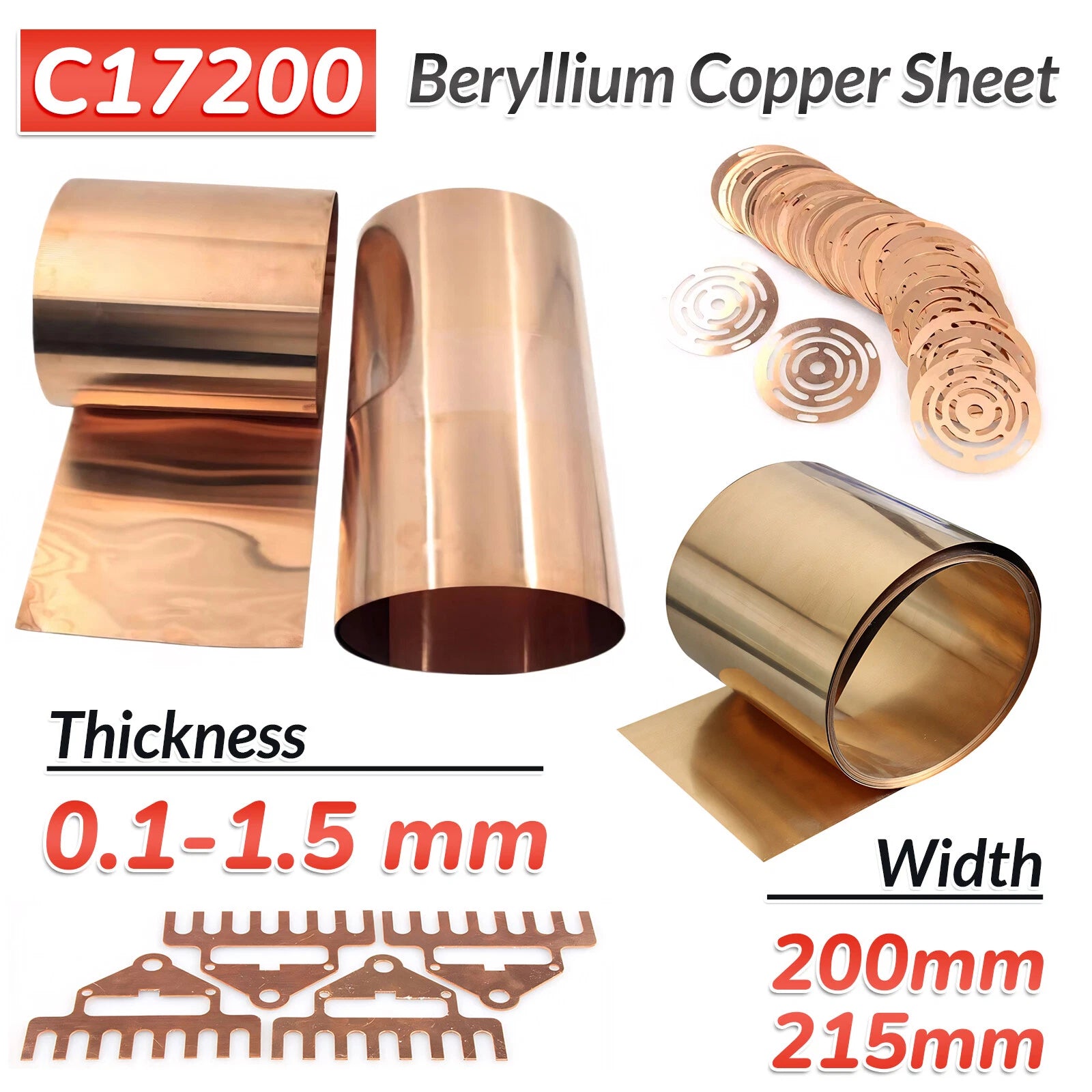
Beryllium Copper Sheet Plate Becu Panel 0.1mm To 1.5mm Thick 12 Sizes Available

No reviews

Price:
Sale price$10.57 USD
Stock:
In stock (500 units), ready to be shipped

Payment & Security

Ach Direct Debit Amazon American Express Apple Pay Bancontact BLIK Diners Club Discover EPS Google Pay iDEAL Wero JCB Maestro Mastercard Multibanco MobilePay PayPal Przelewy24 Shop Pay Twint Union Pay USDC Visa

Your payment information is processed securely. We do not store credit card details nor have access to your credit card information.

Limited Offer — Spend More, Save More
Spend $55+
Save $5
Spend $100+
Save $10
Spend $200+
Save $25
HomeDIYer DIY Expert Support

DIY Expert Support

Get fitment advice & recommendations

Mon–Fri  8:30 AM – 8:00 PM
24-Hour Fast Ship
Arrives in 3–14 Days
Worldwide Shipping
30-Day Returns
1 tree planted with every purchase

Description

Beryllium Copper Sheet — Precision BeCu Plate for Springs, Contacts & Shielding

When your project demands a metal that combines the conductivity of copper with the spring-back of steel, standard sheet stock simply falls short. Engineers, electronics hobbyists, and precision fabricators who need reliable flex-fatigue resistance and consistent dimensional tolerance will find the beryllium copper sheet an indispensable material. Whether you are prototyping a contact spring, machining a shim, or cutting an EMI shield, sourcing the right thickness in a ready-to-use panel format saves hours of secondary processing.

Each panel is cut from C17200 / CuBe2 alloy beryllium copper (BeCu), delivering a copper-beryllium composition that balances electrical conductivity (~22% IACS) with tensile strength typically in the 1,100–1,400 MPa range in the aged condition. Panels are available in two footprints — 200 mm × 200 mm (approx. 7.87" × 7.87") and 215 mm × 200 mm (approx. 8.46" × 7.87") — across 12 thickness options spanning 0.1 mm to 1.5 mm (0.004" to 0.059").

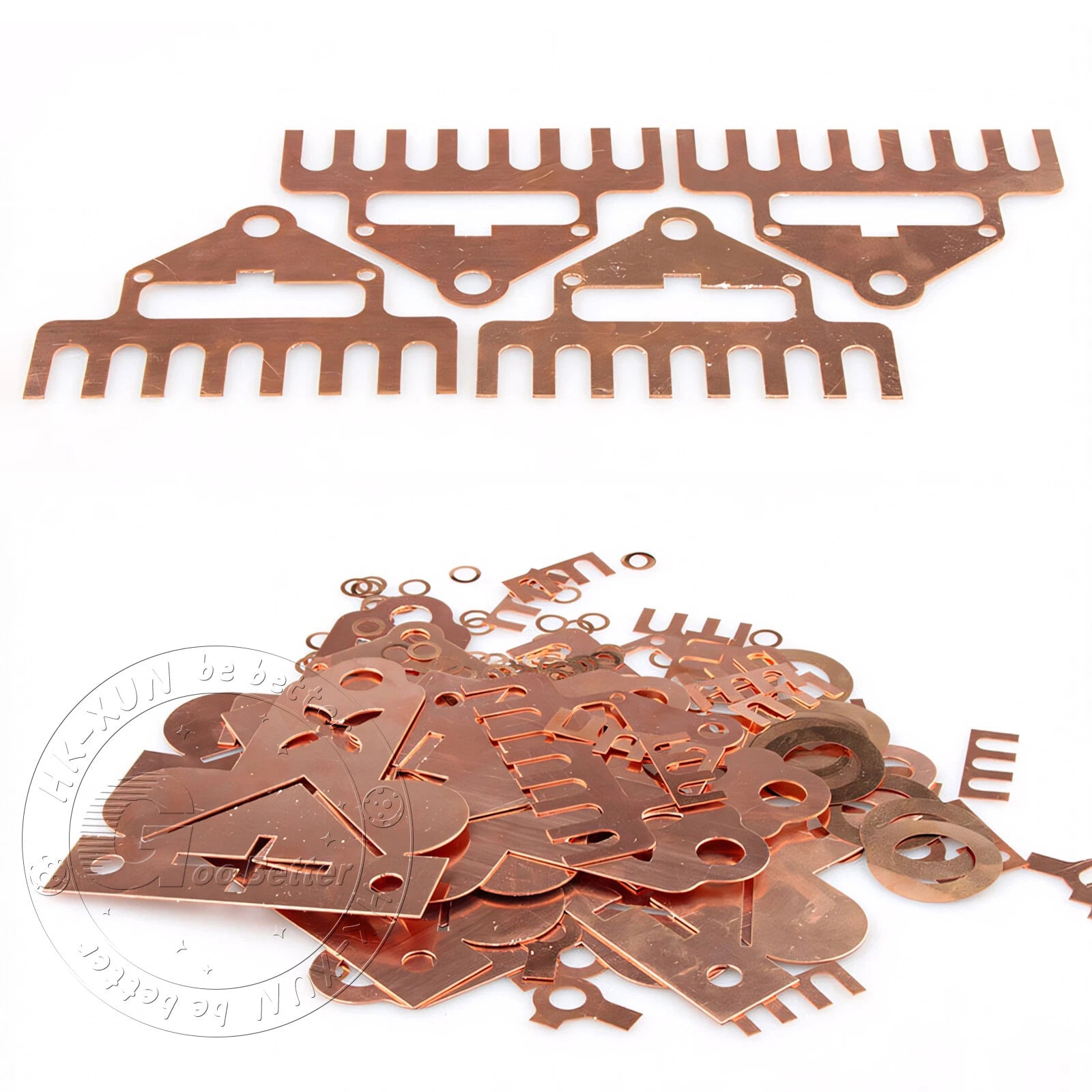
Typical use cases include: cutting custom leaf springs and snap-action contacts for electronic assemblies; fabricating thin shim stock for precision mechanical clearance adjustment; and forming EMI/RFI shielding enclosures where both conductivity and structural rigidity are required. Long-tail applications such as "thin beryllium copper spring stock", "BeCu shim sheet for electronics", and "precision copper alloy plate for DIY projects" are all well served by this versatile panel format.

🔧 Compatible with: CNC laser cutting, waterjet, shearing, stamping, EDM wire cutting, and hand-tool fabrication. Suitable for use in electronics, aerospace prototyping, mechanical engineering, and precision DIY builds.

✅ Key Features of These Beryllium Copper Sheet Panels

High Electrical Conductivity

BeCu alloy delivers approximately 22% IACS conductivity — far superior to spring steel — making it the go-to choice for electrical contacts, connector springs, and signal-carrying flex members.

🔩 Exceptional Spring-Back & Fatigue Life

The beryllium-copper matrix provides outstanding elastic memory and resistance to stress relaxation, enabling reliable repeated deflection in snap-action contacts and leaf springs without permanent set.

📐 12 Thickness Options in One Listing

Choose from 0.1 mm, 0.15 mm, 0.2 mm, 0.25 mm, 0.3 mm, 0.4 mm, 0.5 mm, 0.6 mm, 0.8 mm, 1.0 mm, 1.2 mm, and 1.5 mm — covering ultra-thin shim work through structural panel applications, all from a single product page.

🛡️ Corrosion & Oxidation Resistance

The copper-rich alloy forms a stable oxide layer that resists atmospheric corrosion, salt spray, and mild chemical exposure, extending service life in demanding environments without surface treatment.

✂️ Ready-to-Use Panel Format

Panels arrive flat and clean-cut, ready for immediate layout, scribing, and cutting. The consistent surface finish reduces prep time and supports accurate marking for CNC or hand-tool operations.

🔬 Precision Dimensional Tolerance

Thickness tolerance is held to tight commercial sheet tolerances, ensuring predictable fit in precision assemblies, shim stacks, and layered contact designs where dimensional consistency is critical.

📐 Technical Specifications — Beryllium Copper Sheet

Alloy / Grade C17200 / CuBe2 (BeCu)
Beryllium Content Approx. 1.8–2.0%
Copper Content Balance (~98%)
Thickness Range 0.1 mm – 1.5 mm (0.004" – 0.059")
Available Thicknesses 0.1, 0.15, 0.2, 0.25, 0.3, 0.4, 0.5, 0.6, 0.8, 1.0, 1.2, 1.5 mm
Panel Size Options 200 × 200 mm (7.87" × 7.87") / 215 × 200 mm (8.46" × 7.87")
Tensile Strength (aged) Typically 1,100–1,400 MPa
Electrical Conductivity Approx. 22% IACS
Hardness (aged) Typically 36–42 HRC
Surface Finish Mill finish, clean-cut edges
Quantity per Order See variant options
Weight per Panel See variant options

❓ Frequently Asked Questions

How do I choose the right thickness for my project?

For ultra-thin shims and flexible contact springs, 0.1–0.3 mm is the typical range. Mid-range thicknesses (0.4–0.8 mm) suit snap-action contacts, small leaf springs, and EMI shielding panels. Thicker options (1.0–1.5 mm) are better for structural brackets, heavier spring elements, or applications requiring rigidity alongside conductivity. If you are unsure, contact us with your deflection load and gap requirements and we can advise.

Is beryllium copper stronger than regular copper or brass?

Yes — significantly. In the age-hardened condition, C17200 BeCu reaches tensile strengths of 1,100–1,400 MPa, compared to roughly 200–400 MPa for standard copper alloys and 300–600 MPa for common brass grades. This makes it one of the strongest copper-based alloys available, while still retaining useful electrical and thermal conductivity.

Will this sheet corrode or tarnish over time?

Beryllium copper has good atmospheric corrosion resistance. It forms a stable, adherent oxide layer that slows further oxidation. It performs well in indoor electronics environments, moderate humidity, and mild chemical exposure. For aggressive salt-spray or acidic environments, a protective plating (nickel, gold, or tin) is recommended, which BeCu accepts readily due to its stable surface.

Can I cut or machine this sheet with standard tools?

Thinner gauges (0.1–0.5 mm) can be cut with sharp metal shears, a craft knife and straightedge, or a laser cutter. Thicker panels (0.6–1.5 mm) are best processed with a bandsaw, waterjet, CNC router with carbide tooling, or EDM wire cutting. Standard HSS drill bits work for drilling; carbide is preferred for longer runs. Always wear appropriate PPE when machining BeCu — fine beryllium dust requires respiratory protection.

Is this compatible with soldering and welding?

BeCu solders well with standard tin-lead or lead-free solders using a mild flux — a common requirement for electrical contact assembly. Resistance spot welding and laser welding are also viable. Fusion welding (MIG/TIG) is possible but requires specialist filler and ventilation controls due to the beryllium content. For most DIY electronics and contact assembly work, soldering is the recommended joining method.

What is the difference between the two panel sizes?

The 200 × 200 mm (7.87" × 7.87") square panel is available across all thicknesses from 0.1 mm to 0.8 mm. The 215 × 200 mm (8.46" × 7.87") panel is offered for the thicker gauges — 1.0 mm, 1.2 mm, and 1.5 mm — reflecting the slightly larger blank size used in production for those gauges. Both sizes are suitable for most prototyping and small-batch fabrication needs.

How should I store unused BeCu sheet to prevent surface degradation?

Store panels flat in a dry, low-humidity environment away from direct sunlight and corrosive fumes. Interleave with acid-free tissue or polyethylene film if stacking multiple sheets to prevent surface contact marks. Avoid storing near ammonia-based cleaners or solvents, which can attack the copper surface. For long-term storage, a sealed plastic bag with a silica gel desiccant packet is effective.

🛒 Select your Thickness and Width × Length above, then add to cart.


You may also like

Recently viewed





