The chain is fine...but I ordered the wrong size. Nine links of the chain I ordered equals six of the size I wanted. My error...
How can I straighten out the springs? I can't use them coil uo as is.
Your payment information is processed securely. We do not store credit card details nor have access to your credit card information.
Get fitment advice & recommendations
When a seized bearing brings a build to a halt — whether it's a drone arm, a CNC spindle, or a 3D printer carriage — the root cause is almost always the wrong material or an inadequate shield. Engineers, hobbyists, and maintenance technicians who work in moisture-prone or high-speed environments need a bearing that resists corrosion without sacrificing dimensional accuracy.
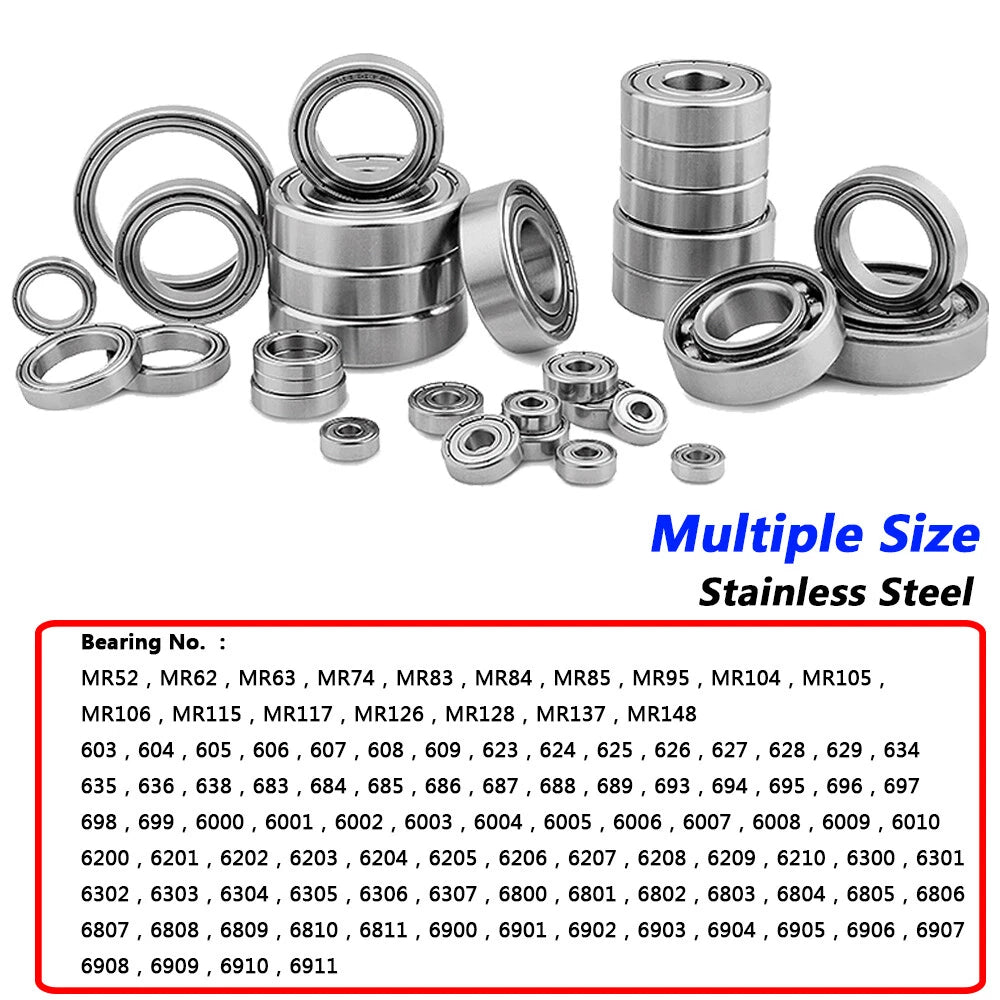
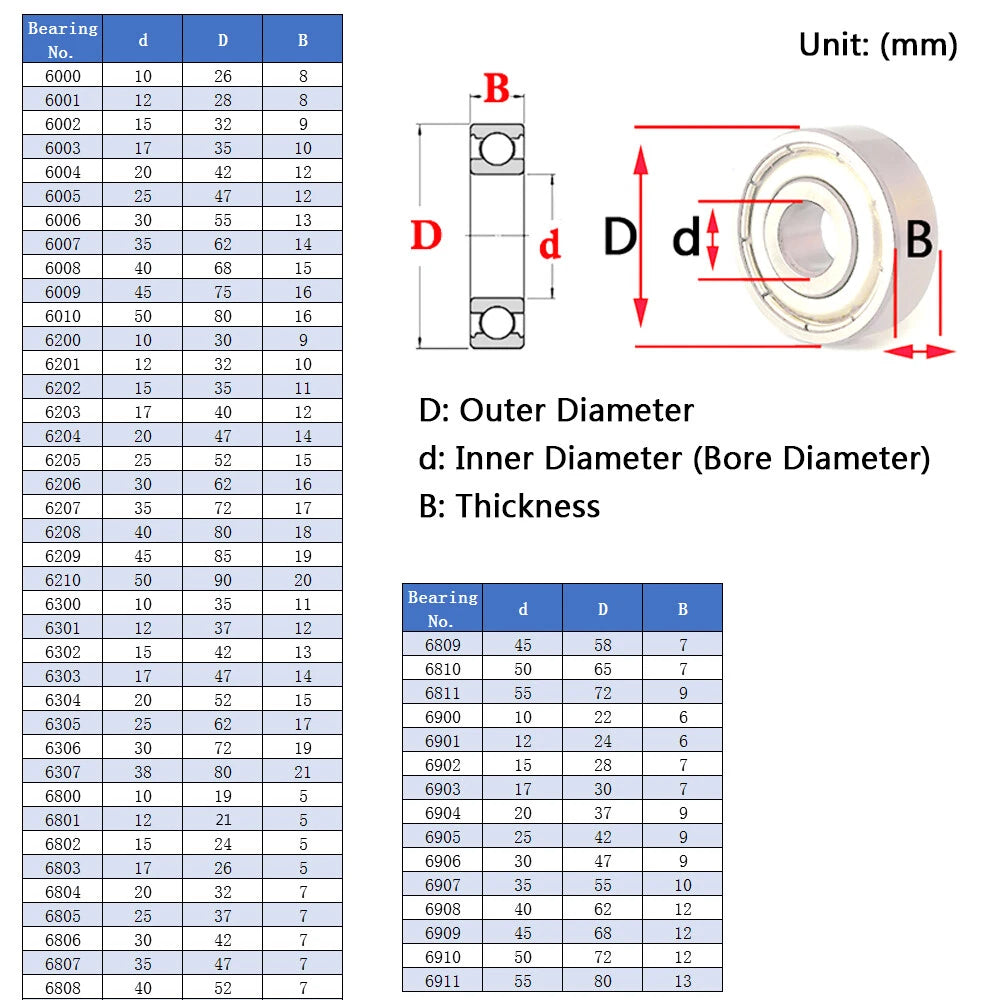
These stainless steel deep groove ball bearings are manufactured to standard metric dimensions, covering bore diameters from 2 mm (approx. 0.079 in) up to 50 mm (approx. 1.969 in), with outer diameters ranging from 5 mm to 90 mm and widths from 2.5 mm to 21 mm. Each bearing features a double-shielded (ZZ) construction that retains grease and blocks particulate ingress, making them suitable for sealed or semi-sealed assemblies.
Typical use cases include RC car wheel hubs and steering pivots, brushless motor front and rear shafts, linear rail end supports, small pump impeller shafts, and precision instrument pivots — anywhere a compact, corrosion-resistant rolling element is required. The MR and 6xx series numbers follow ISO/JIS naming conventions, simplifying cross-referencing with OEM specifications.
| Bearing Type | Deep Groove Ball Bearing |
|---|---|
| Shield Configuration | Double-Shielded (ZZ) |
| Material | Stainless Steel (races and rolling elements) |
| Bore Diameter (I.D.) Range | 2 mm – 50 mm (approx. 0.079 in – 1.969 in) |
| Outer Diameter (O.D.) Range | 5 mm – 90 mm (approx. 0.197 in – 3.543 in) |
| Width Range | 2.5 mm – 21 mm (approx. 0.098 in – 0.827 in) |
| Bearing Series | MR Series, 6xx, 6x0x, 6x0x, 6xx Series (ISO/JIS) |
| Load Direction | Radial + moderate axial (both directions) |
| Lubrication | Factory-greased (sealed by shields) |
| Operating Temperature | See variant options |
| Quantity Options | 1 Pcs / 10 Pcs |
| Dimensional Standard | ISO / JIS metric |
Match the bearing's I.D. to your shaft diameter, the O.D. to your housing bore, and the width to the available axial space. Use the "Size(I.D x O.D x Thickness)" variant selector to find the exact dimensions. If you know the bearing number from an OEM drawing, select it directly from the "Bearing No." dropdown — all designations follow ISO/JIS conventions.
MR-series bearings (e.g., MR52, MR62, MR104) are ultra-miniature bearings with bore diameters typically from 2 mm to 8 mm, designed for RC vehicles, micro-motors, and precision instruments. The 6xx and 6x0x series (e.g., 6200, 6305, 6804) follow standard ISO numbering and cover a broader size range used in general mechanical and light industrial applications. Both series in this listing use the same stainless steel, double-shielded construction.
Yes. The stainless steel races and balls resist rust and surface oxidation in humid, splash-wet, or lightly corrosive conditions — environments where standard carbon steel bearings would corrode quickly. The double metal shields also help retain grease and block water ingress. For full submersion or aggressive chemical exposure, additional sealing at the housing level is recommended.
Deep groove ball bearings are primarily designed for radial loads but can accommodate moderate axial loads in both directions simultaneously. They are not intended for heavy, sustained axial-only loading — for that, a dedicated thrust bearing would be more appropriate. For combined radial and light axial loads (typical in motors, fans, and wheels), these bearings perform well.
Yes, each bearing is factory-greased before the shields are fitted. The double-shield design is intended to retain this grease for the service life of the bearing under normal operating conditions. Because the metal shields are not easily removable without risk of damage, re-lubrication is generally not practical — replacement is the standard approach when the bearing reaches end of life.
Measure the bore (I.D.), outer diameter (O.D.), and width (thickness) of the old bearing using calipers. Then match those three dimensions to the "Size(I.D x O.D x Thickness)" column in the variant selector. Alternatively, if a part number is stamped on the bearing shield, look it up in the "Bearing No." dropdown — standard ISO/JIS numbers are used throughout this listing.
The 10 Pcs option offers a lower per-unit cost and is practical for production builds, prototyping batches, or stocking workshop spares. If you are replacing a single failed bearing or testing a size before committing to a larger quantity, the 1 Pcs option lets you verify fit and performance first. Both quantity options are available for every bearing number in this listing.