
The chain is fine...but I ordered the wrong size. Nine links of the chain I ordered equals six of the size I wanted. My error...
How can I straighten out the springs? I can't use them coil uo as is.
Your payment information is processed securely. We do not store credit card details nor have access to your credit card information.
Get fitment advice & recommendations
When your project demands a reliable, workable metal strip that cuts cleanly, bends without cracking, and solders with ease, finding the right thickness and width in one place can be a real challenge. Whether you are a hobbyist building custom enclosures, a maker crafting decorative inlays, or a technician fabricating EMI shielding gaskets, this brass copper flat strip sheet is designed to meet your exact dimensional needs without compromise.
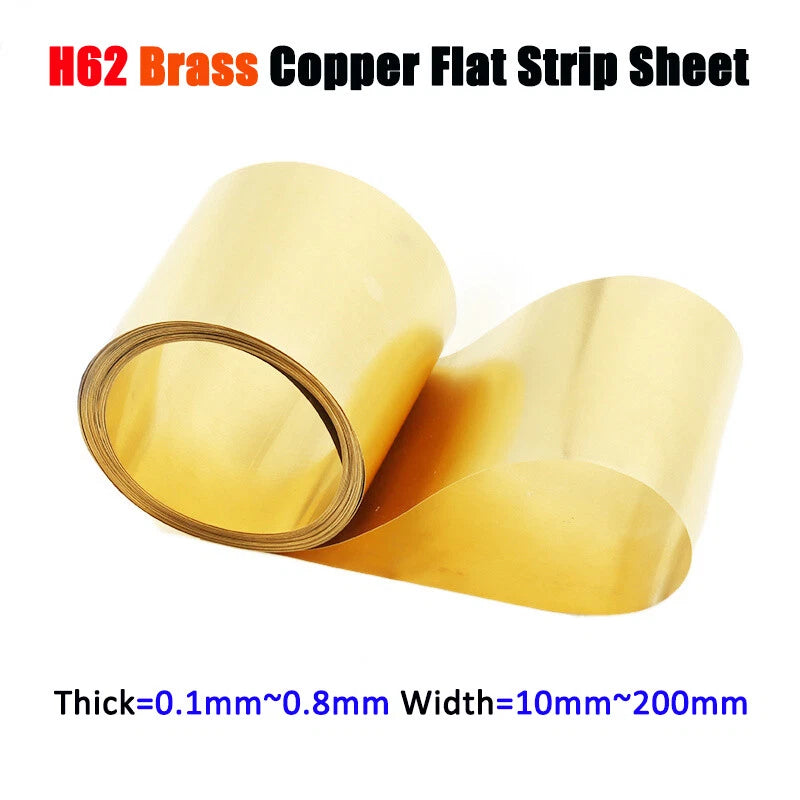
Each strip is made from C26000 cartridge brass / copper alloy, combining the warm golden tone of brass with the excellent electrical conductivity of copper. Thickness ranges from 0.1 mm to 0.8 mm (approximately 0.004 in to 0.031 in), and width options span 10 mm to 300 mm (approximately 0.39 in to 11.81 in). Strips are sold by the meter (1 m or 0.5 m), giving you precise control over material quantity and cost.
Typical use cases include DIY copper foil tape for stained glass and jewelry making, thin brass shim stock for mechanical gap-filling and alignment, flat copper strip for bus bar fabrication in electronics, and decorative brass inlay strips for woodworking and furniture restoration. Long-tail applications such as "thin copper strip for EMI shielding" and "brass foil sheet for craft projects" are well served by the wide size matrix available.
| Material | Brass / Copper Alloy (C26000 cartridge brass or equivalent) |
|---|---|
| Thickness Range | 0.1 mm – 0.8 mm (0.004 in – 0.031 in) |
| Width Range | 10 mm – 300 mm (0.39 in – 11.81 in) |
| Available Lengths | 0.5 Meter / 1 Meter |
| Temper | Soft-annealed (H00 / O temper, typical) |
| Surface Finish | Mill finish (natural metallic) |
| Electrical Conductivity | See variant options |
| Tensile Strength | See variant options |
| Corrosion Resistance | Good — suitable for indoor and light-outdoor use |
| Solderability | Excellent with standard tin-lead or lead-free solder |
| Weight per Meter | See variant options (varies by thickness × width) |
For decorative inlay, jewelry, and craft foil work, 0.1 mm – 0.2 mm is typically sufficient and easy to cut with scissors. For structural shims, gaskets, and bus bar applications where rigidity matters, 0.3 mm – 0.8 mm provides better mechanical strength. If you are unsure, start with 0.3 mm as a versatile mid-range option.
Yes. Brass copper alloy in the 0.3 mm – 0.8 mm thickness range offers adequate tensile strength for shim stock applications such as bearing alignment, machinery gap-filling, and precision spacers. Thinner gauges (0.1 mm – 0.2 mm) are better suited to light-duty or decorative roles.
Brass and copper alloys do not rust (iron-based corrosion). They may develop a natural patina (oxidation layer) over time when exposed to air and moisture, which can be desirable for decorative applications. For applications requiring a bright finish, apply a clear lacquer or metal sealant after installation. The alloy is well-suited for indoor environments and light-outdoor use.
Yes. Brass and copper alloys have excellent solderability. Standard tin-lead (60/40) and lead-free (SAC305) solder alloys bond well with a light flux application. For brazing, use a silver-bearing brazing alloy with appropriate flux. Clean the surface with isopropyl alcohol or fine abrasive before soldering for best results.
Thin gauges (0.1 mm – 0.3 mm) can be cut cleanly with sharp scissors or craft knives. Thicker gauges (0.4 mm – 0.8 mm) are best handled with aviation tin snips, bench shears, or a metal-cutting blade on a rotary tool. For bending, a metal brake or a straight-edge and mallet works well. Always deburr cut edges with a fine file or sandpaper for safety.
Yes. Copper-rich brass alloy provides good electromagnetic shielding attenuation. For DIY RF enclosures, Faraday cages, or PCB shielding cans, a 0.2 mm – 0.5 mm strip offers a practical balance of shielding effectiveness and ease of forming. Ensure all seams are soldered or clamped tightly for optimal shielding continuity.
Choose 0.5 m if you need a small quantity for a single project or want to test a size before committing to more material. The 1 m option offers better value per unit length for larger projects or when you anticipate needing multiple pieces. Both lengths are cut from the same continuous roll and carry identical material specifications.





