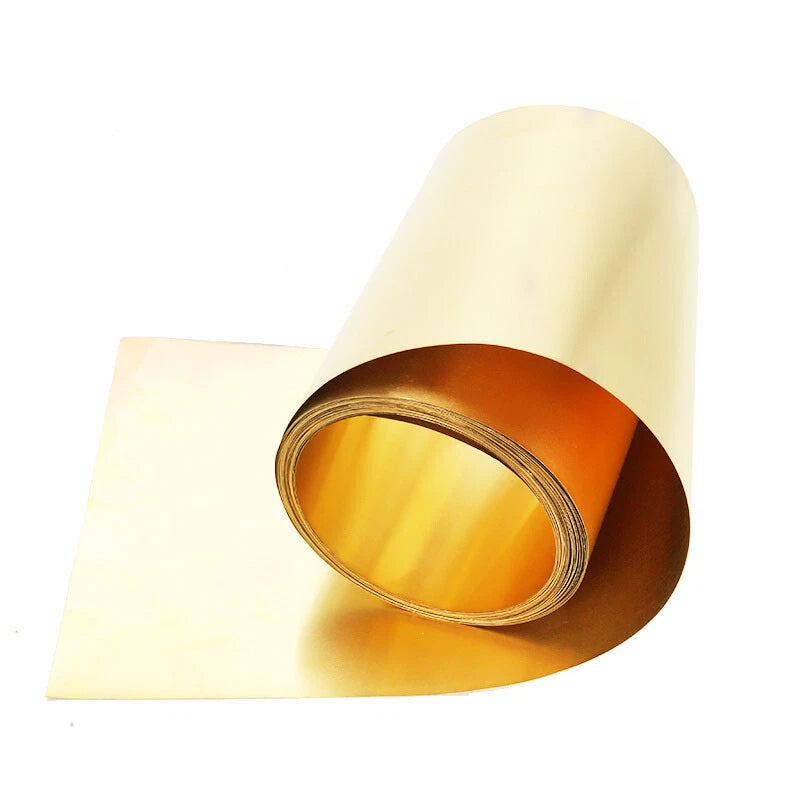
Brass Sheet Foil Roll — Precision Thin Metal Strip for DIY Metalwork & Fabrication
When your project demands a metal shim, gasket, heat shield, or decorative inlay that fits exactly right, standard off-the-shelf stock rarely cuts it. Whether you are a hobbyist machinist, a model builder, a jeweler, or a hands-on homeowner tackling a repair, finding a brass sheet foil roll in the exact thickness and width you need can be frustrating. This listing solves that problem with a wide matrix of precision-rolled brass foil options sized for real-world DIY and light fabrication work.
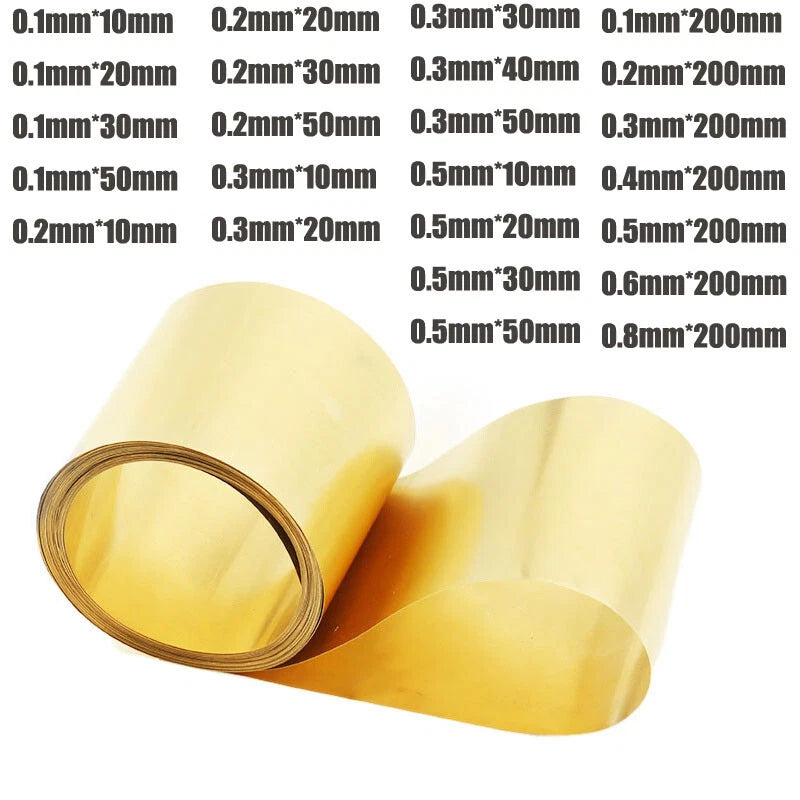
Each brass sheet foil roll is made from C26000 cartridge brass alloy — a copper-zinc composition (approximately 70% copper, 30% zinc) known for its excellent formability, corrosion resistance, and bright golden appearance. Thickness options range from 0.1 mm to 0.8 mm (approximately 0.004 in to 0.031 in), and width options span 10 mm to 200 mm (approximately 0.39 in to 7.87 in). Each piece is supplied as a 1 m (approximately 39.4 in) length, available in quantities of 1, 3, or 5 pieces per order.
Typical use cases include precision shimming between mechanical components to eliminate play or adjust clearance, cutting custom gaskets for plumbing or automotive repairs, crafting decorative inlays and trim for woodworking projects, and fabricating small electrical contacts or heat-conducting strips in electronics DIY. Long-tail applications such as thin brass shim stock for lathe work, brass foil for etching and engraving, and narrow brass strip for jewelry making are all well served by the size range available here.
🔧
Compatibility: Suitable for general metalworking, model engineering, jewelry fabrication, electronics DIY, and light structural shimming. Compatible with standard metal snips, jeweler's shears, rotary cutters, and laser cutters. Can be soldered, brazed, or bonded with metal-rated adhesives.
✅ Key Features of These Brass Sheet Foil Rolls
📐
Wide Size Matrix — Thickness from 0.1 mm to 0.8 mm and width from 10 mm to 200 mm give you precise control over material cross-section, eliminating the need to grind or file down thicker stock.
🟡
C26000 Cartridge Brass Alloy — The 70/30 copper-zinc ratio delivers a balance of strength, ductility, and corrosion resistance that makes this foil easy to cut, bend, and form without cracking.
📏
1 m Ready-to-Use Length — Each roll provides approximately 39.4 inches of usable material. Order 1, 3, or 5 pieces to match your project scope and reduce per-unit cost on larger jobs.
✂️
Easy to Cut and Form — Brass foil at these gauges cuts cleanly with metal snips or a sharp utility knife and bends without springback issues common in harder alloys, making it ideal for tight-tolerance shim work.
🛡️
Corrosion-Resistant Surface — The natural oxide layer on brass provides meaningful resistance to moisture and mild chemicals, making these strips suitable for both indoor and sheltered outdoor applications.
⚡
Electrically Conductive — Brass offers good electrical conductivity, making these foil strips useful for grounding straps, RF shielding patches, and low-current contact fabrication in electronics projects.
📐 Technical Specifications — Brass Sheet Foil Roll
| Material |
C26000 Cartridge Brass (70% Cu / 30% Zn) |
| Thickness Range |
0.1 mm – 0.8 mm (0.004 in – 0.031 in) |
| Width Range |
10 mm – 200 mm (0.39 in – 7.87 in) |
| Length per Piece |
1 m (approx. 39.4 in) |
| Available Quantities |
1 Pcs / 3 Pcs / 5 Pcs |
| Surface Finish |
Mill finish, bright rolled |
| Temper |
See variant options |
| Tensile Strength |
See variant options |
| Hardness |
See variant options |
| Weight per Piece |
See variant options |
| Color |
Golden yellow (natural brass) |
| Machinability |
Good — suitable for cutting, bending, soldering, and brazing |
❓ Frequently Asked Questions
How do I choose the right thickness for my project?
For shimming applications where you need to fill a small gap or adjust clearance between parts, start with the thinnest option (0.1 mm) and stack pieces if needed. For gaskets that must withstand moderate compression, 0.2–0.3 mm is a common choice. For structural brackets, heat shields, or parts that will be bent and hold their shape, 0.5–0.8 mm provides better rigidity. If you are unsure, order a 1-piece sample of two or three thicknesses to test before committing to a larger quantity.
How strong is this brass foil — will it tear or crack when bent?
C26000 cartridge brass is one of the most formable brass alloys available. At the thinner gauges (0.1–0.3 mm) the foil bends easily around tight radii without cracking. At thicker gauges (0.5–0.8 mm) you may need to anneal the material with a torch if you are making sharp bends, but for gentle curves and flat shim applications no annealing is required. Avoid repeated back-and-forth bending at the same point, as work hardening will eventually cause fatigue cracking in any metal foil.
Is this brass foil corrosion-resistant enough for outdoor or wet environments?
Brass naturally forms a protective oxide patina that resists moisture and mild atmospheric corrosion. It performs well in sheltered outdoor settings and in contact with fresh water. However, brass is not recommended for prolonged immersion in salt water or exposure to ammonia-based chemicals, which can cause stress corrosion cracking. For marine or highly corrosive environments, consider a stainless steel or copper alternative instead.
What tools do I need to cut this brass foil to size?
For widths up to about 50 mm and thicknesses up to 0.3 mm, a sharp utility knife and a metal straightedge on a cutting mat work well. For wider strips or thicker gauges, aviation-style metal snips or jeweler's shears give cleaner edges. A rotary cutter with a metal-rated blade is excellent for long straight cuts. Laser cutters handle brass foil cleanly at all thicknesses in this range. Always deburr cut edges with a fine file or sandpaper before handling.
Is this foil compatible with soldering and brazing?
Yes. C26000 brass solders readily with standard rosin-core or acid-core solder and a suitable flux. For stronger joints, silver brazing with a torch and silver brazing alloy works very well. Clean the surface with fine abrasive or flux before soldering to remove any oxide layer. Avoid lead-free solders with very high tin content if you need the joint to remain flexible, as they can be brittle on thin brass foil.
How do I decide between ordering 1, 3, or 5 pieces?
If you are prototyping or testing a fit, a single 1 m piece is usually sufficient. For a defined project where you know you will need multiple cuts — such as shimming several bearing housings or making a set of gaskets — ordering 3 pieces reduces the per-unit cost and ensures you have material for mistakes. The 5-piece option offers the best per-unit value and is ideal for workshop stock, repeat repairs, or sharing with a project partner. Check the price per piece across the three quantity options before adding to cart.
Can I use this brass foil for electrical or electronics applications?
Yes. Brass has an electrical conductivity of approximately 28% IACS (International Annealed Copper Standard), which is sufficient for grounding straps, RF shielding patches, low-current contact springs, and bus bar fabrication in hobby electronics. For high-current applications, pure copper foil would be a better choice due to its higher conductivity. Ensure good mechanical contact or solder the joint to minimize contact resistance.
🛒 Select your Size (Thick×Width), Length, and Quantity above, then add to cart.