
The chain is fine...but I ordered the wrong size. Nine links of the chain I ordered equals six of the size I wanted. My error...
How can I straighten out the springs? I can't use them coil uo as is.
Your payment information is processed securely. We do not store credit card details nor have access to your credit card information.
Get fitment advice & recommendations
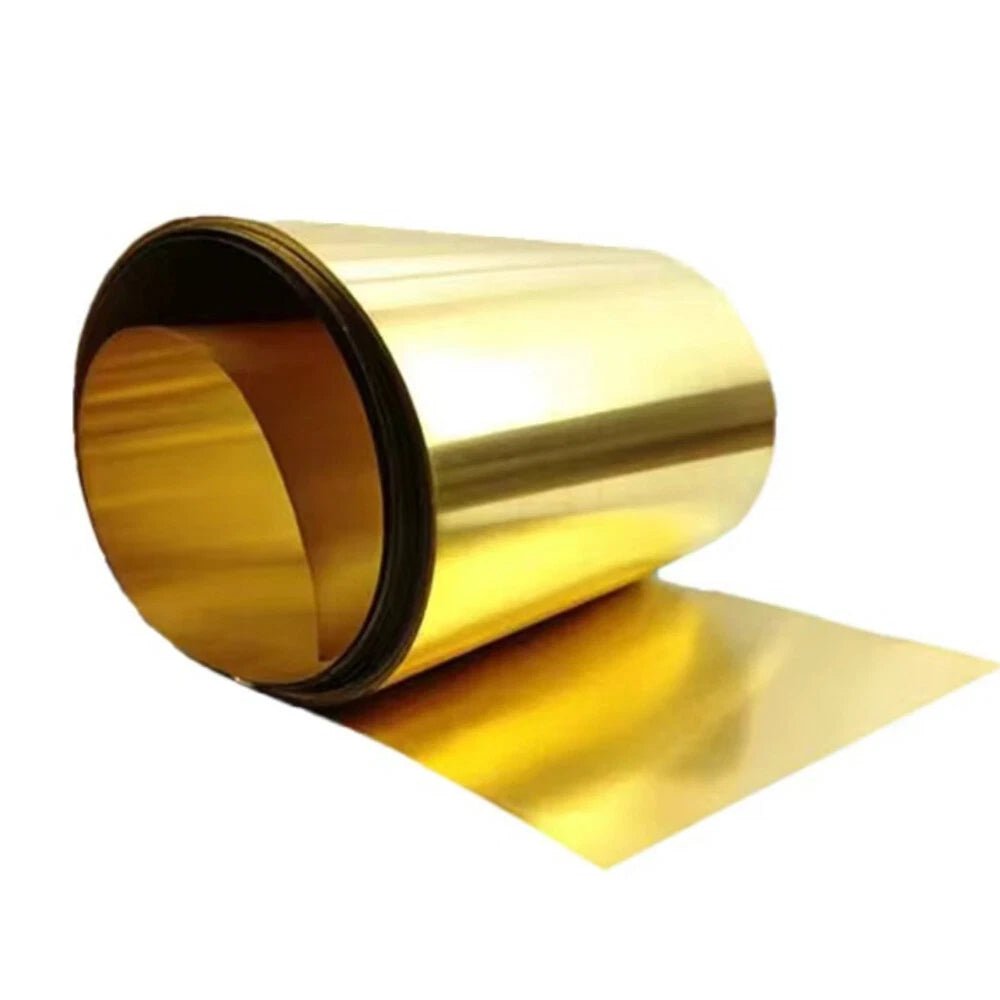
When your project demands a material that holds tight tolerances without adding bulk, finding the right thin metal stock can be a real challenge. Whether you are a maker shimming a bearing, a hobbyist crafting decorative inlays, or an electronics technician needing a reliable conductive layer, this brass sheet foil and strip coil is sized to match your exact needs right out of the box.
Each piece is cut from C26000 cartridge brass (approximately 70% copper, 30% zinc), delivering a warm golden finish with good formability and moderate strength. Thickness ranges from 0.01 mm (0.0004 in) up to 1 mm (0.039 in); width options span 10 mm (0.39 in) to 300 mm (11.81 in); and length options are 500 mm (19.69 in) or 1000 mm (39.37 in) per piece. Select your exact combination using the variant selector above.
Typical use cases include precision shim stock for mechanical assemblies, thin brass strip for jewelry making and decorative metalwork, conductive foil for RF shielding and grounding applications, and flexible strip for model-making and architectural scale models. Long-tail searches that land here often include "thin brass shim sheet 0.1mm", "brass foil strip coil for crafts", and "narrow brass strip 10mm wide 1000mm long".
| Material | Brass (approx. C26000, 70% Cu / 30% Zn) |
|---|---|
| Finish | Mill finish, bright golden surface |
| Thickness Range | 0.01 mm – 1 mm (0.0004 in – 0.039 in) |
| Width Range | 10 mm – 300 mm (0.39 in – 11.81 in) |
| Length Options | 500 mm (19.69 in) or 1000 mm (39.37 in) |
| Thickness Tolerance | See variant options |
| Hardness | See variant options |
| Temper | See variant options |
| Quantity per Order | 1 piece (select quantity variant for multiples) |
| Applications | Shim stock, RF shielding, jewelry, crafts, model-making, electronics |
For precision shimming in mechanical assemblies (bearings, gearboxes), thicknesses of 0.05 mm – 0.2 mm are most common. For decorative inlays and jewelry, 0.1 mm – 0.3 mm offers a good balance of rigidity and formability. For RF shielding foil or flexible wrapping, 0.02 mm – 0.05 mm is typically sufficient. If you are unsure, start with 0.1 mm — it is the most versatile gauge in this range.
Yes — gauges up to approximately 0.05 mm can be cut cleanly with sharp scissors. From 0.05 mm to 0.2 mm, heavy-duty scissors or tin snips work well. For 0.3 mm and above, aviation snips, a metal shear, or a CNC router will give the cleanest edge. A craft knife can score and snap thinner gauges against a steel ruler.
Brass has moderate natural corrosion resistance and performs well in dry indoor environments and light outdoor exposure. Over time, uncoated brass will develop a patina (oxidation) when exposed to moisture and air. For long-term outdoor applications, applying a clear lacquer or wax coating will significantly extend the bright finish. It is not recommended for continuous immersion in water or highly corrosive environments without a protective coating.
Yes. C26000 cartridge brass is highly solderable with standard rosin-core or water-soluble flux and 60/40 or lead-free solder. It also responds well to silver brazing for stronger joints. Clean the surface with isopropyl alcohol or fine abrasive before soldering to remove any surface oxidation for the best bond.
Both lengths are cut from the same material and alloy. The 500 mm option is ideal when you need a shorter piece for small projects or want to minimize waste. The 1000 mm option gives you a full meter-length strip, which is more economical per millimeter and better suited for longer runs, continuous shim applications, or when you want extra material for test cuts.
C26000 brass in the annealed or half-hard temper bends cleanly at room temperature. Thinner gauges (≤0.1 mm) are very flexible and can be bent repeatedly. Thicker gauges (0.5 mm – 1 mm) require more force and a tighter bend radius to avoid cracking — use a bending brake or clamp over a mandrel for clean results. Avoid sharp 90° bends on the thicker gauges without proper tooling.
Choose a narrow strip (10 mm – 30 mm) when you need a ready-to-use shim, contact strip, or decorative border without further cutting. Choose a wider sheet (100 mm – 300 mm) when you need to cut multiple pieces from a single blank, cover a larger surface area for shielding, or create custom shapes. Wider sheets offer more flexibility but require cutting tools to size down.





