
The chain is fine...but I ordered the wrong size. Nine links of the chain I ordered equals six of the size I wanted. My error...
How can I straighten out the springs? I can't use them coil uo as is.
Your payment information is processed securely. We do not store credit card details nor have access to your credit card information.
Get fitment advice & recommendations
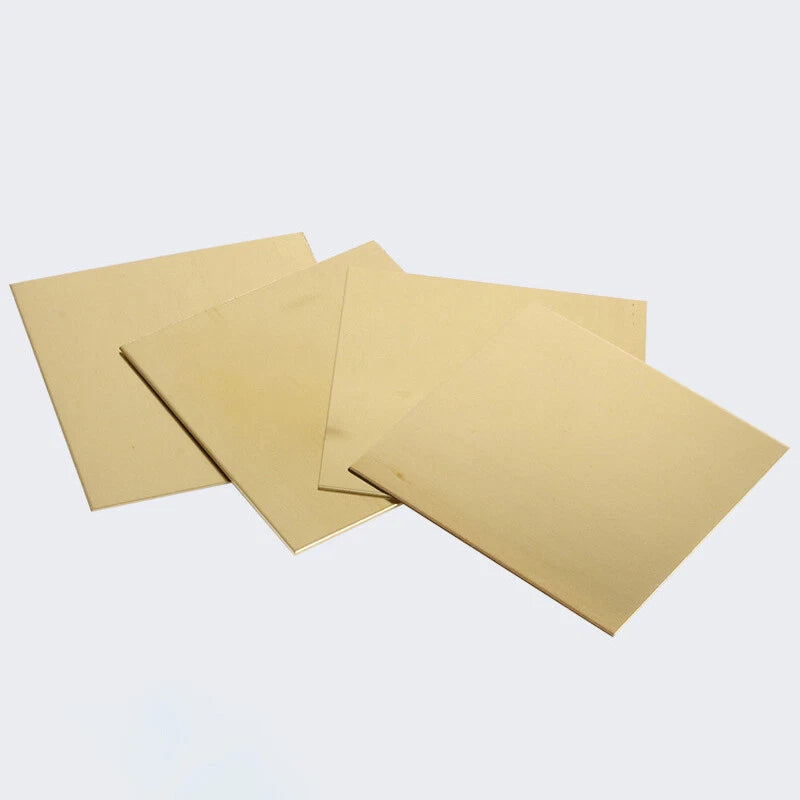
Finding a reliable source of accurately cut brass sheet for small-batch projects can be frustrating — off-spec edges, inconsistent thickness, and minimum order quantities that leave you with far more material than you need. These brass sheet plate guillotine offcuts are designed for makers, model engineers, jewellers, and workshop hobbyists who need precise, usable pieces without committing to full-sheet quantities.
Each piece is guillotine-cut from solid brass sheet, delivering clean, straight edges ready for immediate use. Available in sheet thicknesses ranging from 0.5mm to 6mm (approximately 0.020" to 0.236") and in a range of flat dimensions from 50×50mm up to 300×300mm (roughly 2"×2" to 11.8"×11.8"), these offcuts cover a wide spectrum of project requirements. The material is a standard yellow brass alloy, offering a warm golden appearance with good machinability and moderate corrosion resistance.
Typical applications include DIY brass sheet metalwork for decorative inlays and trim, engineering prototypes requiring brass plate offcuts for brackets and spacers, jewellery and craft projects using thin brass sheet for etching and forming, and scale modelling where guillotine-cut brass pieces provide accurate, burr-free stock.
| Material | Yellow Brass (nominally CW508L / C26000 equivalent) |
|---|---|
| Finish | Mill finish (as-sheared, unpolished) |
| Sheet Thickness Range | 0.5mm – 6mm (0.020" – 0.236") |
| Available Flat Sizes | 50×50mm up to 300×300mm (see variant options) |
| Cut Method | Guillotine shear |
| Edge Condition | Sheared, burr-minimal, straight |
| Quantity per Order | 1, 2, or 4 pieces (see variant options) |
| Colour | Golden yellow (natural brass) |
| Machinability | Good — suitable for drilling, tapping, sawing, and filing |
| Corrosion Resistance | Moderate — suitable for indoor and sheltered outdoor use |
| Approximate Weight | See variant options (varies by size and thickness) |
For decorative inlays, etching, and jewellery work, thinner sheets (0.5mm–1.2mm) are easiest to cut and form by hand. For structural brackets, spacers, and engineering components that need to bear load or resist bending, thicker options (2mm–6mm) provide the necessary rigidity. If you are unsure, 1.5mm–2mm is a versatile mid-range choice for most general workshop tasks.
Guillotine-sheared edges are straight and burr-minimal, but as with any cut metal, light deburring with a fine file or emery cloth is recommended before handling extensively or fitting into assemblies. Thicker pieces (3mm and above) may have a slightly more pronounced shear edge that benefits from a quick pass with a flat file.
Brass offers moderate natural corrosion resistance, making it suitable for indoor applications and sheltered outdoor environments. For prolonged outdoor exposure or contact with moisture, applying a clear lacquer or wax coating will extend the appearance and service life. Brass is not recommended for direct immersion in salt water without additional protection.
Yes. Standard yellow brass is well-suited to both soft soldering (using flux and tin-lead or lead-free solder) and silver brazing. Ensure the surface is clean and free of oxidation before joining. A suitable flux appropriate to your joining method should always be used for reliable bonds.
Absolutely. The thinner gauges (0.5mm and 0.8mm) are particularly popular for scale modelling, architectural models, and miniature engineering. The guillotine-cut edges provide accurate, straight reference faces that simplify scribing and cutting to final dimensions.
Use the Size variant to choose your flat sheet dimensions, the Sheet Thickness variant to select your gauge, and the Quantity(pcs) variant to specify how many pieces you need. If you are prototyping, ordering a single piece first allows you to confirm fit and finish before committing to a larger quantity.
Yes. Thinner sheets (up to approximately 1.5mm) can be cut with aviation snips or a jeweller's saw. Thicker pieces are best cut with a hacksaw, angle grinder with a metal-cutting disc, or a bandsaw fitted with a bi-metal blade. Always secure the workpiece firmly and wear appropriate eye and hand protection.





