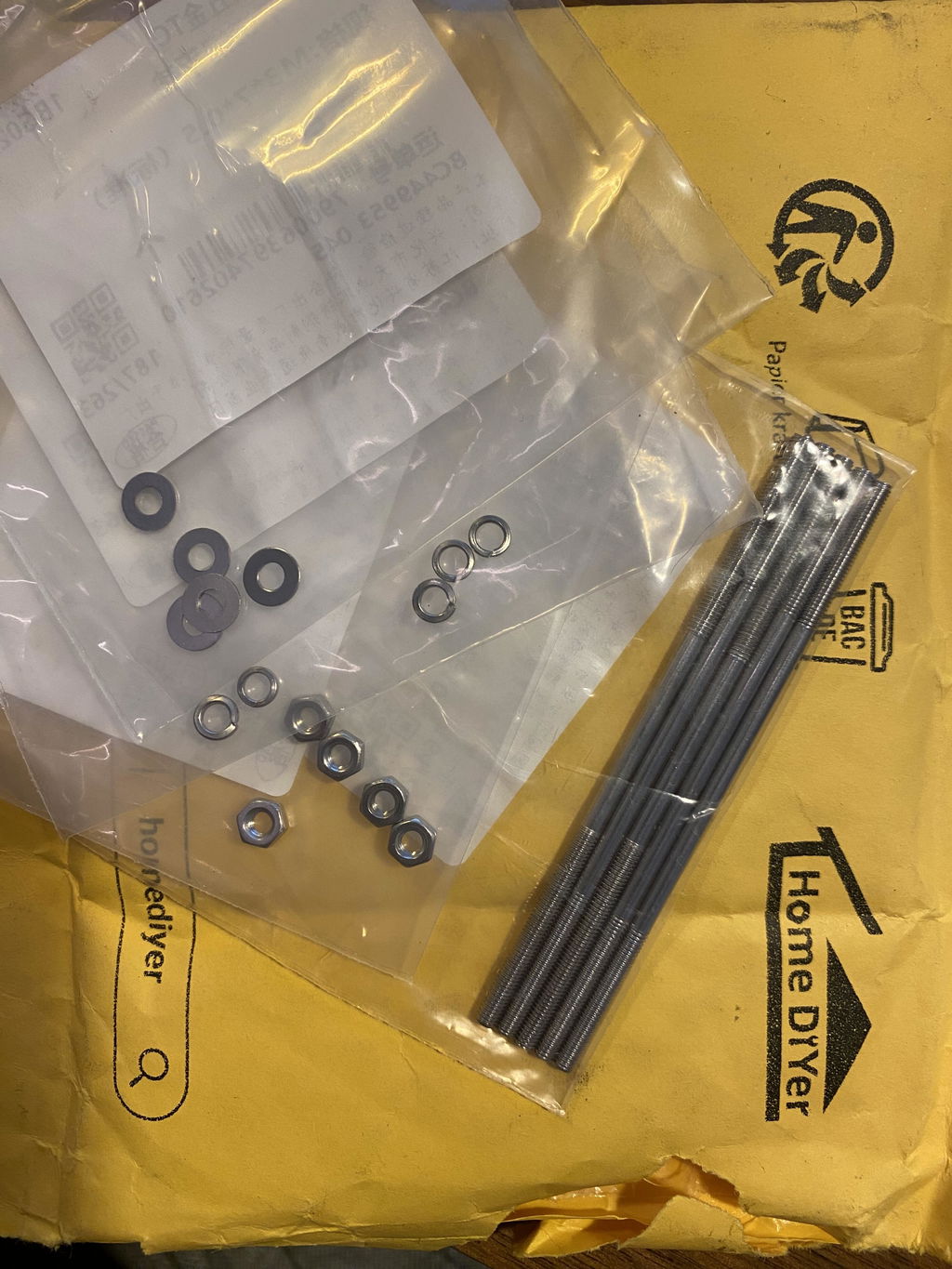
The chain is fine...but I ordered the wrong size. Nine links of the chain I ordered equals six of the size I wanted. My error...
How can I straighten out the springs? I can't use them coil uo as is.
Your payment information is processed securely. We do not store credit card details nor have access to your credit card information.
Get fitment advice & recommendations
When your model build, craft project, or small-batch fabrication job demands a material that machines cleanly, solders reliably, and holds tight tolerances, generic sheet metal just does not cut it. These brass sheet and plate blanks are sized and cut for makers, hobbyists, and small workshop operators who need consistent thickness and flat, burr-free surfaces right out of the package.
Each piece is a solid brass (CuZn alloy) flat sheet available in thicknesses from 0.8 mm (~0.031 in) up to 4 mm (~0.157 in), and in square formats of 100x100 mm (~3.94x3.94 in), 200x200 mm (~7.87x7.87 in), and 300x300 mm (~11.81x11.81 in). The surface is mill-finished with a smooth, consistent texture suitable for further machining, etching, or finishing.
Typical use cases include architectural scale model making, RC vehicle chassis fabrication, custom PCB shielding blanks, decorative inlay work, and DIY engraving projects - anywhere a flat brass sheet with a known thickness is the starting point.
| Material | Brass (CuZn alloy) |
|---|---|
| Thickness Options | 0.8 mm, 1 mm, 1.2 mm, 1.5 mm, 2 mm, 2.5 mm, 3 mm, 4 mm |
| Sheet Size Options | 100x100 mm / 200x200 mm / 300x300 mm |
| Surface Finish | Mill finish (smooth, uncoated) |
| Shape | Flat square plate / sheet |
| Machinability | Excellent - suitable for cutting, drilling, bending, etching, soldering |
| Corrosion Resistance | Good - suitable for indoor and light outdoor use |
| Weight per Piece | See variant options |
| Quantity per Order | 1 pcs (per variant) |
| Typical Applications | Scale model making, RC chassis, PCB shielding, decorative inlay, engraving blanks |
For fine detail work and thin structural skins (e.g., aircraft fuselage panels, ship hull plating), 0.8 mm-1.2 mm is typically ideal. For load-bearing frames, chassis rails, or parts that need to hold a threaded insert, 2 mm-4 mm provides the rigidity you need. When in doubt, start with 1.5 mm - it bends cleanly by hand with a brake tool and still machines without chatter.
The 100x100 mm size suits small detail parts, brackets, and test cuts. The 200x200 mm sheet covers most single-panel model components. The 300x300 mm sheet is best when you need to cut multiple parts from one blank or are building larger structural elements. Order the size closest to your largest single part to minimize waste.
Thin gauges (0.8 mm-1.5 mm) can be cut with a sufficiently powerful fiber laser or CO2 laser with a metal-cutting lens. Thicker gauges (2 mm and above) typically require a fiber laser, CNC router with a carbide end mill, or bench shears. Always verify your machine's rated cutting capacity for brass before attempting a cut.
Yes. Brass solders and brazes very well with standard silver solder, soft solder (tin-lead or lead-free), and brass brazing rod. Clean the surface with fine abrasive or flux before joining to remove any surface oxidation. The mill finish does not require stripping before soldering in most hobby applications.
Brass does not rust (it contains no iron), but it will develop a natural patina (darkening or greenish tarnish) when exposed to moisture and air over time. For indoor display models, this is typically not an issue. If you want to preserve the bright finish, apply a clear lacquer or wax coat after completing your project. For outdoor or high-humidity environments, a protective coating is recommended.
Yes, brass is ductile and bends well when worked at room temperature. Thinner gauges (0.8 mm-1.5 mm) can be bent by hand over a straight edge or with a simple sheet metal brake. Thicker gauges (2 mm-4 mm) require a bench brake or press brake. Avoid sharp-radius bends on thicker stock - use a bend radius of at least 1x the material thickness to prevent cracking.
The 200x200 mm sheet gives you 4x the surface area of the 100x100 mm piece, and the price per square millimeter is lower on larger sizes. If your project requires multiple small parts, ordering one larger sheet and cutting it down is usually more economical than ordering several small pieces individually.