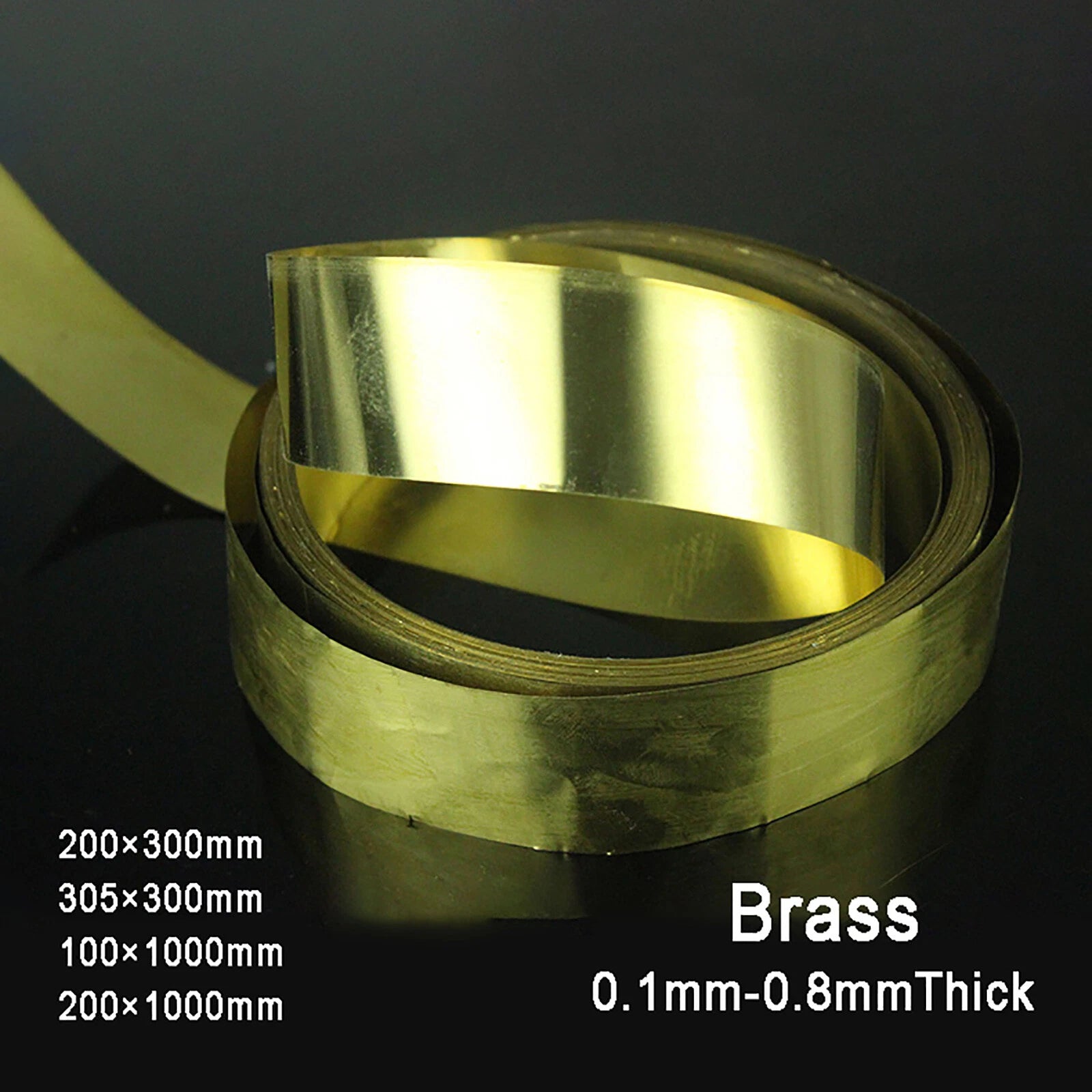
Brass Sheet Roll Metal Foil Plate, 0.1mm - 0.8mm Thick, Various Width and Length

No reviews

Price:
Sale price$21.80 USD
Stock:
In stock (500 units), ready to be shipped

Payment & Security

Ach Direct Debit Amazon American Express Apple Pay Bancontact BLIK Diners Club Discover EPS Google Pay iDEAL Wero JCB Maestro Mastercard Multibanco MobilePay PayPal Przelewy24 Shop Pay Twint Union Pay USDC Visa

Your payment information is processed securely. We do not store credit card details nor have access to your credit card information.

Quantity Discount Promotion
🎯 BULK DISCOUNT: Buy More, Save More!
Buy 2 Items
5% OFF
Buy 4 Items
10% OFF
Buy 6 Items
15% OFF
Expert

DIY Expert Support

Get fitment advice & recommendations

Mon-Fri, 8:30AM-8PM
24-Hour Fast Ship
🚚
Arrives in 3-14 days
🌍
Global Reach
↩️
30-Day Returns
🌱 1 tree planted with every purchase

Description

Brass Sheet Roll Metal Foil Plate — Precision Thickness for Every DIY Metalwork Need

When your project demands a reliable, workable metal sheet that cuts cleanly, bends without cracking, and holds its shape, finding the right thickness and width in one place is rarely straightforward. Whether you are a hobbyist machinist, a model maker, or a hands-on homeowner tackling repairs, these brass sheet rolls give you the exact gauge you need without ordering custom stock.

Each sheet is made from brass — a copper-zinc alloy known for its machinability, corrosion resistance, and warm golden appearance. Thickness options range from 0.1 mm to 0.8 mm (approximately 0.004 in to 0.031 in), with widths of 100 mm (≈3.94 in), 200 mm (≈7.87 in), and 300 mm (≈11.81 in), and lengths from 300 mm up to 1000 mm (≈11.8 in to 39.4 in). Packing quantities of 1, 2, or 4 pieces are available to match your project scale.

Typical applications include crafting precision shim stock for machinery alignment, fabricating decorative inlays and jewelry components, repairing or reinforcing household fixtures, building scale models and RC vehicle parts, and creating custom gaskets or heat shields for light-duty DIY metalwork projects.

🔧 Compatible with standard metal snips, hobby knives, bench shears, and CNC cutting tools. Suitable for soldering, brazing, and light forming operations.

✅ Key Features of These Brass Sheet Roll Metal Foil Plates

📏 Wide Thickness Range

Available from 0.1 mm to 0.8 mm (0.004 in – 0.031 in), covering ultra-thin foil work through to structural shim applications in a single product line.

🟡 Brass Alloy Construction

Copper-zinc brass alloy delivers excellent machinability, natural corrosion resistance, and a consistent golden finish that ages gracefully without surface treatment.

✂️ Easy to Cut and Form

Thin gauges cut cleanly with standard hobby knives or metal snips; thicker gauges respond well to bench shears and CNC routers, with minimal burring at cut edges.

📐 Multiple Width and Length Options

Choose from 100 mm, 200 mm, or 300 mm widths and lengths up to 1000 mm, so you can select the closest match to your project dimensions and reduce waste.

🔩 Solderable and Brazeable

Brass bonds reliably with standard soft solder and silver brazing alloys, making these sheets suitable for electrical connections, plumbing repairs, and decorative metalwork joints.

📦 Flexible Pack Quantities

Order 1, 2, or 4 pieces per variant to match your exact project needs — whether you need a single test piece or a small batch for a production run.

📐 Technical Specifications — Brass Sheet Roll Metal Foil Plate

Material Brass (Copper-Zinc Alloy)
Thickness Range 0.1 mm – 0.8 mm (0.004 in – 0.031 in)
Width Options 100 mm, 200 mm, 300 mm
Length Options 300 mm, 500 mm, 1000 mm
Surface Finish Mill finish (smooth, uncoated)
Temper See variant options
Packing Quantity 1 pcs / 2 pcs / 4 pcs (see variant options)
Weight per Piece See variant options
Applicable Processes Cutting, bending, soldering, brazing, stamping
Corrosion Resistance Good — inherent brass alloy resistance to moisture and mild chemicals

❓ Frequently Asked Questions

How do I choose the right thickness for my project?

For decorative inlays, jewelry, or ultra-thin shims, start with 0.1 mm – 0.2 mm. For general-purpose shim stock, gaskets, or light structural reinforcement, 0.3 mm – 0.5 mm is a practical range. For heavier-duty applications such as bearing shims or robust repair plates, 0.6 mm – 0.8 mm provides greater rigidity. If you are unsure, order a thinner gauge first — it is easier to stack thin sheets than to thin down a thick one.

Is brass strong enough for structural or load-bearing repairs?

Brass sheet in the 0.1 mm – 0.8 mm range is suited for light-duty structural tasks such as shimming, reinforcing, and patching rather than primary load-bearing applications. For heavier structural work, consider thicker plate stock. These sheets excel in precision fitting, decorative work, and applications where corrosion resistance and workability matter more than tensile strength.

Will brass corrode or tarnish over time?

Brass naturally develops a patina over time when exposed to air and moisture, shifting from bright gold toward a darker amber or brown tone. This patina is a surface oxide layer that actually protects the underlying metal from deeper corrosion. If you prefer to maintain the original bright finish, apply a clear lacquer or metal polish after cutting and forming. For outdoor or high-humidity environments, a protective coating is recommended.

What tools do I need to cut and shape these sheets?

Thin gauges (0.1 mm – 0.3 mm) cut cleanly with a sharp hobby knife, metal snips, or scissors designed for sheet metal. Thicker gauges (0.4 mm – 0.8 mm) are best handled with aviation snips, a bench shear, or a CNC router with a suitable end mill. For curved cuts, a jeweler's saw or rotary tool with a cutting disc works well. Always deburr cut edges with a fine file or sandpaper for safe handling.

Can I solder or braze these brass sheets?

Yes. Brass bonds reliably with standard 60/40 or lead-free soft solder using a rosin flux, and it responds well to silver brazing alloys for stronger joints. Clean the surface with fine abrasive paper or flux before soldering to remove any oxidation. Avoid overheating thin gauges (0.1 mm – 0.2 mm) as they can warp; use a lower-temperature iron and work quickly.

Which size combination should I order for a shim or gasket application?

For shim stock, select a thickness that matches or slightly exceeds your required gap — you can always sand or lap a shim thinner but not thicker. For gaskets, 0.2 mm – 0.4 mm is a common range for light-duty fluid sealing. Choose a width and length that gives you enough material to cut your pattern with minimal waste. The 100 mm × 1000 mm roll is popular for long, narrow shim strips, while the 200 mm × 300 mm sheet suits compact gasket blanks.

Is this the same as copper sheet or bronze sheet?

No. Brass is a copper-zinc alloy, distinct from pure copper sheet (which is softer and more electrically conductive) and bronze (a copper-tin alloy, which is harder and more wear-resistant). Brass sits between the two in terms of hardness and machinability, and its golden color makes it a popular choice for decorative and precision mechanical applications where both appearance and workability matter.

🛒 Select your thickness, width, length, and packing quantity above, then add to cart.

You may also like

Recently viewed