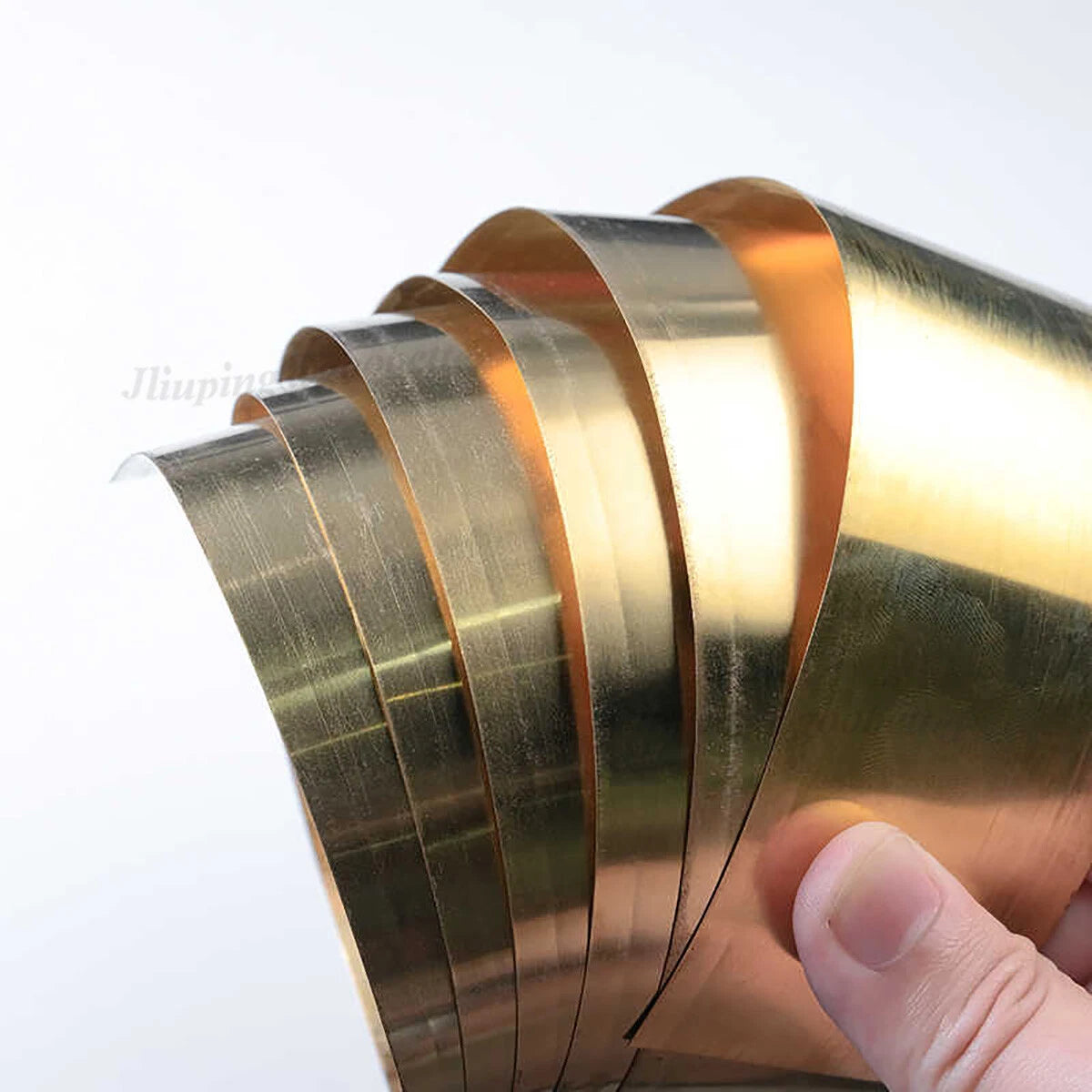
Brass Sheet Roll Metal Foil Plate Strip Thickness 0.5mm Width 5mm-400mm by Meter

No reviews

Price:
Sale price$3.74 USD
Stock:
In stock (500 units), ready to be shipped

Payment & Security

Ach Direct Debit Amazon American Express Apple Pay Bancontact BLIK Diners Club Discover EPS Google Pay iDEAL Wero JCB Maestro Mastercard Multibanco MobilePay PayPal Przelewy24 Shop Pay Twint Union Pay USDC Visa

Your payment information is processed securely. We do not store credit card details nor have access to your credit card information.

Limited Offer — Spend More, Save More
Spend $55+
Save $5
Spend $100+
Save $10
Spend $200+
Save $25
HomeDIYer DIY Expert Support

DIY Expert Support

Get fitment advice & recommendations

Mon–Fri  8:30 AM – 8:00 PM
24-Hour Fast Ship
Arrives in 3–14 Days
Worldwide Shipping
30-Day Returns
1 tree planted with every purchase

Description

Brass Sheet Roll 0.5mm Thick — Stiff Metal Strip for Shims, Spring Contacts, and Structural Work

When a project demands a brass strip that resists deflection under load but still cuts and bends without specialist tooling, 0.5mm is the gauge that delivers. Mechanical engineers shimming bearing housings, electronics fabricators forming leaf-spring contacts, and woodworkers cutting structural inlay banding all reach for a 0.5mm brass sheet roll when thinner foils lack the backbone the job requires.

This brass sheet roll is 0.5mm thick and supplied in 1000mm (39.4 in) lengths. Width options run from 5mm (0.20 in) to 400mm (15.75 in) across 22 variants, letting you select the exact coverage your application needs. The alloy is a standard copper-zinc brass composition with a mill-finish golden surface, offering a reliable combination of ductility, moderate tensile strength, and good solderability.

Typical applications include precision shim stock for machine tool and bearing adjustments, leaf-spring contact strips in low-current electrical assemblies, decorative banding and inlay work in furniture and cabinetry, and thin structural facing panels in scale model engineering. The 0.5mm gauge is also a practical choice for EMI shielding gaskets and grounding straps where mechanical durability matters alongside conductivity.

🔧 Compatible with: Tin snips, metal shears, guillotine cutters, and CNC routers. Suitable for soldering, brazing, and adhesive bonding. Bends cleanly by hand or with a sheet metal brake for most forming operations without annealing.

✅ Key Features of These Brass Sheet Roll Metal Strips

📏0.5mm Gauge — Noticeably Stiffer Than Thinner Foils
At 0.5mm, this strip holds its shape under light-to-moderate mechanical load, making it the right choice for spring contacts, structural inlays, and shim applications where 0.3mm or 0.4mm foil would flex or buckle.
↔️22 Width Options (5–400mm)
From a 5mm (0.20 in) narrow strip to a 400mm (15.75 in) wide sheet, the full width range lets you match the material precisely to your project footprint, minimising offcuts and material cost.
Moderate Electrical Conductivity
Brass conducts electricity at approximately 28% IACS, making these strips a practical choice for grounding straps, EMI shielding gaskets, and low-current contact applications where copper-level conductivity is not required.
✂️Cuts and Bends Without Specialist Tooling
Despite its added stiffness, the 0.5mm gauge shears cleanly with tin snips or a metal shear and forms to shape with a sheet metal brake or hand bending — no annealing required for most operations.
🛡️Corrosion-Resistant in Indoor Environments
Brass resists oxidation under typical indoor and light outdoor conditions, maintaining its golden finish and electrical properties over extended service without surface treatment.
📐1000mm Length per Piece
Each strip is supplied at 1000mm (39.4 in) — long enough for most single-piece applications and easy to subdivide with standard shop tools for smaller components.

📐 Technical Specifications — Brass Sheet Metal Strip

Material Brass (copper-zinc alloy)
Thickness 0.5mm (0.020 in)
Width Range 5mm – 400mm (0.20 in – 15.75 in)
Length 1000mm (39.4 in) per piece
Finish Mill finish, warm golden tone
Tensile Strength Typically 300–500 MPa (varies by alloy temper)
Electrical Conductivity Approx. 28% IACS (typical for brass)
Workability Shearable, hand-bendable, solderable, brazeable
Available Widths See variant options
Weight per Piece See variant options

❓ Frequently Asked Questions

How does 0.5mm compare to 0.3mm or 0.4mm — which thickness should I choose?

The 0.5mm strip is 25% thicker than 0.4mm and 67% thicker than 0.3mm, which produces a meaningful increase in stiffness. Choose 0.5mm when the strip needs to resist deflection under light mechanical load — for example, as a leaf-spring contact, a structural inlay, or a shim that must not compress under clamping force. Choose 0.3mm or 0.4mm when flexibility and tight-radius forming are the priority.

What width should I select for my project?

Select a width that matches or slightly exceeds the widest dimension of your target area. For shims and spacers, choose the narrowest width that fully covers the joint. For shielding panels or decorative banding, measure the opening and pick the next width up. All variants share the same 0.5mm thickness and 1000mm length — only the width changes between options.

Can I cut 0.5mm brass with standard hand tools?

Yes, though the added thickness compared to thinner foils means heavy-duty tin snips or a dedicated metal shear will give cleaner results than scissors. For long, straight cuts on wider strips, a guillotine-style metal shear or CNC router is recommended. Score-and-snap is not advised — shear in a single pass for the cleanest edge and to avoid work-hardening along the cut line.

Is 0.5mm brass suitable for use as a leaf spring or contact strip?

Yes — 0.5mm brass is a common gauge for light-duty leaf springs and electrical contact strips in low-current applications. It provides enough spring-back after bending to function as a contact element, while remaining workable with hand tools. For high-cycle fatigue applications or elevated temperatures, consult a materials engineer to confirm suitability.

Will this brass strip corrode or tarnish over time?

Brass develops a natural patina in humid or outdoor environments. For indoor applications — electronics, furniture inlays, model making — the surface remains stable for years without treatment. To preserve the bright golden finish, apply a thin coat of clear lacquer or metal wax after cleaning. For outdoor or marine use, a protective coating is recommended.

Can I solder or braze this brass strip?

Yes. Brass solders readily with standard rosin-core or acid-core solder and an appropriate flux. For brazing, use a brass-compatible brazing rod and ensure the surface is clean and oxide-free. The 0.5mm gauge handles torch heat well compared to thinner foils, but avoid dwelling in one spot to prevent localised warping.

How does brass compare to copper or stainless steel at this thickness?

At 0.5mm, brass offers a practical balance of stiffness, workability, and corrosion resistance. Copper at the same gauge is softer and more conductive but more expensive and prone to surface oxidation. Stainless steel is harder and more corrosion-resistant but significantly more difficult to cut, bend, and solder. Brass is the most versatile option for most DIY, craft, and light engineering applications at this gauge.

🛒 Select your size (Thickness × Width × Length) above, then add to cart.


You may also like

Recently viewed