
The chain is fine...but I ordered the wrong size. Nine links of the chain I ordered equals six of the size I wanted. My error...
How can I straighten out the springs? I can't use them coil uo as is.
Your payment information is processed securely. We do not store credit card details nor have access to your credit card information.
Get fitment advice & recommendations
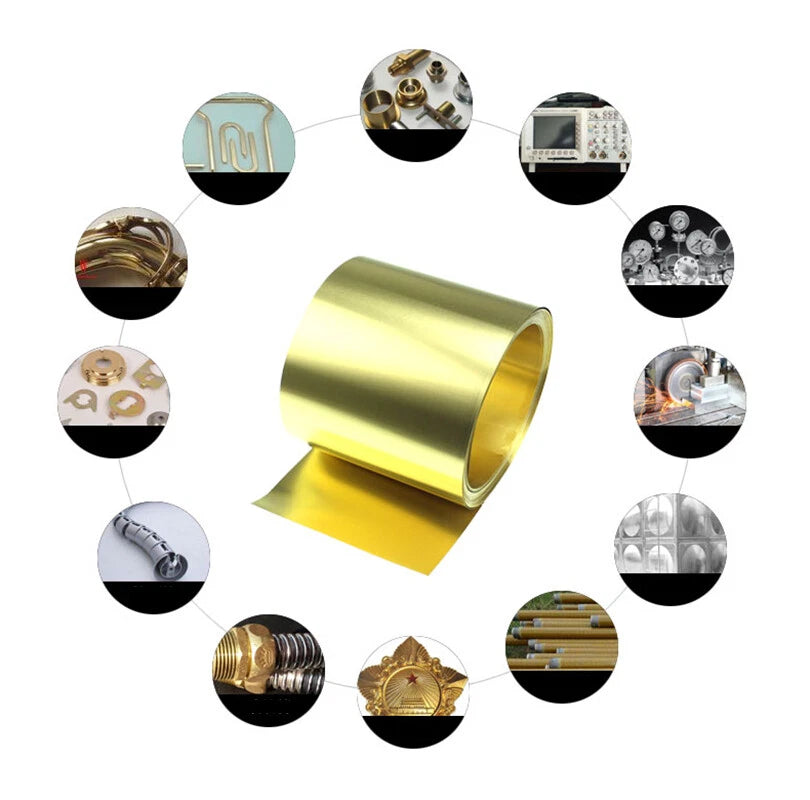
When your project demands a flat, workable metal that holds its shape without adding bulk, finding the right brass sheet foil in the exact thickness can be a real challenge. Whether you are a maker shimming a tight mechanical fit, a craftsperson adding decorative metalwork, or a workshop technician needing a reliable spacer material, this brass sheet thin foil roll delivers the dimensional accuracy and material consistency your work requires.
Each piece is made from pure brass (copper-zinc alloy), supplied in a flat square sheet or continuous roll format. Thickness options range from 0.02 mm to 0.5 mm (approximately 0.0008 in to 0.020 in). Sheet sizes are available as 200×300 mm (approx. 7.9×11.8 in) flat panels, 48 mm×5000 mm (approx. 1.9 in×196.9 in) long rolls, and 100×1000 mm (approx. 3.9×39.4 in) strip rolls, giving you flexibility to cut exactly what you need.
Typical applications include precision shim stock for machinery and engine components, decorative inlay and etching for woodworking and jewelry projects, electrical contact strips and grounding foil for electronics prototyping, and heat-shield or gasket material for small-engine DIY repairs.
| Material | Brass (Copper-Zinc Alloy) |
|---|---|
| Finish | Mill finish (natural brass) |
| Shape | Flat sheet / Strip roll / Coil roll |
| Thickness Range | 0.02 mm – 0.5 mm (0.0008 in – 0.020 in) |
| Sheet Size Option | 200 mm × 300 mm (7.9 in × 11.8 in) |
| Strip Roll Size Option | 100 mm × 1000 mm (3.9 in × 39.4 in) |
| Coil Roll Size Option | 48 mm × 5000 mm (1.9 in × 196.9 in) |
| Available Thicknesses | 0.02, 0.03, 0.05, 0.1, 0.2, 0.3, 0.4, 0.5 mm |
| Pack Quantities | 1 Pcs / 3 Pcs / 5 Pcs / 10 Pcs |
| Weight (per piece) | See variant options |
| Solderability | Suitable for soft soldering and brazing |
| Machinability | Hand-cuttable; compatible with CNC and laser cutting |
For precision shimming applications (bearing fits, gearbox clearances), thicknesses of 0.05–0.2 mm are most commonly used. For decorative inlay, etching, or embossing work, 0.1–0.3 mm offers a good balance of rigidity and formability. For ultra-thin foil wrapping or electrical grounding strips, 0.02–0.05 mm is appropriate. If you are unsure, start with 0.1 mm as a versatile mid-range option.
Brass has a tensile strength of approximately 300–500 MPa depending on alloy composition and temper. For light-duty shim applications — such as adjusting clearances in woodworking machinery, small engines, or hobby robotics — thicknesses of 0.2 mm and above provide adequate compressive strength. For heavy industrial loads, consult an engineer to confirm suitability.
Brass does not rust (it contains no iron), but it will oxidise over time when exposed to moisture and air, developing a darker patina. For outdoor or high-humidity applications, a clear lacquer or wax coating is recommended to preserve the original finish. Brass also has good resistance to many common chemicals, making it suitable for mild industrial environments.
Yes. Brass is well-suited to both soft soldering (using standard electrical or plumbing solder) and silver brazing. Ensure the surface is clean and free of oxidation before soldering. A mild flux appropriate for brass is recommended to achieve a strong, clean joint.
Choose the 200×300 mm flat sheet if you need a compact panel for cutting custom shapes or patches. Choose the 100×1000 mm strip roll if you need a longer run of material for gaskets, edging, or continuous shim strips. Choose the 48 mm×5000 mm coil roll if you need a narrow, very long continuous strip — ideal for wrapping, coiling, or feeding through machinery.
For thicknesses up to 0.1 mm, ordinary household scissors or craft scissors work well. For 0.2–0.3 mm, dedicated tin snips or aviation shears give cleaner edges. For 0.4–0.5 mm, tin snips or a metal guillotine are recommended for straight cuts. A steel ruler and craft knife can score and snap thinner gauges cleanly.
Yes — the per-piece cost decreases significantly with larger pack quantities. If you anticipate needing multiple pieces for a project (for example, shimming several bearing housings or creating multiple decorative panels), ordering a 5-pack or 10-pack offers a lower unit cost compared to purchasing individual pieces separately.





