The chain is fine...but I ordered the wrong size. Nine links of the chain I ordered equals six of the size I wanted. My error...
How can I straighten out the springs? I can't use them coil uo as is.
Your payment information is processed securely. We do not store credit card details nor have access to your credit card information.
Get fitment advice & recommendations
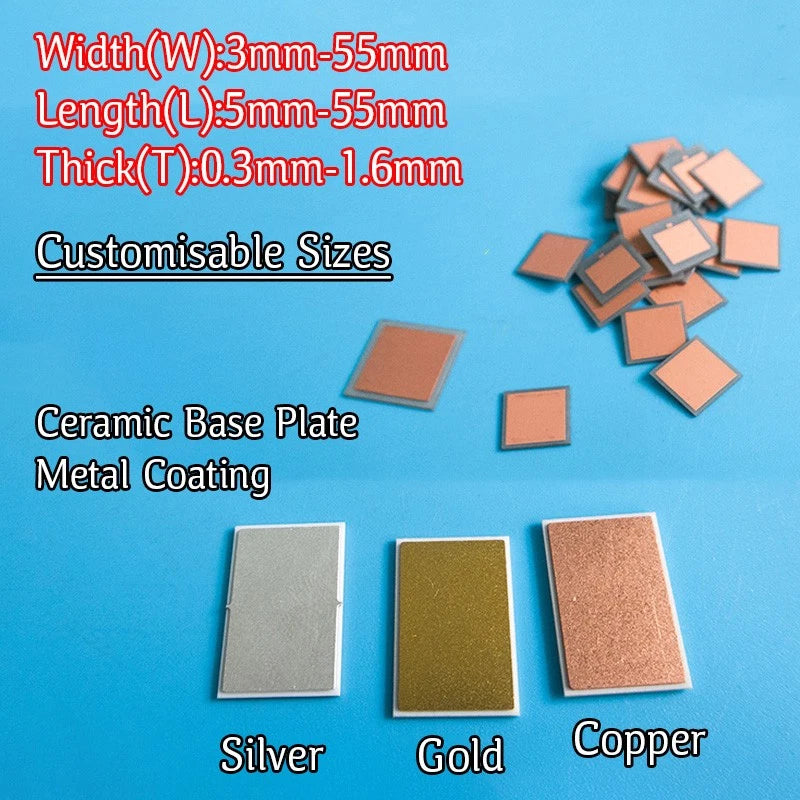
When your LED driver, power module, or custom PCB runs hot and standard FR4 just won't cut it, you need a substrate that conducts heat away fast while keeping circuits electrically isolated. These ceramic base sheets with surface metal coating are engineered for makers, electronics engineers, and small-workshop builders who demand reliable thermal management without the cost of full custom fabrication.
Each sheet consists of a rigid ceramic base — either Alumina (Al₂O₃) or Aluminum Nitride (AlN) — bonded with a precision metal surface layer of copper, silver, or gold. Dimensions span from 3×5mm (approx. 0.12"×0.20") up to 55×55mm (approx. 2.17"×2.17"), with thickness ranging from 0.3mm to 1.6mm (approx. 0.012"–0.063"). Single-side and double-side metallized options are available across the range.
Typical use cases include thermal interface substrates for high-power LED arrays, insulating base layers for DIY power electronics and motor driver boards, and precision ceramic carriers for RF/microwave circuit prototyping. Long-tail applications include ceramic DBC (Direct Bonded Copper) substrate replacement, custom thermoelectric cooler (TEC) mounting plates, and small-batch IGBT module base fabrication.
| Base Material | Al₂O₃ (Alumina) or AlN (Aluminum Nitride) — see variant options |
|---|---|
| Surface Metallization | Copper / Silver / Gold — see variant options |
| Coating Sides | Single Side or Double Side — see variant options |
| Dimensions (L × W) | 3×5mm to 55×55mm (approx. 0.12"×0.20" to 2.17"×2.17") — see variant options |
| Thickness | 0.3mm – 1.6mm (approx. 0.012" – 0.063") — see variant options |
| Shape | Rectangle |
| System of Measurement | Metric |
| Al₂O₃ Thermal Conductivity | Typically 20–25 W/m·K |
| AlN Thermal Conductivity | Typically 150–170 W/m·K |
| Dielectric Strength | Contact us to confirm |
| Surface Finish | Smooth, flat metallized surface |
| Condition | New |
Al₂O₃ (Alumina) is the more affordable option with thermal conductivity of ~20–25 W/m·K, suitable for moderate heat loads such as LED drivers and small power modules. AlN (Aluminum Nitride) offers significantly higher thermal conductivity (~150–170 W/m·K) and is the right choice for high-power applications like IGBT modules, laser diodes, or thermoelectric cooler mounts where heat must be removed rapidly. If your component dissipates more than a few watts in a compact footprint, AlN is the recommended choice.
Single-side coating means only one face of the ceramic substrate has the metal layer — typically used when you need one solderable or bondable surface and the other side mounts directly to a heatsink or chassis. Double-side coating provides metal on both faces, enabling electrical connections or solder joints on both sides, which is common in DBC (Direct Bonded Copper) substrate applications and sandwich-style power module assemblies.
Copper is the most cost-effective and is fully solderable with standard Sn-Pb or lead-free solders — ideal for most DIY power electronics and LED builds. Silver offers slightly higher electrical conductivity and is used in silver-epoxy bonding processes. Gold is the most corrosion-resistant and is preferred for wire bonding, long-term reliability in humid environments, or applications where the surface must remain oxide-free over time. Select based on your bonding process and environmental requirements.
Ceramic substrates are brittle and cannot be cut with standard metal tools. Precision cutting requires diamond-tipped blades or laser cutting equipment. If you need a custom size not listed in the variants, we recommend selecting the closest larger size and consulting a specialist ceramic machining service for trimming. Drilling is possible with diamond-coated drill bits at low speed with water cooling, but should be approached carefully to avoid cracking.
Yes — copper and silver metallized variants are compatible with standard reflow soldering and hand-soldering processes using appropriate flux. Gold-coated variants are compatible with wire bonding and gold-tin solder processes. Ensure the substrate is clean and free of contamination before soldering. The ceramic base itself is not affected by typical soldering temperatures (up to ~300°C for lead-free processes).
Measure the footprint of your component or die that will be mounted on the substrate, then select a sheet that is at least 1–2mm larger on each side to allow for solder fillet or bonding margin. For LED arrays, match the substrate to the LED star or COB footprint. For power transistors or IGBTs, the substrate should cover the full device base plus any required clearance to adjacent conductors. Refer to the variant size list above for all available dimensions.
Store in a dry, low-humidity environment away from corrosive gases. Copper-coated variants are most susceptible to surface oxidation over time — if long-term storage is needed before use, consider vacuum-sealed packaging or desiccant storage. Gold and silver variants are significantly more stable and can be stored under normal workshop conditions without special precautions. Avoid touching the metallized surface with bare hands to prevent contamination from skin oils.