Ceramic Sheet with Copper Coating Surface-plated Metal Plate

No reviews

Price:
Sale price$36.54 USD
Stock:
In stock (500 units), ready to be shipped

Payment & Security

Ach Direct Debit Amazon American Express Apple Pay Bancontact BLIK Diners Club Discover EPS Google Pay iDEAL Wero JCB Maestro Mastercard Multibanco MobilePay PayPal Przelewy24 Shop Pay Twint Union Pay USDC Visa

Your payment information is processed securely. We do not store credit card details nor have access to your credit card information.

Limited Offer — Spend More, Save More
Spend $55+
Save $5
Spend $100+
Save $10
Spend $200+
Save $25
HomeDIYer DIY Expert Support

DIY Expert Support

Get fitment advice & recommendations

Mon–Fri  8:30 AM – 8:00 PM
24-Hour Fast Ship
Arrives in 3–14 Days
Worldwide Shipping
30-Day Returns
1 tree planted with every purchase

Description

Ceramic Sheet with Copper Coating — Precision-Plated Metal Plate for Electronics & Thermal Applications

When your DIY electronics build, PCB prototype, or thermal management project demands a substrate that combines electrical conductivity with heat resistance, standard metal sheets fall short. Makers, hobbyists, and small-workshop engineers working on power modules, LED heat spreaders, and RF circuit boards need a material that handles both — and that's exactly what these copper-coated ceramic sheets deliver.

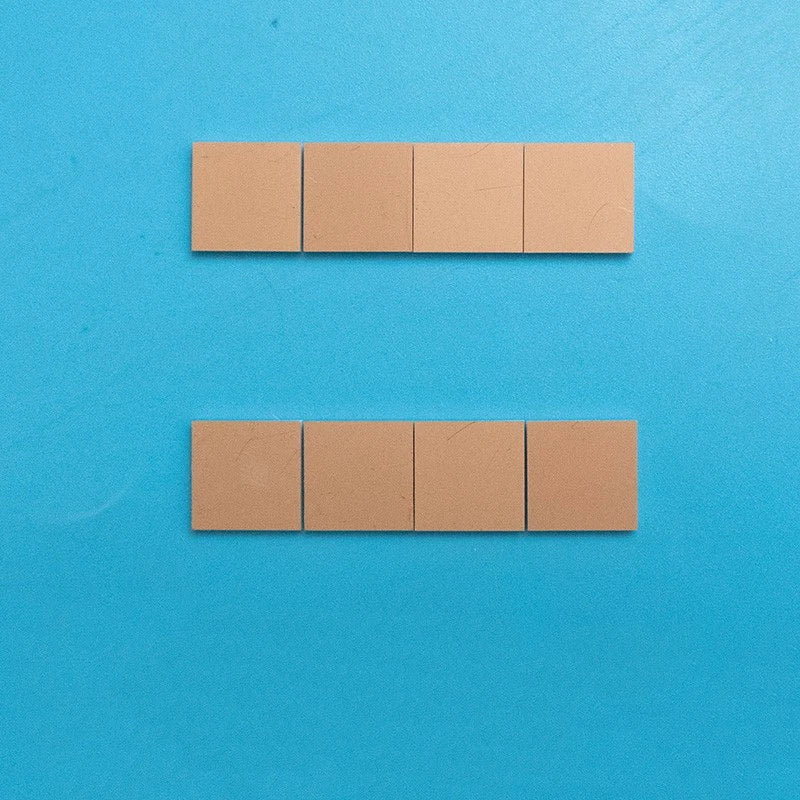
Each sheet is composed of a ceramic base substrate with a copper coating applied to one or both surfaces (single-side or double-side plating, depending on the variant selected). Available in two footprint sizes — 8.2 mm × 8.2 mm (~0.32 in × 0.32 in) and 10 mm × 10 mm (~0.39 in × 0.39 in) — with thickness options ranging from 0.3 mm to 2 mm (approximately 0.012 in to 0.079 in), these plates cover a wide range of design requirements.

Typical use cases include copper-clad ceramic substrates for DIY PCB etching, thermal interface pads in LED driver assemblies, and insulating heat spreader plates in compact power electronics — all scenarios where a copper-plated ceramic sheet for electronics outperforms bare copper or aluminium alternatives.

⚙️ Compatibility: Suitable for PCB prototyping, power module assembly, LED thermal management, RF shielding substrates, and general DIY electronics fabrication requiring an electrically conductive, thermally stable ceramic base.

✅ Key Features of These Copper-Coated Ceramic Sheets

🔲 Square Footprint, Two Sizes

Available in 8.2 mm × 8.2 mm and 10 mm × 10 mm formats — compact dimensions suited for tight PCB layouts and modular thermal pad stacking.

🔁 Single-Side & Double-Side Copper Options

Choose single-side plating for one-layer conductor applications or double-side copper coating for designs requiring ground planes or dual-layer traces.

📏 Multiple Thickness Variants

Thickness options from 0.3 mm to 2 mm let you match mechanical clearance and thermal resistance requirements across different assembly depths.

🌡️ Ceramic Base for Thermal Stability

The ceramic substrate provides electrical insulation while conducting heat efficiently — ideal for LED heat spreaders and power semiconductor mounting pads.

Conductive Copper Surface Layer

The copper coating enables soldering, trace bonding, and direct electrical contact — making these plates functional as copper-clad ceramic laminates in prototype circuits.

🔩 Metric Dimensioning Throughout

All dimensions follow the metric system for straightforward integration into metric-standard PCB designs and CNC-machined enclosures.

📐 Technical Specifications — Copper-Coated Ceramic Sheet

Material Ceramic substrate with copper coating
Shape Square
Available Sizes (L × W) 8.2 mm × 8.2 mm / 10 mm × 10 mm
Thickness Range 0.3 mm – 2 mm (approx. 0.012 in – 0.079 in)
Plating Type Single-side or Double-side copper (see variant options)
Copper Layer Thickness See variant options
Surface Finish Copper-plated
System of Measurement Metric
Condition New

❓ Frequently Asked Questions

How do I choose between single-side and double-side copper coating?

Choose single-side copper if your design only requires one conductive surface — for example, a simple heat spreader pad or a one-layer PCB trace. Select double-side copper when your circuit needs a ground plane on the reverse side, or when you require electrical contact on both faces of the substrate.

Which thickness should I select for my application?

Thinner sheets (0.3 mm) offer lower thermal resistance and are suited for compact assemblies where space is tight. Thicker sheets (1.1 mm – 2 mm) provide greater mechanical rigidity and are better for applications where the plate must also serve a structural role, such as a mounting base for power components.

Can I solder directly onto the copper surface?

Yes. The copper coating is designed to accept standard solder alloys. For best results, clean the surface with isopropyl alcohol before soldering and use a flux appropriate for copper substrates. Avoid excessive heat dwell time to protect the ceramic base.

How does the ceramic base improve corrosion resistance compared to bare copper sheets?

The ceramic substrate itself is chemically inert and does not corrode. The copper surface layer may oxidise over time if left unprotected, but the ceramic core remains unaffected by moisture or mild chemical exposure — making these plates more durable in humid environments than solid copper sheets of equivalent thickness.

Are these sheets compatible with standard PCB etching processes?

These copper-clad ceramic sheets can be used with ferric chloride or ammonium persulfate etching solutions commonly used in DIY PCB fabrication. The ceramic base is resistant to these etchants, so only the unmasked copper areas are removed. Always follow safe chemical handling practices when etching.

What size should I order for LED thermal management applications?

For standard 1 W – 3 W LED packages, the 10 mm × 10 mm size is typically sufficient to spread heat away from the die. For higher-power LEDs or multi-chip arrays, consider tiling multiple sheets or selecting the thicker variants for improved heat capacity. Check your LED datasheet for recommended substrate footprint dimensions.

Can these plates be cut or machined to custom shapes?

Ceramic substrates can be scribed and snapped along straight lines using a carbide scriber, or cut with a diamond-tipped rotary tool. Standard metal-cutting tools are not recommended as they may crack the ceramic. Always wear eye protection when cutting ceramic materials.

🛒 Select your size and thickness above, then add to cart.

You may also like

Recently viewed