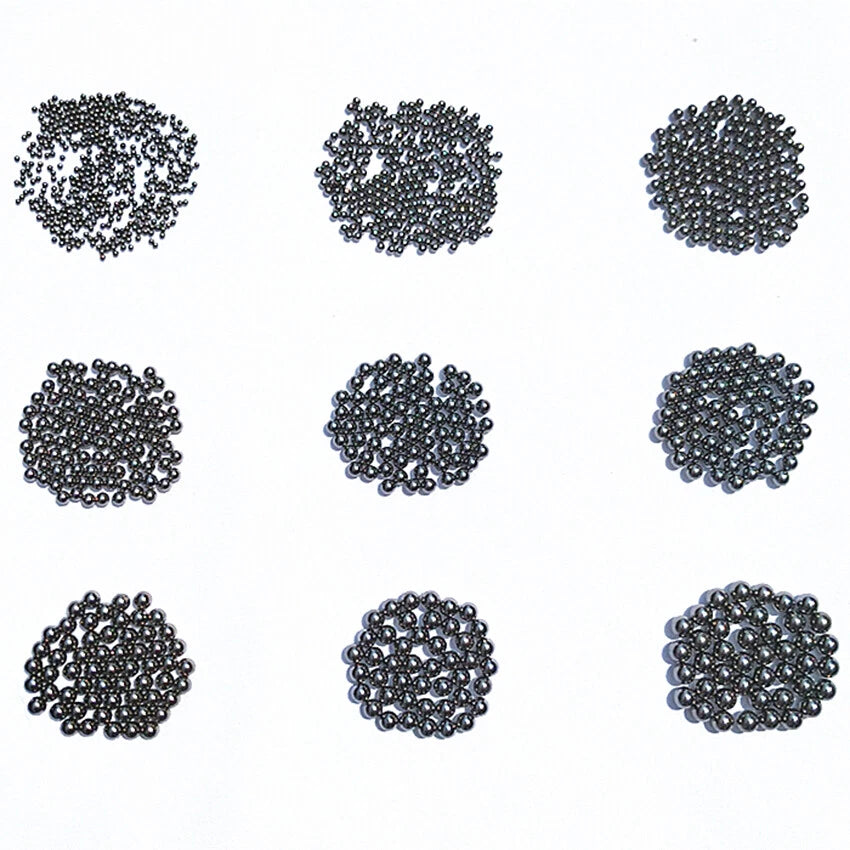
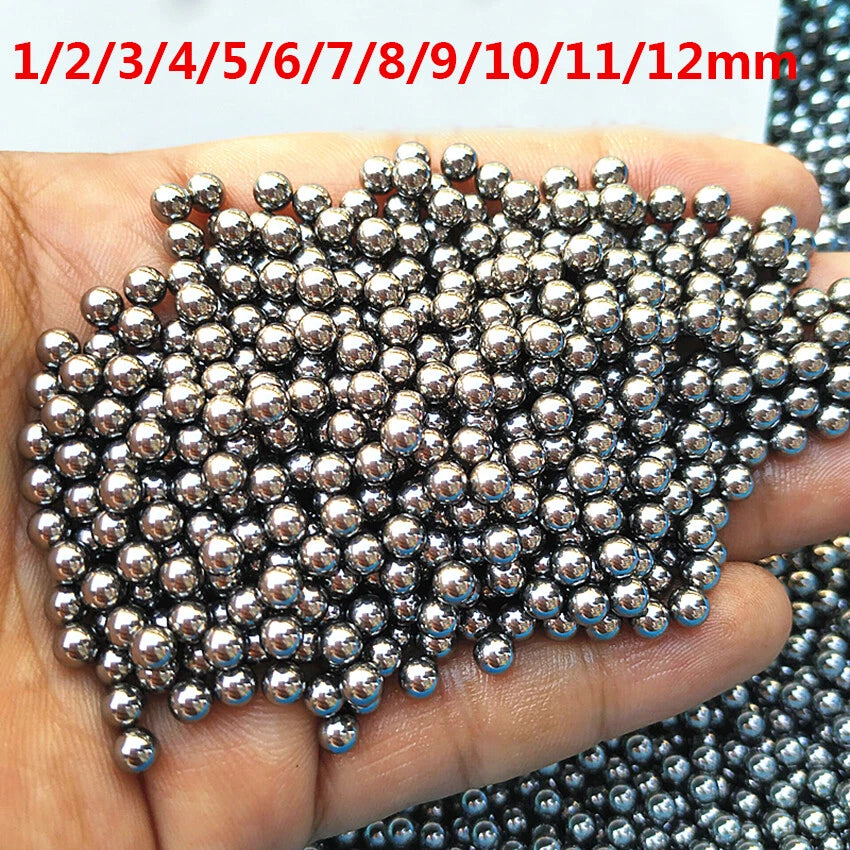
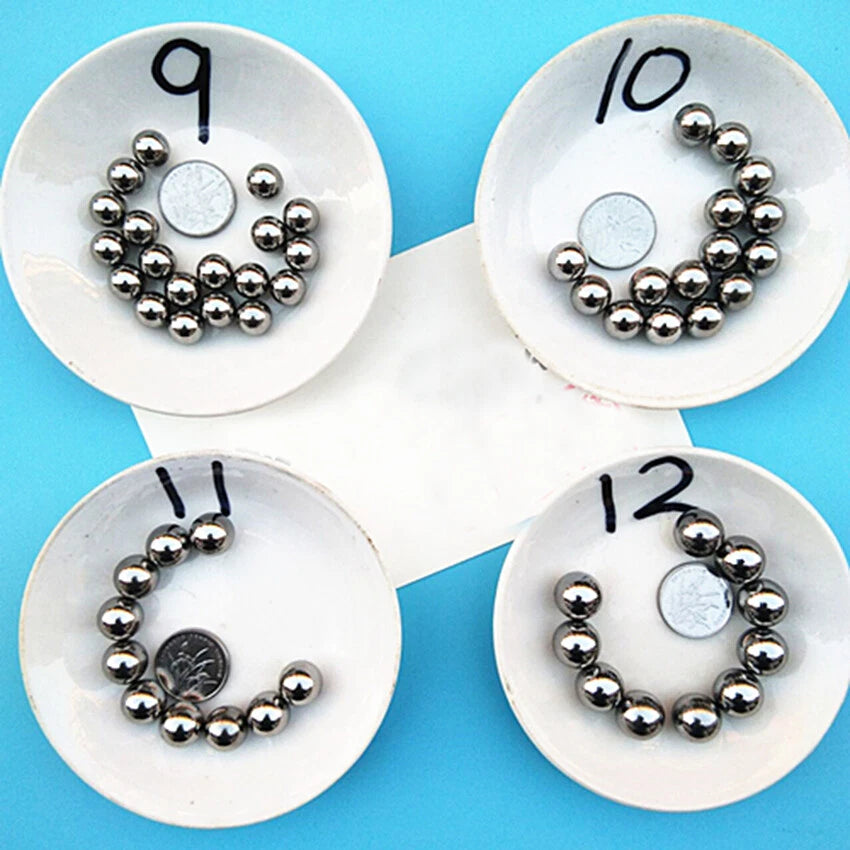
1/2/3/4/5/6/7/8/9/10/11/12mm Chrome Steel Ball Bearings Grade 10 High Precision

No reviews

Price:
Sale price$1.35 USD
Stock:
In stock (500 units), ready to be shipped

Payment & Security

Ach Direct Debit Amazon American Express Apple Pay Bancontact BLIK Diners Club Discover EPS Google Pay iDEAL Wero JCB Maestro Mastercard Multibanco MobilePay PayPal Przelewy24 Shop Pay Twint Union Pay USDC Visa

Your payment information is processed securely. We do not store credit card details nor have access to your credit card information.

Limited Offer — Spend More, Save More
Spend $55+
Save $5
Spend $100+
Save $10
Spend $200+
Save $25
HomeDIYer DIY Expert Support

DIY Expert Support

Get fitment advice & recommendations

Mon–Fri  8:30 AM – 8:00 PM
24-Hour Fast Ship
Arrives in 3–14 Days
Worldwide Shipping
30-Day Returns
1 tree planted with every purchase

Description

Chrome Steel Ball Bearings Grade 10 — Precision Rolling Elements for Demanding Applications

When a loose or undersized ball causes premature bearing failure, vibration, or unacceptable runout in a precision assembly, the root cause is almost always dimensional inconsistency. Engineers, machinists, and serious DIYers who work with spindles, linear slides, ball screws, and instrument-grade mechanisms need chrome steel ball bearings Grade 10 that hold tight tolerances across every unit in the batch.

These chrome steel ball bearings are manufactured from through-hardened GCr15 (52100-equivalent) bearing steel and are available in diameters from 1 mm (≈ 0.039") to 12 mm (≈ 0.472"). Grade 10 classification means a maximum diameter variation of 0.25 µm and a surface roughness Ra ≤ 0.025 µm, making them suitable for applications where Grade 25 or Grade 100 balls would introduce measurable error.

Typical use cases include replacement balls in deep-groove and angular-contact bearing housings, load-distributing elements in ball-screw nuts and linear guides, precision pivot points in optical and measuring instruments, and valve seats in fluid-control assemblies where consistent seating diameter is critical.

⚙️ Compatibility: Sized to ISO 3290 Grade 10 tolerances. Verify bore diameter and radial clearance of your bearing housing before ordering. Available in 1–12 mm diameters — select your exact size from the variant options above.

✅ Key Features of These Chrome Steel Ball Bearings

  • 🔩GCr15 Through-Hardened Steel — Equivalent to AISI 52100 bearing steel; Rockwell hardness typically 60–66 HRC for resistance to deformation under cyclic load.
  • 📏Grade 10 Dimensional Accuracy — Maximum diameter variation ≤ 0.25 µm and sphericity ≤ 0.25 µm per ISO 3290-1, enabling low-noise, low-vibration operation in precision assemblies.
  • 🌊Smooth Surface Finish — Ra ≤ 0.025 µm surface roughness reduces friction and wear at the ball-raceway contact zone, extending service life in both lubricated and minimally lubricated environments.
  • 📐Wide Size Range in One Listing — Diameters from 1 mm to 12 mm (0.039"–0.472") cover the majority of small-to-medium precision bearing applications without sourcing from multiple suppliers.
  • 📦Flexible Pack Quantities — Available in 1, 10, 20, 30, 50, and 100-piece packs, allowing single-unit replacement or bulk stocking for production and maintenance workflows.
  • 🛡️Corrosion-Resistant Surface Treatment — Balls are finished with a light anti-corrosion coating suitable for indoor mechanical environments; for wet or chemical-exposure applications, confirm compatibility or consider stainless alternatives.

📐 Technical Specifications — Chrome Steel Ball Bearings

Material GCr15 Chrome Steel (AISI 52100 equivalent)
Grade Grade 10 (ISO 3290-1)
Diameter Range 1 mm – 12 mm (0.039" – 0.472")
Diameter Variation (VDws) ≤ 0.25 µm
Sphericity (VRws) ≤ 0.25 µm
Surface Roughness (Ra) ≤ 0.025 µm
Hardness Typically 60–66 HRC
Finish Bright, light anti-corrosion treatment
Available Sizes 1 / 2 / 3 / 4 / 5 / 6 / 7 / 8 / 9 / 10 / 11 / 12 mm
Pack Quantities 1 / 10 / 20 / 30 / 50 / 100 Pcs
Applicable Standard ISO 3290-1
Typical Applications See variant options

❓ Frequently Asked Questions

How do I choose the correct ball diameter for my bearing?

Measure the existing ball with a micrometer or use the bearing manufacturer's datasheet to find the specified ball diameter. The nominal diameter must match the raceway groove radius — using an oversized ball increases preload and heat; an undersized ball increases play and noise. If you are replacing worn balls in a full-complement bearing, measure several existing balls and select the size closest to the original specification.

What does Grade 10 mean, and when do I need it instead of Grade 25 or Grade 100?

ISO 3290-1 grades define maximum allowable diameter variation and sphericity error. Grade 10 allows ≤ 0.25 µm variation — tighter than Grade 25 (≤ 0.63 µm) and Grade 100 (≤ 2.5 µm). Choose Grade 10 when your application requires low vibration, low noise, or high rotational accuracy, such as in spindle bearings, precision instruments, or high-speed assemblies. For general-purpose or low-speed applications, Grade 25 or Grade 100 may be sufficient and more cost-effective.

Are these balls suitable for outdoor or wet environments?

GCr15 chrome steel is not inherently stainless. The light anti-corrosion finish provides short-term protection during storage and handling in dry indoor environments. For applications exposed to water, humidity, cutting fluids, or corrosive media, stainless steel balls (AISI 440C or equivalent) are the appropriate choice. Using chrome steel balls in wet conditions without additional sealing or lubrication will lead to surface rust and accelerated wear.

Can I mix balls of different sizes in the same bearing?

No. All balls in a single bearing must be the same nominal diameter and the same grade. Mixing sizes — even within the tolerance band of different grades — creates uneven load distribution, increased vibration, and rapid raceway wear. When replacing balls in a bearing, replace the full complement with balls of identical diameter and grade.

What lubrication is recommended for these chrome steel balls?

For most bearing applications, a light mineral or synthetic grease (NLGI Grade 2) applied to the raceway is sufficient. For high-speed spindle applications, a low-viscosity spindle oil (ISO VG 10–32) is preferred to minimize churning losses. Avoid over-lubrication, which generates heat. For instrument or vacuum applications where outgassing is a concern, consult a specialist lubricant supplier for PFPE or dry-film options.

How many balls do I need to replace a full complement in my bearing?

The number of balls depends on the bearing bore, outer diameter, and ball diameter. A common approximation for a full-complement radial bearing is: Number of balls ≈ π × (bore OD + ball diameter) / (2 × ball diameter). For a precise count, refer to the bearing manufacturer's datasheet or disassemble the bearing and count the existing balls before ordering. Use the pack quantity options (10, 20, 30, 50, or 100 Pcs) to match your required count.

What is the load capacity of these balls?

Individual ball load capacity depends on diameter, material hardness, and the contact geometry of the raceway — it is not a fixed value for the ball alone. For dynamic and static load ratings, refer to the complete bearing assembly specification from the bearing manufacturer. As a general reference, larger diameter balls distribute load over a greater contact area and support higher loads. For critical load calculations, use Hertzian contact stress formulas with the actual ball diameter and raceway radius.

🛒 Select your Size and Qty above, then add to cart.


You may also like

Recently viewed