
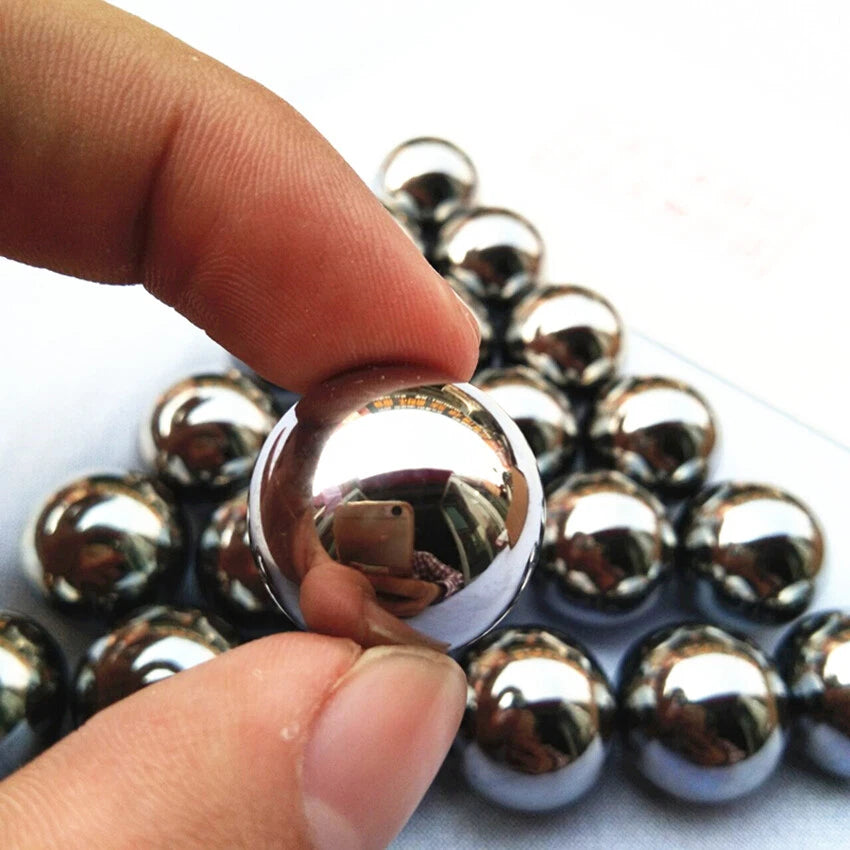
Chrome Steel Ball Bearings 20mm - 77mm Grade 10 Bike Replace Part High Precision

No reviews

Price:
Sale price$125.19 USD
Stock:
In stock (500 units), ready to be shipped

Payment & Security

Ach Direct Debit Amazon American Express Apple Pay Bancontact BLIK Diners Club Discover EPS Google Pay iDEAL Wero JCB Maestro Mastercard Multibanco MobilePay PayPal Przelewy24 Shop Pay Twint Union Pay USDC Visa

Your payment information is processed securely. We do not store credit card details nor have access to your credit card information.

Limited Offer — Spend More, Save More
Spend $55+
Save $5
Spend $100+
Save $10
Spend $200+
Save $25
HomeDIYer DIY Expert Support

DIY Expert Support

Get fitment advice & recommendations

Mon–Fri  8:30 AM – 8:00 PM
24-Hour Fast Ship
Arrives in 3–14 Days
Worldwide Shipping
30-Day Returns
1 tree planted with every purchase

Description

Chrome Steel Ball Bearings — Grade 10 Precision for Bikes, Skateboards & Mechanical Applications

When a worn or pitted bearing starts introducing play into your drivetrain, wheel hub, or pivot assembly, the fix demands a rolling element you can trust to spec. Cyclists, skaters, and equipment technicians who need a direct-fit replacement without guesswork will find these chrome steel ball bearings sized to cover the most common imperial and metric diameters in a single listing.

Each ball is manufactured from through-hardened chrome steel (GCr15 / 52100 equivalent) and finished to ABEC Grade 10 tolerances. Diameters span 20 mm (0.787 in) through 76.2 mm (3.000 in), with both metric and fractional imperial sizes available as separate variants. Quantity options of 1, 2, 5, and 10 pieces let you order exactly what a single repair or a workshop restock requires.

Typical use cases include bicycle bottom-bracket and hub overhauls, skateboard and inline-skate axle replacements, light industrial conveyor rollers, and precision jig or fixture pivot points where dimensional accuracy directly affects performance. The tight sphericity tolerance of Grade 10 also makes these balls suitable for load-distribution applications in custom bearing housings.

⚙️ Compatibility note: These are loose ball bearings intended for open or retainer-style bearing races. Verify your race's ball-seat diameter before ordering. Not pre-assembled into a cartridge bearing unit.

✅ Key Features of These Chrome Steel Ball Bearings

🔩 Grade 10 Tolerance

Sphericity and diameter variation held to ABEC Grade 10 (ISO Grade 10) limits — tighter than standard Grade 25 balls — for reduced vibration and longer race life.

🛡️ Through-Hardened Chrome Steel

GCr15 / 52100 chrome steel provides a surface hardness of typically 60–66 HRC, resisting deformation under radial and axial loads in both static and dynamic applications.

📐 Wide Size Range — 20 mm to 76.2 mm

Over 60 individual diameter options covering metric (20 mm, 22 mm … 76 mm) and fractional imperial (20.638 mm / 13/16 in, 25.4 mm / 1 in, 38.1 mm / 1½ in, etc.) to match OEM specifications without custom machining.

🚲 Direct Bike Replacement Fit

Sized to match common bicycle hub, bottom-bracket cup, and headset race diameters. Suitable for road, mountain, BMX, and vintage track bikes that use loose-ball bearing systems.

Mirror-Polished Surface Finish

Balls are ground and lapped to a surface roughness of typically Ra ≤ 0.025 µm, minimising rolling friction and heat generation during continuous operation.

📦 Flexible Quantity Options

Available in packs of 1, 2, 5, or 10 pieces per order — order a single ball for a one-off repair or a 10-pack for workshop stock without paying for excess inventory.

📐 Technical Specifications — Chrome Steel Ball Bearings

Material Chrome steel (GCr15 / AISI 52100 equivalent)
Grade Grade 10 (ABEC / ISO)
Diameter Range 20 mm – 76.2 mm (0.787 in – 3.000 in)
Available Sizes See variant options
Quantity per Pack 1 Pcs / 2 Pcs / 5 Pcs / 10 Pcs (see variant options)
Surface Hardness Typically 60–66 HRC
Surface Finish Ground & lapped, Ra ≤ 0.025 µm (typical)
Bearing Type Loose ball (not pre-assembled in cartridge)
Corrosion Resistance Standard chrome steel; not stainless — keep lubricated in wet environments
Typical Applications Bicycle hubs, bottom brackets, headsets, skate axles, light industrial rollers
Weight See variant options

❓ Frequently Asked Questions

How do I choose the correct ball diameter for my bearing race?

Measure the diameter of the existing balls with a micrometer or digital caliper — do not rely on the race cup diameter alone. The ball diameter should match the original to within ±0.01 mm for proper load distribution. If the original balls are worn, measure the race groove width and consult the bearing manufacturer's specification sheet for the correct ball size.

What is the difference between Grade 10 and Grade 25 ball bearings?

Grade numbers refer to the maximum allowable deviation in sphericity and diameter variation, measured in ten-thousandths of an inch. Grade 10 balls have a tighter tolerance (max 10 µin / 0.25 µm deviation) than Grade 25 (max 25 µin / 0.635 µm). For bicycle hubs and precision machinery, Grade 10 reduces vibration, noise, and premature race wear compared to standard-grade replacements.

Are these ball bearings suitable for wet or outdoor use?

Chrome steel (GCr15 / 52100) is not inherently stainless. In wet or humid environments, apply a compatible bearing grease or oil before installation and re-lubricate periodically. For applications with continuous water exposure — such as kayak paddle bearings or marine equipment — consider stainless steel Grade 100 balls instead, as chrome steel will surface-rust without adequate lubrication.

Can I use these balls in a sealed or shielded cartridge bearing?

These are loose balls designed for open or retainer-style (cage) bearing assemblies where individual balls are replaced. Sealed and shielded cartridge bearings (e.g., 6001-2RS, 608-ZZ) are press-fit units that are not serviceable with loose balls — those must be replaced as a complete cartridge. If you are unsure which type your application uses, look for a retainer ring or cage around the balls; if present, loose ball replacement is appropriate.

How many balls do I need for a bicycle hub or bottom bracket?

The number varies by component: a typical cup-and-cone front hub uses 9–10 balls per side (18–20 total), a rear hub uses 9 balls per drive side and 10 per non-drive side, and a threaded bottom bracket cup uses 9–11 balls per cup. Always count the original balls before discarding them, or consult your component's service manual. Ordering a 10-pack covers most single-hub overhauls with spares.

What lubricant should I use when installing chrome steel ball bearings?

For bicycle applications, a medium-weight bearing grease (e.g., Phil Wood Waterproof Grease, Park Tool PolyLube 1000, or equivalent lithium-complex grease) is standard. Pack the race cup approximately half-full — over-greasing increases drag. For light industrial or high-speed applications, a low-viscosity bearing oil may be preferable to minimise heat build-up. Avoid petroleum-based greases that can degrade rubber seals in adjacent components.

Do these balls come with a retainer cage or are they sold loose?

These balls are sold loose — no retainer cage is included. They are intended for use in existing cup-and-cone or open-race assemblies that already have a cage or that use a full-complement (cageless) ball arrangement. If your bearing uses a snap-in plastic or steel retainer, reuse the original cage after cleaning it, or source a replacement cage separately sized to your ball diameter.

🛒 Select your Size and Qty above, then add to cart.


You may also like

Recently viewed





