
The chain is fine...but I ordered the wrong size. Nine links of the chain I ordered equals six of the size I wanted. My error...
How can I straighten out the springs? I can't use them coil uo as is.
Your payment information is processed securely. We do not store credit card details nor have access to your credit card information.
Get fitment advice & recommendations
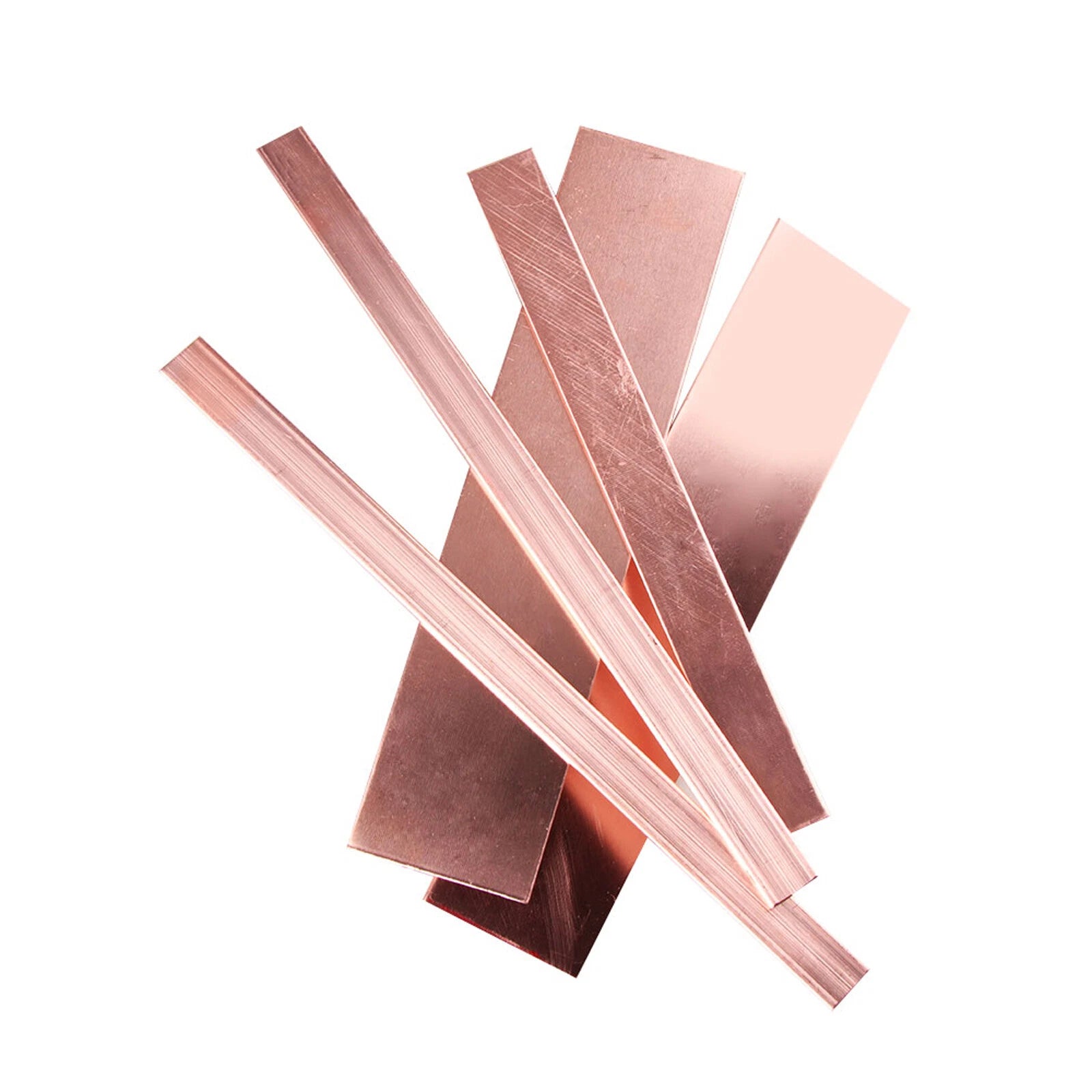
When your project demands reliable conductivity and dimensional accuracy, generic metal stock simply won't cut it. Whether you're a hobbyist wiring a custom bus bar, a maker building a grounding strap, or a small workshop fabricating copper brackets, sourcing flat bar in the exact thickness and width you need is a constant headache. These T2-grade copper flat bars solve that problem with a wide size matrix covering thicknesses from 1 mm to 50 mm (0.04" to 1.97") and widths from 5 mm to 125 mm (0.20" to 4.92").
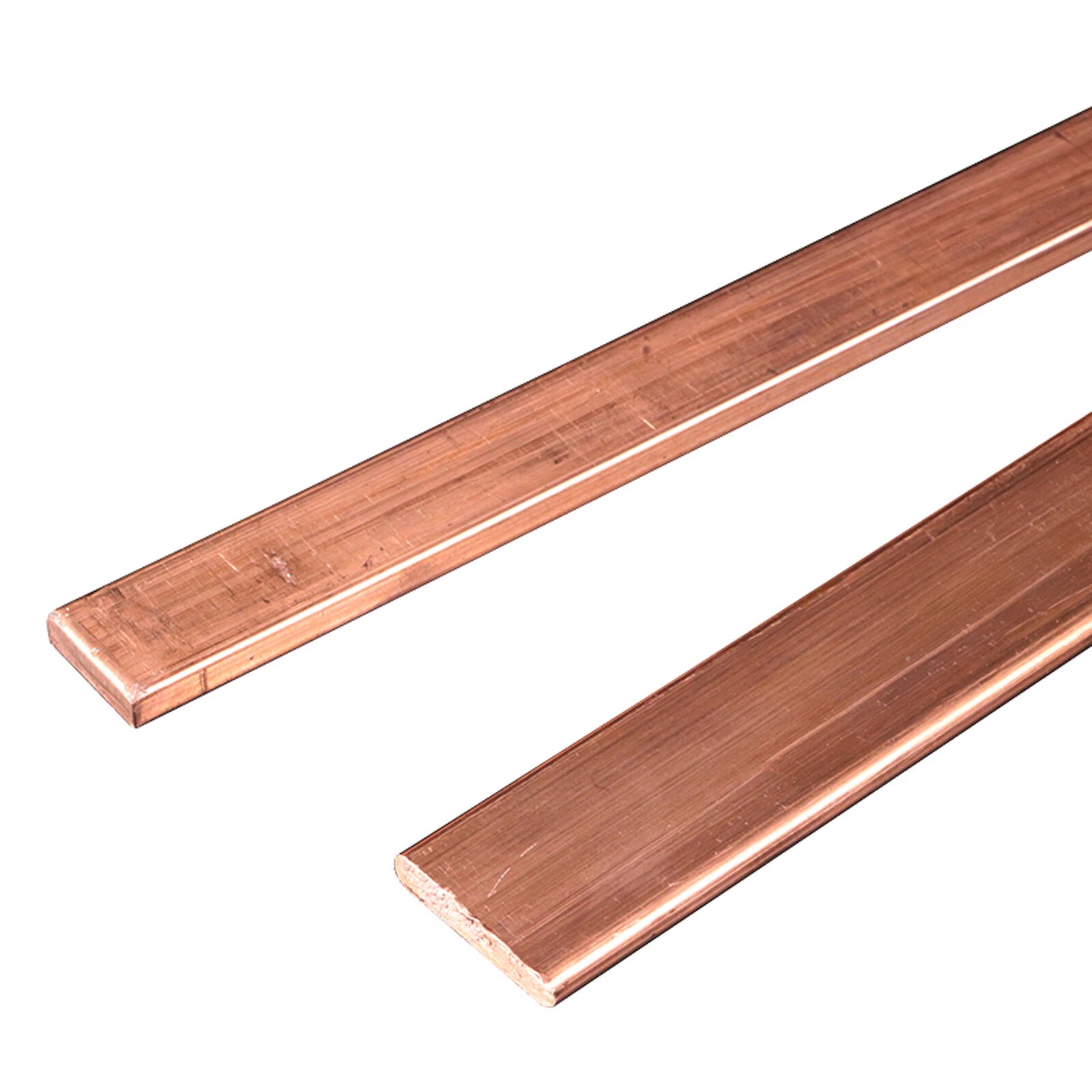
Each piece is a solid copper flat bar cut from T2-grade (C11000-equivalent) copper at 99.9% minimum purity. The standard length is 1000 mm (39.37"). Cross-sections range from slim strips such as 1 mm × 10 mm up to substantial bars like 50 mm × 50 mm, giving you the flexibility to order exactly what your design calls for without paying for material you'll cut away.
Typical applications include DIY electrical bus bars and grounding conductors, custom copper heat spreaders for electronics cooling, decorative inlay and architectural metalwork, and workshop fabrication of clamps, brackets, and shims. The combination of 99.9% copper purity and a flat-bar profile makes these strips a go-to choice for anyone searching for pure copper flat bar stock, T2 copper strip 1 meter, or solid copper plate for electrical projects.
T2 copper meets ≥99.9% Cu content, delivering electrical conductivity of approximately 100% IACS — ideal for bus bars, grounding straps, and conductive components where resistivity matters.
Thickness from 1 mm to 50 mm, width from 5 mm to 125 mm, all at a fixed 1000 mm length. Order the exact cross-section your design requires without over-buying material.
Full solid cross-section throughout the 1-meter length ensures consistent mechanical strength and uniform conductivity from end to end.
With thermal conductivity around 385–400 W/(m·K), these bars work well as heat spreaders, cooling fins, and thermal interface components in electronics and industrial assemblies.
The clean copper surface accepts soldering, brazing, and silver soldering without pre-treatment, and can be bent, drilled, or machined with standard metalworking tools.
Each variant is listed per piece (1 pcs). Order the quantity you need — whether a single prototype bar or multiple pieces for a production run.
| Material | T2 Copper (≥99.9% Cu) |
|---|---|
| Grade / Standard | T2 (equivalent to C11000 ETP Copper) |
| Purity | ≥99.9% Copper |
| Profile | Flat Bar (Solid) |
| Thickness Range | 1 mm – 50 mm (0.04" – 1.97") |
| Width Range | 5 mm – 125 mm (0.20" – 4.92") |
| Length | 1000 mm (1 Meter / 39.37") |
| Surface Finish | Mill finish (natural copper) |
| Electrical Conductivity | ≈100% IACS |
| Thermal Conductivity | ≈385–400 W/(m·K) |
| Density | ≈8.9 g/cm³ |
| Melting Point | ≈1083°C (1981°F) |
| Quantity per Order | See variant options |
| Weight per Piece | See variant options |
Start with your current-carrying or load-bearing requirement. For electrical bus bars, calculate the cross-sectional area needed based on amperage (a common rule of thumb is 1 mm² of copper per 1–2 A for moderate current density). For structural brackets or shims, choose a thickness that provides the required rigidity. Select your variant from the Thick×Width×Length dropdown above — over 100 size combinations are available.
T2 is the designation used in the GB/T standard and is functionally equivalent to C11000 (Electrolytic Tough Pitch copper) used in ASTM standards. Both specify ≥99.9% copper content and deliver near-100% IACS electrical conductivity, making them interchangeable for most electrical and thermal applications.
T2 copper in the annealed or as-rolled condition has a tensile strength of approximately 200–280 MPa and a Brinell hardness of around 40–90 HB depending on temper. It is suitable for light structural applications such as clamps, brackets, and shims, but is not a high-strength structural alloy. For load-bearing structures, consider the specific cross-section and loading conditions carefully.
Copper naturally oxidises in air, forming a thin oxide layer that slows further corrosion. In dry indoor environments the surface will darken to a brown patina over time. In humid or outdoor environments, a green patina (verdigris) may develop. For applications requiring a bright finish, apply a clear lacquer or anti-tarnish coating. For electrical connections, ensure contact surfaces are clean and use appropriate terminal hardware.
Yes. T2 copper solders readily with standard tin-lead or lead-free solders and fluxes. It can be silver-brazed or torch-brazed using copper-phosphorus or silver-alloy filler rods. TIG and MIG welding are possible but require deoxidised copper filler (e.g. C18150) and good shielding gas coverage to avoid porosity. For most DIY and electronics work, soldering or brazing is the recommended joining method.
Thin bars (1–3 mm) can be cut with a metal-cutting hacksaw, angle grinder with a thin cutting disc, or a bandsaw. Thicker bars (4 mm and above) are best cut with a cold saw, bandsaw, or angle grinder. For drilling, use HSS or cobalt drill bits with cutting oil and a slow feed rate to avoid work-hardening the surface. Copper is ductile and tends to grab — use sharp tooling and secure the workpiece firmly.
The listed length is 1000 mm (1 meter). As with all cut metal stock, a manufacturing tolerance of typically ±2–5 mm applies to the length. Width and thickness tolerances are typically ±0.1–0.3 mm depending on the size. If your application requires tighter tolerances, please contact us before ordering to confirm suitability.





