
The chain is fine...but I ordered the wrong size. Nine links of the chain I ordered equals six of the size I wanted. My error...
How can I straighten out the springs? I can't use them coil uo as is.
Your payment information is processed securely. We do not store credit card details nor have access to your credit card information.
Get fitment advice & recommendations
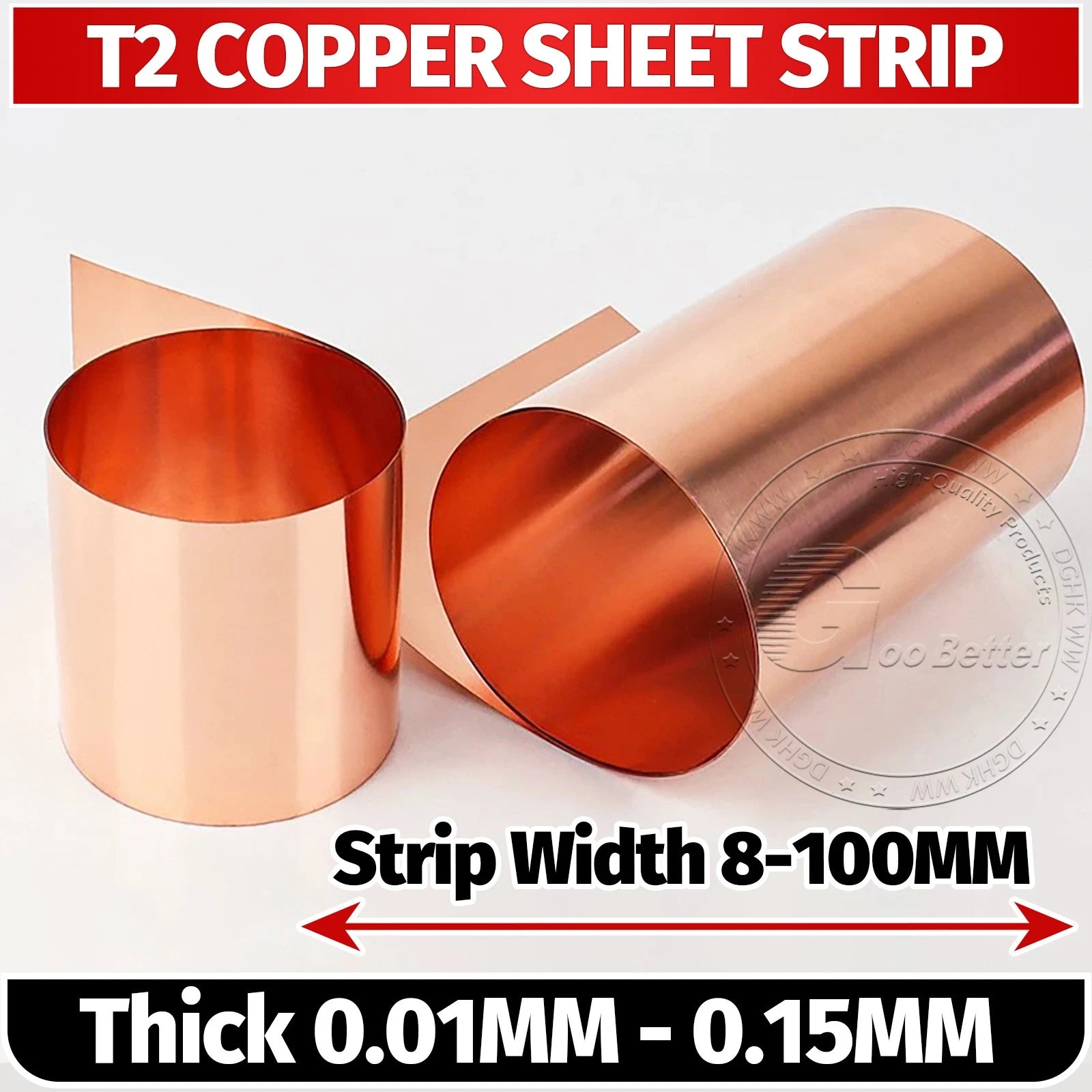
When your project demands exact thickness tolerances and reliable conductivity, standard copper sheet simply won't cut it. Makers, electronics hobbyists, and small-workshop fabricators who need ultra-thin copper sheet strip in precise widths often struggle to find stock that ships in usable lengths without minimum-order headaches. This copper sheet strip solves that problem with a wide selection of thickness-and-width combinations available by the meter.
Each strip is cut from C101 electrolytic-grade pure copper, offering excellent electrical conductivity and a naturally bright finish. Thickness options span 0.01 mm to 0.15 mm (approximately 0.0004" to 0.006"), while widths range from 5 mm to 200 mm (approximately 0.2" to 7.9"). Every variant ships as a 1-meter length, making it easy to cut to your exact requirement.
Typical applications include EMI/RFI shielding tape for electronics enclosures, thin copper foil for stained-glass and art projects, flexible bus-bar stock for battery packs and DIY spot-welding setups, and precision shim material for mechanical assemblies requiring ultra-thin copper sheet strip in custom widths.
| Material | Pure Copper, C101 Electrolytic Grade |
|---|---|
| Purity | ≥99.9% Cu |
| Thickness Range | 0.01 mm – 0.15 mm (0.0004" – 0.006") |
| Width Range | 5 mm – 200 mm (0.20" – 7.87") |
| Length per Unit | 1 Meter (approx. 39.4") |
| Temper | Soft / Annealed (flexible) |
| Surface Finish | Bright rolled, uncoated |
| Electrical Conductivity | See variant options |
| Tensile Strength | See variant options |
| Weight per Meter | See variant options (varies by thickness × width) |
For EMI shielding and foil wrapping, 0.01 mm–0.05 mm is typically sufficient and easy to conform to surfaces. For flexible bus bars or spot-welding nickel-strip alternatives, 0.05 mm–0.10 mm offers a better balance of conductivity and mechanical strength. For precision shims or gaskets requiring dimensional stability, 0.10 mm–0.15 mm is recommended. Select your Thickness x Width variant from the dropdown above.
Yes. C101 pure copper solders readily with standard rosin-core or water-soluble flux solder. For best results, lightly abrade the surface with fine-grit sandpaper or a fiberglass pen to remove any surface oxidation before applying flux. Thinner gauges (0.01 mm–0.03 mm) heat very quickly, so use a low-wattage iron and work fast to avoid burning through the foil.
Copper naturally oxidizes in air, forming a brownish patina that is electrically conductive and actually protective. For applications where appearance matters, store unused strips in a sealed bag with a desiccant. If you need a bright finish long-term, a thin coat of clear lacquer or conformal coating will preserve the surface. The patina does not significantly affect electrical performance in most DIY applications.
Copper strip is an excellent conductor for battery interconnects, but note that standard nickel-strip spot welders may struggle to weld copper directly due to copper's high thermal conductivity. For battery tab work, 0.10 mm–0.15 mm thickness is common. Many builders use copper strip between nickel layers or with a pulse welder capable of higher energy output. For general bus-bar connections, copper strip can be bolted or soldered rather than welded.
For thicknesses up to 0.05 mm, sharp scissors or a craft knife against a steel ruler work well. For 0.05 mm–0.15 mm, tin snips or aviation shears give cleaner cuts with less edge distortion. Score-and-snap with a utility knife on a hard surface also works for straight cuts. Avoid tearing, which can create micro-cracks along the edge that may propagate under flexing.
Traditional copper foil tape for stained glass typically runs 5 mm–12 mm wide. The 5 mm, 8 mm, and 10 mm width options in the 0.01 mm–0.05 mm thickness range are well-suited for wrapping glass edges before soldering. Wider strips (20 mm–50 mm) at 0.05 mm–0.10 mm thickness are popular for decorative metalwork, repousse, and mixed-media art applications.
Yes. C101 copper's high conductivity makes it effective for grounding straps and RF/EMI shielding. For shielding enclosures, 0.05 mm–0.10 mm thickness provides a good balance of flexibility and shielding effectiveness. Overlap seams by at least 10 mm and secure with conductive adhesive or solder for continuous shielding. Thinner foils (0.01 mm–0.03 mm) work well as shielding tape applied over cables or PCB areas.





