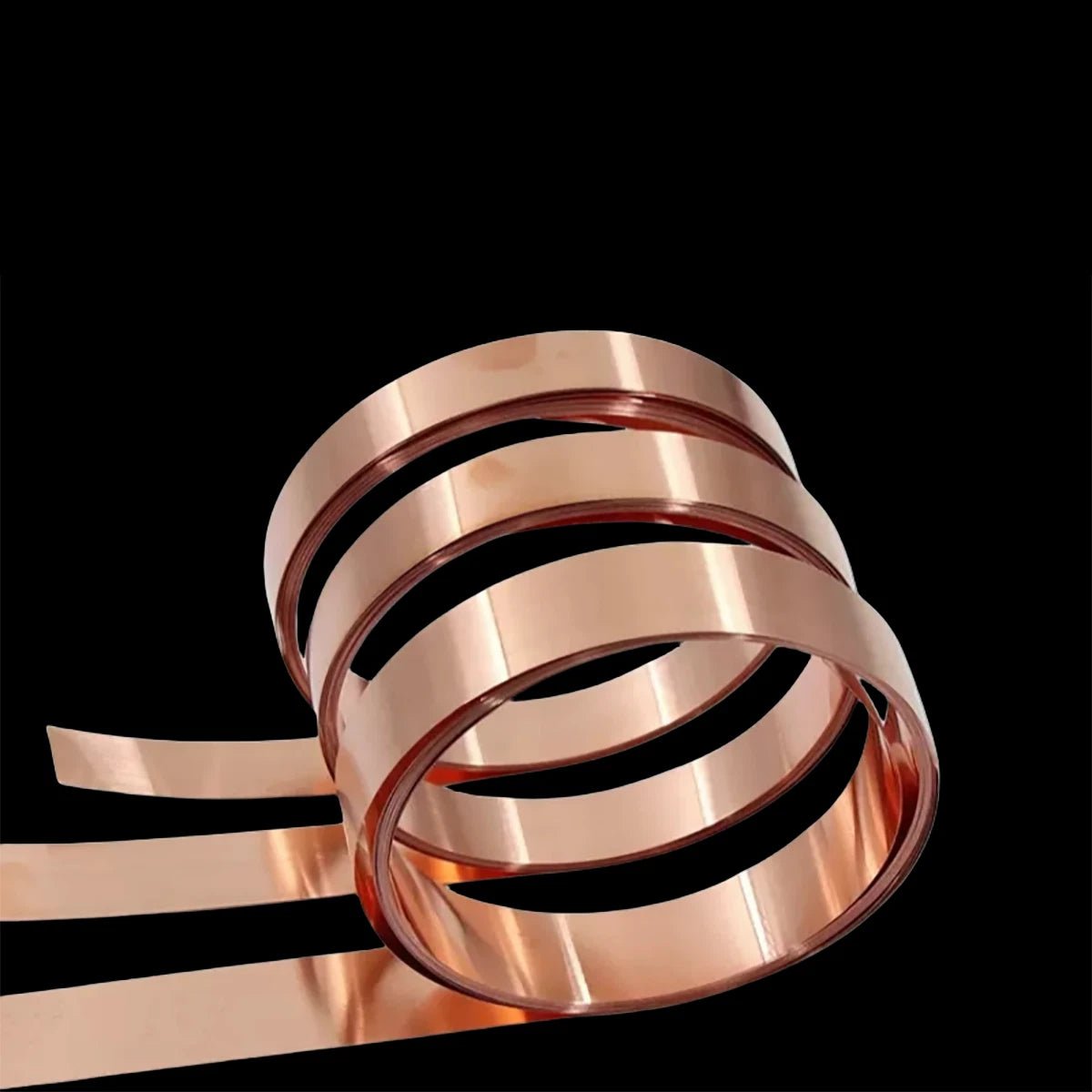
Copper Sheet Strip 0.25mm 0.3mm 0.4mm - 1.0mm Widths Flexible Pure Copper C101

No reviews

Price:
Sale price$4.07 USD
Stock:
In stock (500 units), ready to be shipped

Payment & Security

Ach Direct Debit Amazon American Express Apple Pay Bancontact BLIK Diners Club Discover EPS Google Pay iDEAL Wero JCB Maestro Mastercard Multibanco MobilePay PayPal Przelewy24 Shop Pay Twint Union Pay USDC Visa

Your payment information is processed securely. We do not store credit card details nor have access to your credit card information.

Quantity Discount Promotion
🎯 BULK DISCOUNT: Buy More, Save More!
Buy 2 Items
5% OFF
Buy 4 Items
10% OFF
Buy 6 Items
15% OFF
Expert

DIY Expert Support

Get fitment advice & recommendations

Mon-Fri, 8:30AM-8PM
24-Hour Fast Ship
🚚
Arrives in 3-14 days
🌍
Global Reach
↩️
30-Day Returns
🌱 1 tree planted with every purchase

Description

Copper Sheet Strip C101 — Flexible Pure Copper for Precision DIY & Electrical Work

When your project demands reliable conductivity and a material that bends without cracking, finding the right copper strip in the exact thickness and width can be frustrating. Whether you are a hobbyist wiring a custom circuit, a maker fabricating grounding straps, or a small workshop cutting shims and gaskets, this pure copper sheet strip gives you the dimensional precision you need without ordering bulk coil stock.

Each strip is made from C101 electrolytic tough-pitch copper — one of the highest-purity copper grades commercially available. Thickness options range from 0.25 mm (approximately 0.010 in) up to 1.0 mm (approximately 0.039 in), and widths span from 5 mm (approximately 0.20 in) to 90 mm (approximately 3.54 in). Lengths are available in 1 m and 5 m cuts to suit both quick repairs and longer runs.

Typical applications include RF shielding tape for electronics enclosures, flexible bus bars in battery packs and solar installations, heat-sink shims between components, decorative inlay strips in woodworking, and corrosion-resistant flashing in plumbing or roofing repairs. The soft-annealed temper allows the strip to be bent, formed, and soldered with standard tools.

Compatibility: Suitable for soldering, brazing, and mechanical fastening. Compatible with standard copper flux and silver solder. Works with most PCB, battery, and grounding applications requiring high-conductivity copper.

✅ Key Features of These Copper Sheet Strips

🔩
C101 Electrolytic Copper

Minimum 99.9% copper purity for consistent electrical and thermal conductivity across every strip.

📐
Wide Size Matrix

Thickness from 0.25 mm to 1.0 mm; width from 5 mm to 90 mm — select the exact cross-section your project requires.

✂️
Soft-Annealed Temper

Easily cut with tin snips or a utility knife and bent by hand without cracking, ideal for forming custom shapes on the bench.

⚙️
Solderable & Brazeable

Clean bare copper surface accepts standard rosin flux and silver solder, making electrical joints fast and reliable.

🛡️
Corrosion-Resistant Surface

Copper naturally forms a protective patina over time, resisting moisture and mild chemical exposure in indoor and sheltered outdoor environments.

📦
1 m or 5 m Length Options

Choose a 1 m length for single-use repairs or a 5 m roll for ongoing projects — both lengths ship flat or loosely coiled to prevent kinking.

📐 Technical Specifications — Copper Sheet Strip

Material C101 Electrolytic Tough-Pitch Copper (ETP)
Copper Purity ≥ 99.9%
Temper Soft / Annealed
Thickness Range 0.25 mm – 1.0 mm (0.010 in – 0.039 in)
Width Range 5 mm – 90 mm (0.20 in – 3.54 in)
Available Lengths 1 m / 5 m
Surface Finish Bare / Bright Mill Finish
Electrical Conductivity ≥ 100% IACS (typical for C101)
Thermal Conductivity Approximately 391 W/(m·K)
Tensile Strength (annealed) Typically 200 – 250 MPa
Elongation Typically ≥ 30%
Melting Point Approximately 1083 °C (1981 °F)
Weight per Variant See variant options

❓ Frequently Asked Questions

How do I choose the right thickness and width for my project?

Start with the current or heat load your application must handle. For light signal or grounding traces, 0.25–0.3 mm thickness with a 5–15 mm width is typically sufficient. For bus bars carrying several amps, step up to 0.5–1.0 mm thickness and a wider strip. If you are making shims or gaskets, match the thickness to the gap you need to fill. When in doubt, select the next size up — copper is easy to fold or trim down on the bench.

Is C101 copper the same as pure copper?

C101 (also called ETP copper or electrolytic tough-pitch copper) contains a minimum of 99.9% copper, making it one of the highest-purity commercial copper grades. It offers excellent electrical conductivity — rated at 100% IACS — and is the standard choice for electrical bus bars, transformer windings, and precision grounding applications. It differs from C110 only in minor oxygen content, and both are considered "pure copper" for most DIY and engineering purposes.

Can I solder directly to this copper strip?

Yes. The bare bright mill finish accepts standard rosin-core solder and silver solder without pre-treatment. For best results, lightly abrade the surface with fine sandpaper or a Scotch-Brite pad to remove any surface oxidation, apply a thin layer of rosin flux, and heat with a soldering iron or torch until the solder flows freely. Avoid acid flux on copper that will be used in electrical circuits, as residue can cause corrosion over time.

Will this copper strip corrode or tarnish outdoors?

Copper naturally oxidises when exposed to air and moisture, forming a brown or green patina (verdigris). This patina is actually protective and slows further corrosion — which is why copper is widely used in roofing, plumbing, and marine applications. For indoor electronics or shielding use, the tarnish has no meaningful effect on conductivity. If you need a bright appearance long-term, apply a clear lacquer or keep the strip in a sealed bag when not in use.

Is this strip compatible with aluminium or steel in my assembly?

Copper and aluminium form a galvanic couple that can cause accelerated corrosion at the contact point in the presence of moisture. Use an anti-oxidant compound or isolating washer when joining copper to aluminium in outdoor or humid environments. Copper and stainless steel have a smaller galvanic potential difference and are generally compatible for most indoor applications. Always consider the environment and expected service life when mixing metals.

How do I cut and bend the strip without cracking it?

The soft-annealed temper means this strip is very workable. For straight cuts, use tin snips, aviation shears, or a sharp utility knife guided by a steel rule. For thicker strips (0.8–1.0 mm), a bench shear or angle grinder with a thin cut-off disc gives cleaner edges. To bend, use a metal brake or clamp the strip between two pieces of flat bar and fold by hand. Avoid sharp-radius bends on thicker strips — a bend radius of at least 1× the thickness prevents micro-cracking.

What is the difference between the 1 m and 5 m length options?

Both lengths are the same material and cross-section — the only difference is the total length you receive. The 1 m option is ideal for single repairs, prototyping, or when you only need a short run. The 5 m option offers a lower cost per metre and is suited for ongoing projects, batch production, or when you anticipate needing multiple pieces from the same size. Longer strips are shipped loosely coiled or flat-packed depending on width.

🛒 Select your thickness × width and length above, then add to cart.

You may also like

Recently viewed