The chain is fine...but I ordered the wrong size. Nine links of the chain I ordered equals six of the size I wanted. My error...
How can I straighten out the springs? I can't use them coil uo as is.
Your payment information is processed securely. We do not store credit card details nor have access to your credit card information.
Get fitment advice & recommendations
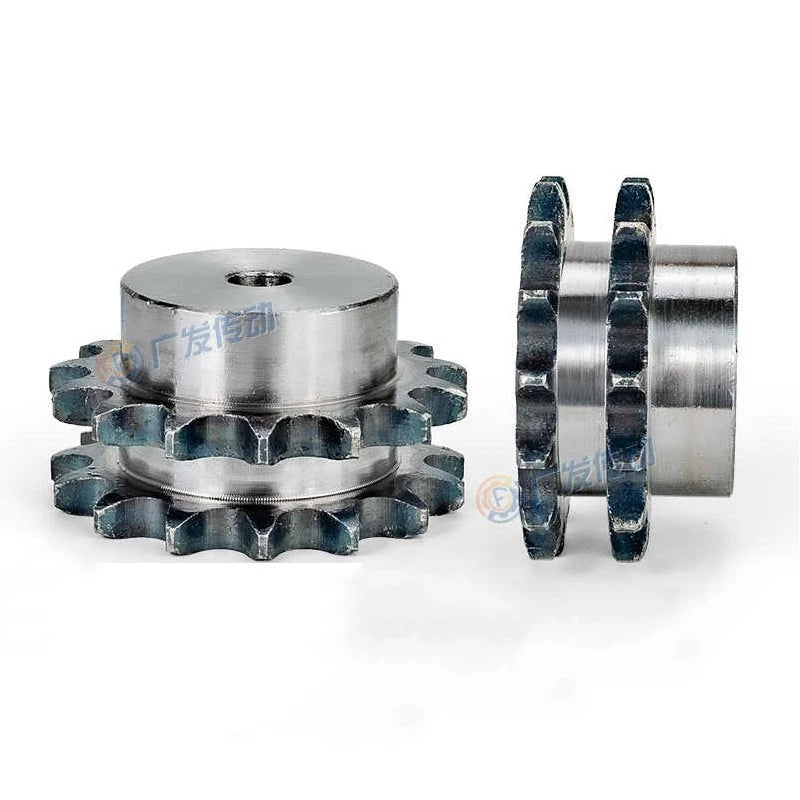
When a worn or mismatched sprocket causes chain skip, vibration, or premature wear, the entire drivetrain suffers — and so does your project timeline. Whether you're building a conveyor, agricultural machine, go-kart, or industrial automation rig, the right duplex sprocket is the foundation of a reliable chain drive. These 12A duplex chain sprockets are engineered to pair directly with #60 (12A) double-strand roller chain, giving makers, fabricators, and machine builders a drop-in solution that holds up under real working loads.
Each sprocket is machined from 45# medium-carbon steel, chosen for its balance of hardness, toughness, and machinability. The tooth profile conforms to the ISO 606 / ANSI B29.1 standard for 12A chain, with a pitch of 19.05 mm (¾ inch). Available tooth counts range from 12T to 24T, with bore and hub dimensions varying by model — refer to variant options for exact bore sizing. Overall sprocket diameter scales with tooth count, typically from approximately 75 mm (2.95 in) at 12T up to approximately 150 mm (5.91 in) at 24T.
These duplex sprockets are well-suited for conveyor drive systems requiring synchronized dual-strand tension, power transmission setups on small agricultural equipment such as seeders and tillers, custom go-kart and mini-bike rear axle assemblies using #60 chain, and DIY automation projects where a compact, torque-capable chain drive is needed. The duplex (double-strand) configuration doubles the load-carrying capacity compared to a simplex sprocket of the same pitch, making it the right choice when single-strand chain would be undersized for the application.
Two parallel tooth rows machined to ISO 606 / ANSI B29.1 tolerances for #60 / 12A roller chain. The dual-strand design doubles load capacity versus a simplex sprocket at the same pitch, reducing chain stress and extending drivetrain service life.
Machined from 45# steel — a medium-carbon grade known for its combination of surface hardness after heat treatment and core toughness. Resists tooth deformation under shock loads and cyclic stress better than low-carbon alternatives.
The 19.05 mm pitch is the defining dimension of #60 / 12A roller chain. Every tooth is cut to this pitch so rollers seat fully and evenly, eliminating the uneven contact that causes accelerated wear on both chain and sprocket.
Eleven tooth-count options from 12T through 24T let you dial in your drive ratio precisely. Pair a small driver sprocket with a larger driven sprocket to multiply torque, or match tooth counts for a 1:1 speed transfer — all within the same chain standard.
Each sprocket receives a protective surface treatment to slow oxidation in moderately humid workshop and outdoor environments. For continuous wet or chemical exposure, pair with a stainless or sealed chain and apply a compatible chain lubricant.
The bore is finish-machined to a consistent diameter (see variant options for exact bore size). The hub accepts standard keyways and set-screw configurations, making shaft mounting straightforward without custom machining in most applications.
| Chain Standard | #60 / 12A Duplex (Double-Strand) Roller Chain |
|---|---|
| Chain Pitch | 19.05 mm (¾ in) |
| Strand Type | Duplex (2-strand) |
| Available Tooth Counts | 12T, 13T, 14T, 15T, 16T, 17T, 18T, 19T, 20T, 22T, 24T |
| Material | 45# Medium-Carbon Steel |
| Bore Diameter | See variant options |
| Hub Diameter | See variant options |
| Overall Width (duplex) | See variant options |
| Pitch Diameter (approx.) | ~72.8 mm (12T) to ~145.6 mm (24T) |
| Surface Treatment | Oxidation-resistant protective finish |
| Mounting | Keyway + set-screw compatible |
| Quantity per Order | 1 Pcs (per listing) |
Your drive ratio is determined by dividing the driven sprocket's tooth count by the driver sprocket's tooth count. For example, pairing a 12T driver with a 24T driven sprocket gives a 2:1 reduction — the output shaft turns at half the speed but with twice the torque. Start by calculating the speed and torque you need at the output shaft, then select tooth counts that achieve that ratio within the 12T–24T range available here.
No. These are duplex (double-strand) sprockets machined with two parallel tooth rows to match #60 / 12A duplex roller chain. Using them with single-strand #60 chain will result in misalignment and rapid wear. If you need a simplex sprocket for #60 chain, please check our simplex sprocket listings.
Bore diameter varies by tooth count — please refer to the variant options on this page for the exact bore size of each model. The bore is finish-machined and accepts standard keyways. If you need a non-standard bore diameter, we recommend consulting a local machine shop to bore the sprocket to your shaft size after purchase, as the 45# steel machines cleanly.
The 45# steel construction provides solid tensile strength (typically 600–800 MPa depending on heat treatment), and the duplex configuration doubles the load-carrying capacity compared to a simplex sprocket of the same pitch. Exact working load depends on your RPM, chain tension, and lubrication conditions. For critical load calculations, refer to the ANSI B29.1 chain drive design standard or consult an engineer for your specific application.
Each sprocket has a protective surface finish that provides moderate resistance to oxidation in typical workshop and outdoor conditions. For continuous exposure to moisture, salt spray, or chemicals, we recommend applying a compatible chain lubricant regularly and pairing with a corrosion-resistant roller chain. For highly corrosive environments, consider stainless steel sprocket options.
Confirm two things: (1) your chain is #60 or 12A duplex roller chain with a 19.05 mm pitch, and (2) your chain is double-strand (duplex), not single-strand. You can measure chain pitch by placing the chain flat and measuring center-to-center between any two roller pins 10 links apart, then dividing by 10 — the result should be 19.05 mm (¾ in). If both conditions match, these sprockets are compatible.
#60 is the ANSI designation and 12A is the ISO 606 designation for the same chain standard — both refer to roller chain with a 19.05 mm (¾ in) pitch. These sprockets are machined to this shared pitch standard and are compatible with chain sold under either designation, as long as it is the duplex (double-strand) variant.