The chain is fine...but I ordered the wrong size. Nine links of the chain I ordered equals six of the size I wanted. My error...
How can I straighten out the springs? I can't use them coil uo as is.
Your payment information is processed securely. We do not store credit card details nor have access to your credit card information.
Get fitment advice & recommendations
When a standard bearing simply won't seat flush against a housing wall, engineers and hobbyists reach for flanged ball bearings. Whether you're rebuilding a brushless motor, assembling a 3D printer carriage, or fabricating a custom RC drivetrain, the flange lip locks axial position without additional retaining hardware — eliminating the slop that causes premature wear in high-cycle assemblies.
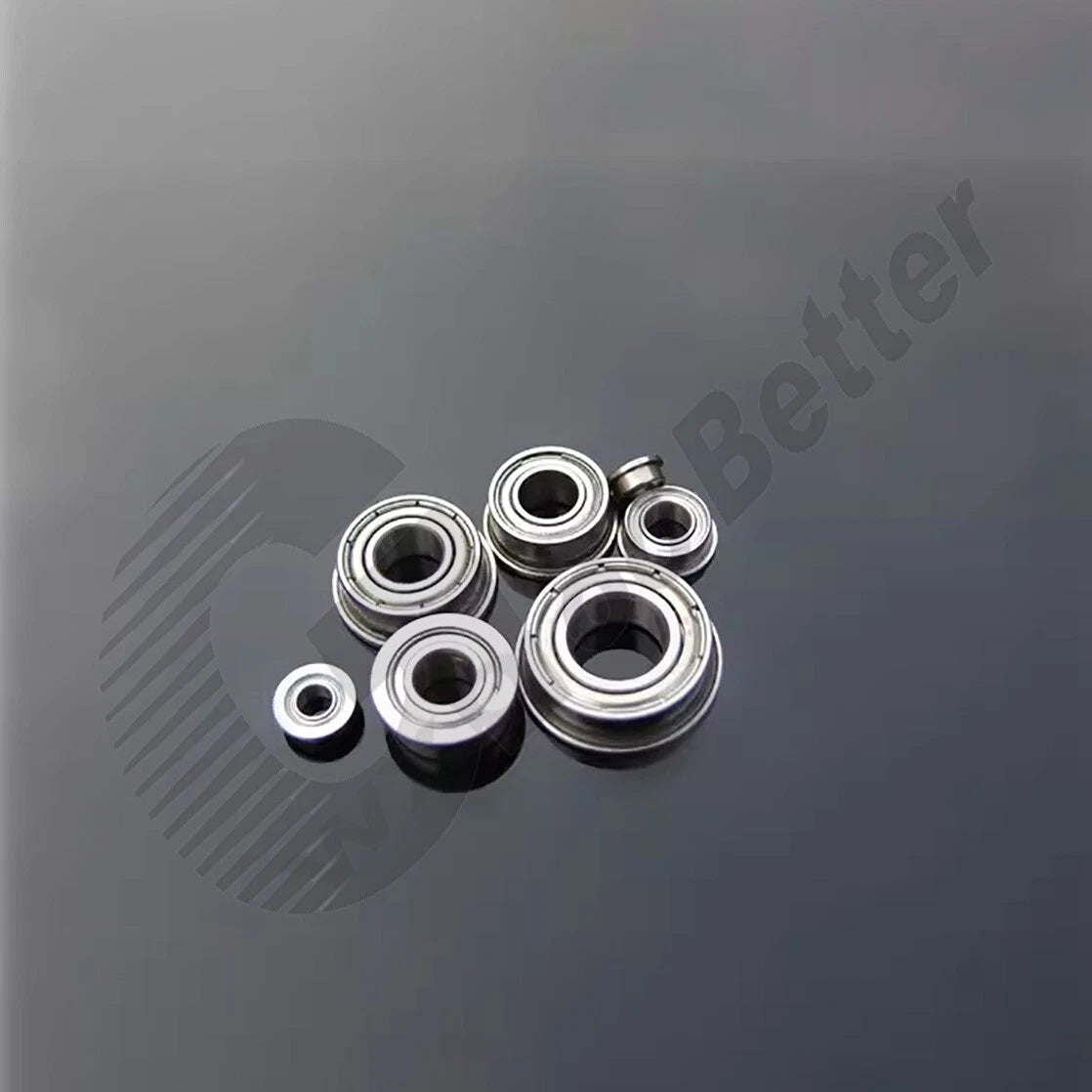
These miniature flanged ball bearings feature a steel inner and outer race with metal shields on both sides, covering inner diameters from 2 mm to 10 mm (~0.079" to ~0.394"). The flange outer diameter extends beyond the standard OD by approximately 1–2 mm, providing a positive stop against the bore shoulder. Available sizes span ID × OD × Height × Flange OD: 2×5×2.3×6 mm, 3×6.2×2.5×7.2 mm, 4×8×3×9.2 mm, 4×9×4×10.3 mm, 5×11×5×12.5 mm, 6×13×5×15 mm, 8×16×5×18 mm, and 10×19×5×21 mm.
Typical use cases include miniature flanged ball bearings for RC car wheel hubs, flanged bearings for 3D printer idler pulleys, and small flanged ball bearings for robotics joint pivots — all applications where axial location accuracy and low rotational drag directly affect performance.
| Bearing Type | Flanged Deep Groove Ball Bearing |
|---|---|
| Shield Type | Metal (ZZ) — both sides |
| Inner Diameter (ID) | 2 mm / 3 mm / 4 mm / 5 mm / 6 mm / 8 mm / 10 mm |
| Outer Diameter (OD) | See variant options |
| Bearing Height | 2.3 mm – 5 mm (varies by size) |
| Flange Outer Diameter | See variant options |
| Material | Hardened steel races; stamped steel shields |
| Lubrication | Factory-greased |
| Operating Temperature | Typically –10°C to +120°C (–14°F to +248°F) |
| Radial Load Capacity | See variant options / Contact us to confirm |
| Pack Quantity | 1 / 2 / 5 / 10 pcs (select above) |
Measure your shaft diameter to determine the required inner diameter (ID). Then confirm the housing bore accepts the bearing's outer diameter (OD) and that the housing shoulder depth is shallower than the flange thickness so the flange seats properly. Cross-reference the Height dimension to ensure the bearing fits within your axial space envelope.
A flanged bearing has a raised lip (flange) extending radially outward from one end of the outer race. This flange acts as a built-in shoulder stop, locating the bearing axially against a housing face without needing a separate snap ring, circlip, or press-fit step. Standard bearings require additional hardware or machined features to achieve the same axial retention.
Metal-shielded (ZZ) bearings are appropriate for moderate-speed applications. For very high RPM environments such as brushless drone motors, confirm the bearing's dynamic load rating and speed limit against your motor's operating RPM. If your application exceeds typical miniature bearing speed ranges, contact us to confirm suitability before ordering.
Metal shields are non-contact and provide splash and debris resistance, but they are not fully sealed. They do not form a hermetic barrier against water ingress or fine dust in harsh outdoor environments. For wet or heavily contaminated conditions, consider rubber-sealed (2RS) bearings instead.
The metal shields can be carefully removed with a fine pick to access the bearing interior for re-lubrication. Use a light machine grease or bearing grease appropriate for your operating temperature and speed. Avoid over-packing, as excess grease increases drag and heat at higher speeds.
For prototyping or single-unit repairs, the 1-piece or 2-piece pack lets you validate fit and function before committing to larger quantities. For production runs or maintenance stock, the 5-piece or 10-piece packs offer a lower per-unit cost and ensure you have spares on hand to minimize downtime.
These bearings use metric dimensions (mm). They will fit metric shafts of the corresponding diameter. Imperial shafts with a close metric equivalent may fit with minimal clearance, but for precision applications always verify the actual shaft diameter in millimeters against the bearing ID before ordering.