
The chain is fine...but I ordered the wrong size. Nine links of the chain I ordered equals six of the size I wanted. My error...
How can I straighten out the springs? I can't use them coil uo as is.
Your payment information is processed securely. We do not store credit card details nor have access to your credit card information.
Get fitment advice & recommendations
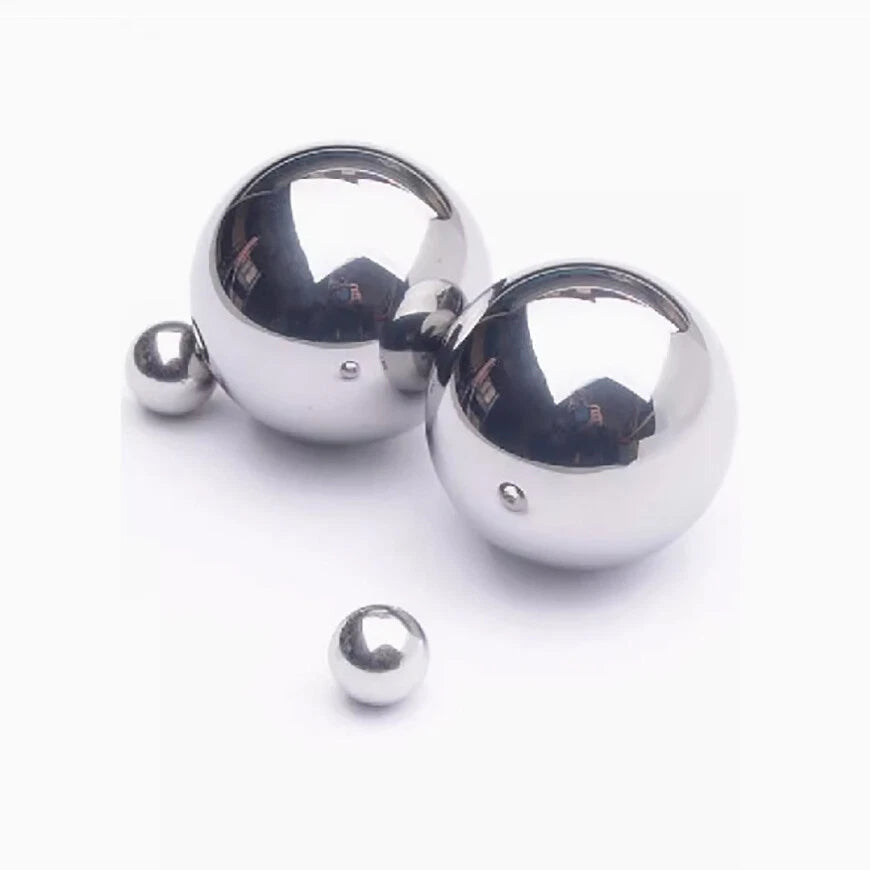
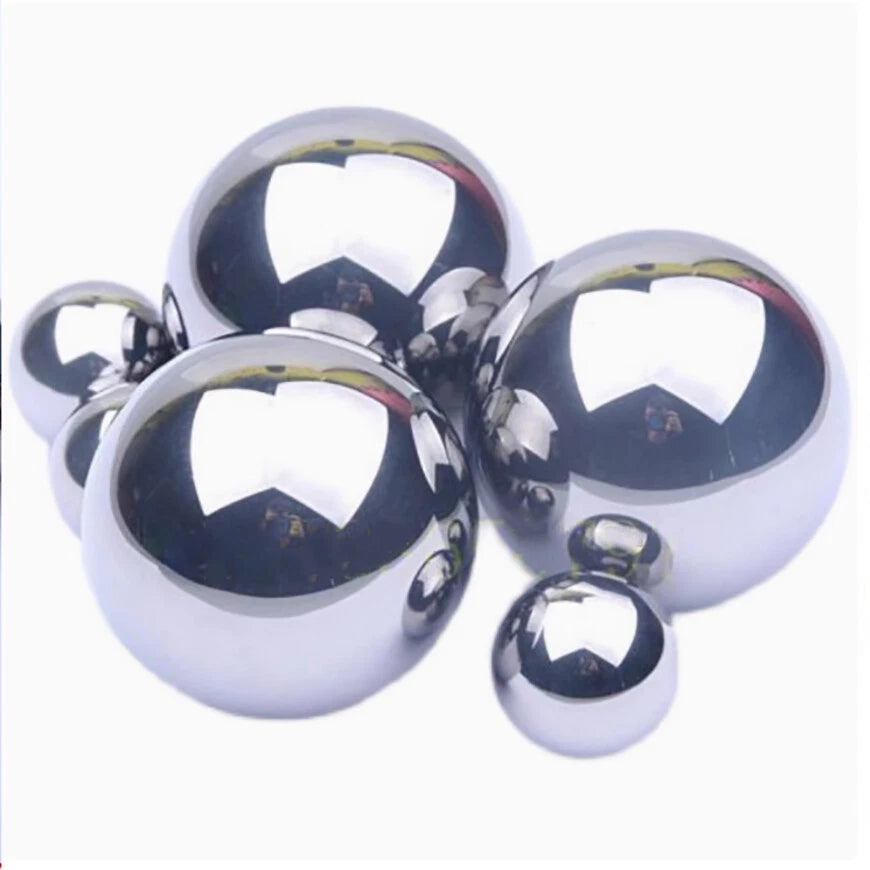
When a worn or undersized ball causes play, noise, or premature failure in a bearing assembly, the fix demands dimensional accuracy you can trust. Engineers, machinists, and serious DIYers who work with linear guides, angular-contact bearings, ball screws, and precision instruments need replacement balls that meet tight tolerances — not generic hardware-bin stock.
These Gcr15 steel ball bearings are manufactured to G10 grade and heat-treated to HRC 60–65 hardness. Gcr15 (equivalent to AISI 52100 chrome steel) delivers a well-balanced combination of surface hardness, core toughness, and fatigue resistance. Diameters span 0.8 mm (0.031 in) through 9 mm (0.354 in), covering both metric and inch-fractional sizes such as 1/16 in (1.588 mm), 3/32 in (2.381 mm), 1/8 in (3.175 mm), 5/32 in (3.969 mm), 3/16 in (4.763 mm), 7/32 in (5.556 mm), 15/64 in (5.953 mm), 1/4 in (6.35 mm), 17/64 in (6.747 mm), 9/32 in (7.144 mm), 5/16 in (7.938 mm), and 11/32 in (8.731 mm).
Typical use cases include replacing balls in deep-groove radial bearings, restocking ball-screw assemblies on CNC machines, loading precision instrument pivots, and supplying check-valve seats in hydraulic or pneumatic circuits. The broad size range also makes these a reliable bench stock for repair shops that service a variety of equipment.
High-carbon chromium alloy steel with consistent carbide distribution, delivering the hardness and fatigue life required for rolling-contact applications.
Diameter tolerance within ±0.25 µm and sphericity deviation ≤0.25 µm per ISO 3290 G10 classification — suitable for precision instrument and machine-tool use.
Heat treatment produces a uniform hardness profile that resists deformation under cyclic load, extending service life in high-cycle bearing applications.
31 discrete sizes covering metric and inch-fractional standards, reducing the need to source from multiple suppliers for mixed-unit assemblies.
Packing quantities scale with ball size so you receive a practical working stock — smaller diameters ship in 300-piece packs; larger sizes in 100-piece packs.
Dimensionally matched to standard bearing catalogues; no secondary machining required for most deep-groove and angular-contact bearing replacements.
| Material | Gcr15 Chrome Steel (AISI 52100 equivalent) |
|---|---|
| Grade | G10 (ISO 3290) |
| Hardness | HRC 60–65 |
| Diameter Range | 0.8 mm – 9 mm (0.031 in – 0.354 in) |
| Available Diameters | 0.8, 1, 1.2, 1.588, 2, 2.381, 2.5, 2.778, 3, 3.175, 3.5, 3.969, 4, 4.5, 4.763, 5, 5.5, 5.556, 5.953, 6, 6.3, 6.35, 6.747, 7, 7.144, 7.5, 7.938, 8, 8.5, 8.731, 9 mm |
| Surface Finish | See variant options |
| Packing Quantity | 100 pcs / 200 pcs / 300 pcs (varies by diameter) |
| Corrosion Resistance | Standard chrome steel; recommend light oil coating for humid environments |
| Typical Applications | Deep-groove bearings, angular-contact bearings, ball screws, linear guides, check valves, instrument pivots |
Measure the existing balls with a micrometer or refer to the bearing manufacturer's datasheet. The ball diameter is listed in the bearing's internal geometry specification. Match the measured diameter to the nearest available size in this listing. For inch-fractional bearings, cross-reference the decimal equivalent (e.g., 1/4 in = 6.35 mm) against the available options.
G10 is an ISO 3290 precision grade indicating a diameter tolerance of ±0.25 µm and a sphericity deviation of ≤0.25 µm. It is suitable for most machine-tool spindles, precision instruments, and general industrial bearings. Applications requiring tighter tolerances (G5 or G3) — such as ultra-precision grinding spindles — should specify a higher grade.
The balls are through-hardened to HRC 60–65 via a controlled heat-treatment process. At this hardness level, plastic deformation under normal rolling-contact loads is negligible. Gcr15 / AISI 52100 is the industry-standard material for bearing balls precisely because of its combination of surface hardness and core toughness.
Gcr15 chrome steel provides moderate corrosion resistance compared to carbon steel, but it is not stainless. For humid, wet, or chemically exposed environments, apply a light rust-inhibiting oil after installation, or consider stainless steel balls (AISI 440C) for those specific conditions. For standard indoor mechanical applications, no additional treatment is required.
Yes, provided the diameter matches the OEM specification. Bearing balls are standardised components; the critical parameters are diameter, grade, and material. These G10 Gcr15 balls meet the material and dimensional standards used by major bearing manufacturers. Always verify the ball count and diameter from the bearing's technical datasheet before ordering.
Packing quantities are set per variant: smaller diameters (0.8 mm–6.3 mm) come in 300-piece packs, mid-range sizes (6.35 mm–7.5 mm) in 200-piece packs, and larger sizes (7.938 mm–9 mm) in 100-piece packs. Each variant is a separate SKU, so you can add multiple diameter variants to your cart independently to build a mixed-size stock order.
Gcr15 (AISI 52100) chrome steel offers higher hardness (HRC 60–65) and superior fatigue life under rolling contact compared to standard 440C stainless (typically HRC 58–62). Choose Gcr15 for high-load, high-cycle applications where corrosion is not a primary concern. Choose stainless steel when the operating environment involves moisture, food contact, or chemical exposure that would corrode chrome steel.





