The chain is fine...but I ordered the wrong size. Nine links of the chain I ordered equals six of the size I wanted. My error...
How can I straighten out the springs? I can't use them coil uo as is.
Your payment information is processed securely. We do not store credit card details nor have access to your credit card information.
Get fitment advice & recommendations
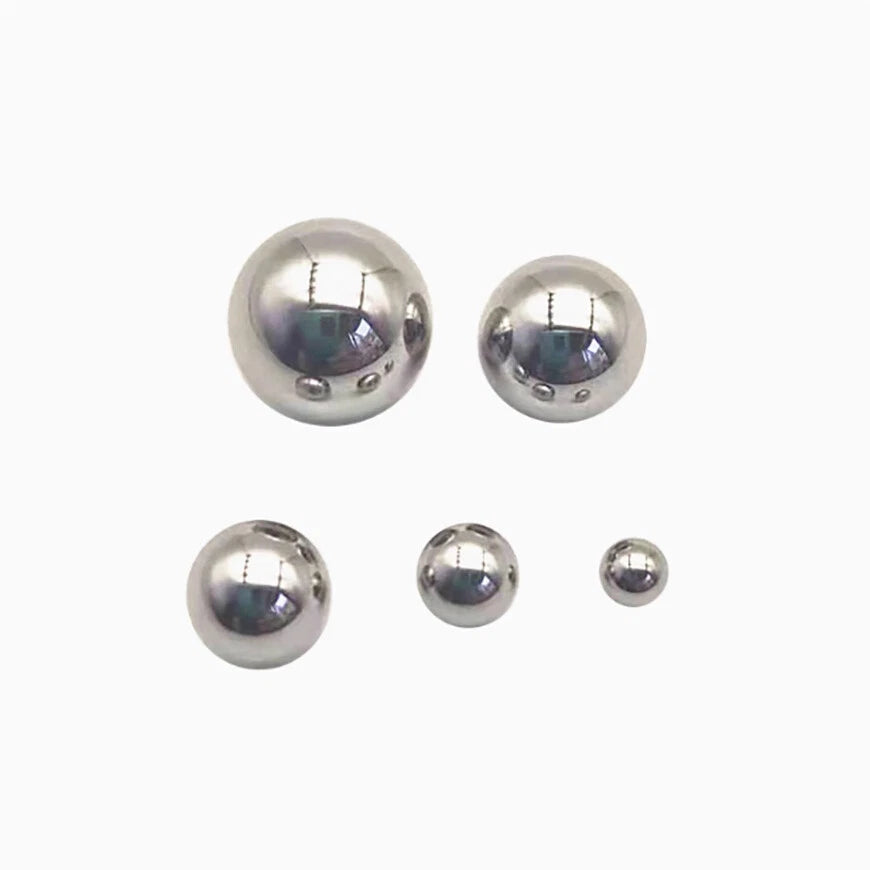
When a worn or undersized ball causes vibration, noise, or premature bearing failure, engineers and maintenance technicians need a replacement they can trust to spec. These solid GCr15 chromium steel balls are precision-ground to tight tolerances, making them a reliable choice for hobbyists, machine builders, and industrial maintenance teams who cannot afford dimensional surprises.
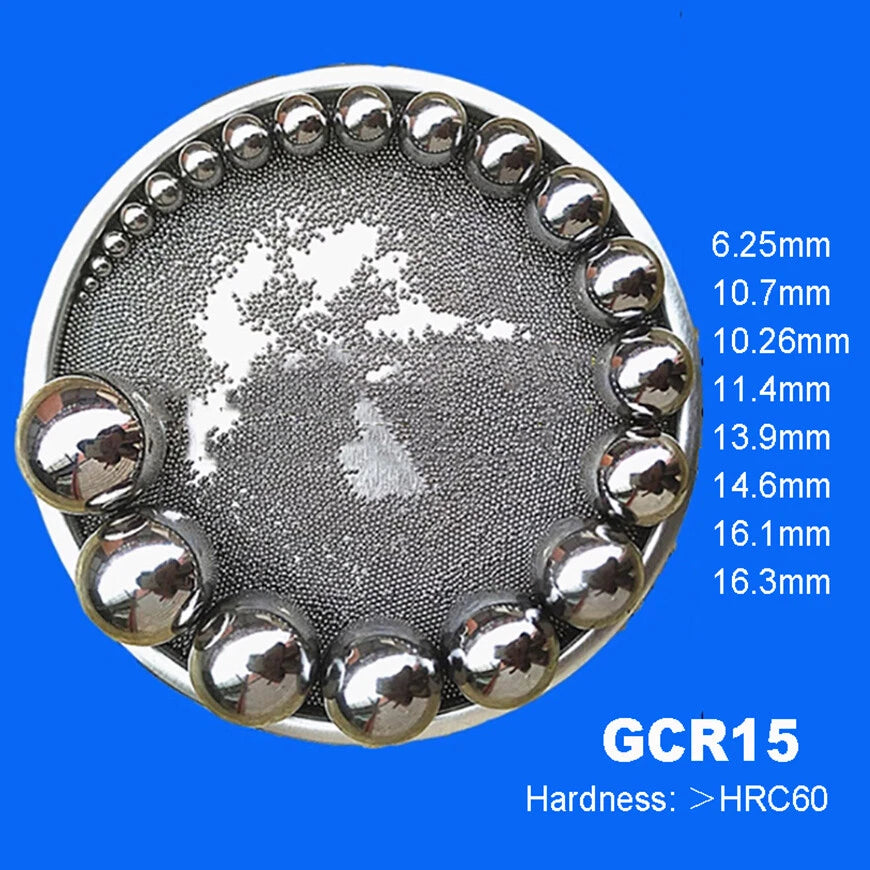
Each ball is machined from GCr15 bearing steel (equivalent to AISI 52100 / SUJ2), a through-hardened chromium alloy recognized for its uniform carbide structure and high surface hardness. Available diameters span 6.25 mm (~0.246 in) to 16.3 mm (~0.642 in), covering a wide range of standard and metric bearing bores. Surface finish is precision-ground to minimize rolling resistance and heat generation.
Typical use cases include replacing rolling elements in deep-groove ball bearings, angular-contact bearings, and linear motion systems; serving as load-transfer media in check valves and ball screws; and acting as precision spacers or pivot points in custom mechanical assemblies and DIY machine tools.
| Material | GCr15 Chromium Bearing Steel (equiv. AISI 52100 / SUJ2) |
|---|---|
| Construction | Solid, one-piece |
| Available Diameters | 6.25 mm, 10.26 mm, 10.7 mm, 11.4 mm, 13.9 mm, 14.6 mm, 16.1 mm, 16.3 mm |
| Surface Hardness | Typically 60–66 HRC (through-hardened) |
| Surface Finish | Precision-ground; low roughness for reduced rolling resistance |
| Tolerance Grade | See variant options |
| Corrosion Resistance | Moderate (suitable for dry / lightly lubricated environments; lubrication recommended for humid use) |
| Packing Quantity | 1 pc per unit (see variant options for bulk packs) |
| Weight | See variant options |
Measure the existing ball with a micrometer or refer to the bearing manufacturer's datasheet. The ball diameter must match the bearing's rolling-element specification exactly — even a 0.1 mm deviation can cause noise, vibration, or accelerated wear. Select the matching size from the variant options above.
GCr15 (equivalent to AISI 52100 / SUJ2) is a through-hardened chromium alloy specifically developed for rolling-contact applications. Compared to standard carbon steel, it offers higher surface hardness (typically 60–66 HRC), finer carbide distribution, and significantly better fatigue resistance under cyclic compressive loads — making it the industry standard for precision ball bearings.
GCr15 steel provides moderate corrosion resistance. For dry or lightly lubricated indoor applications, the polished surface performs well without additional treatment. In humid, wet, or chemically aggressive environments, apply a compatible grease or oil, or consider stainless-steel balls instead. Contact us if you need guidance on material selection for your specific conditions.
Yes — these solid balls are designed as replacement rolling elements for standard deep-groove and angular-contact ball bearings. Confirm the required ball diameter and grade from your bearing's datasheet before ordering. If the original bearing specifies a precision grade (e.g., G10, G16, G25), contact us to confirm the grade available for your selected size.
These balls are not recommended for high-temperature environments above approximately 150 °C (302 °F) without verifying heat-treatment stability, nor for strongly acidic or alkaline media without additional corrosion protection. For food-grade, medical, or highly corrosive applications, stainless-steel or ceramic balls are typically more appropriate.
Store in a clean, dry location away from direct moisture and contaminants. Keep balls in their original packaging or a sealed container. Apply a light coat of rust-preventive oil if storing for extended periods. Avoid contact with abrasive surfaces that could scratch the precision-ground finish before installation.