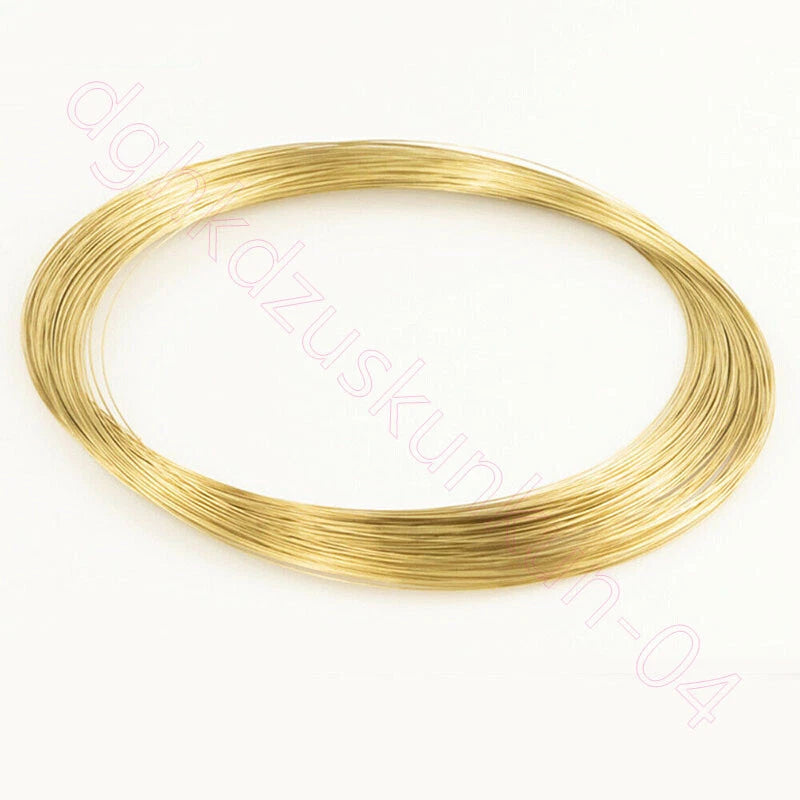
H62 Bare Brass Wire Brass Thin Wire Round Bar Diameter Φ0.3/ 0.5/0.8/1mm~Φ3mm

No reviews

Price:
Sale price$2.03 USD
Stock:
In stock (500 units), ready to be shipped

Payment & Security

Ach Direct Debit Amazon American Express Apple Pay Bancontact Diners Club Discover Google Pay iDEAL Wero Mastercard PayPal Shop Pay USDC Visa

Your payment information is processed securely. We do not store credit card details nor have access to your credit card information.

Quantity Discount Promotion
🎯 BULK DISCOUNT: Buy More, Save More!
Buy 2 Items
5% OFF
Buy 4 Items
10% OFF
Buy 6 Items
15% OFF
Expert

DIY Expert Support

Get fitment advice & recommendations

Mon-Fri, 8:30AM-8PM
24-Hour Fast Ship
🚚
Arrives in 3-14 days
🌍
Global Reach
↩️
30-Day Returns
🌱 1 tree planted with every purchase

Description

H62 Bare Brass Wire Round Bar — Precise Diameter, Sold by the Meter

When your project demands a conductor, structural element, or decorative accent that holds its shape without coating interference, bare brass wire is the go-to choice. Hobbyists, electricians, jewelers, and model builders all reach for H62 bare brass wire when they need a material that bends cleanly, solders reliably, and resists everyday corrosion without a protective finish getting in the way.

This H62 bare brass wire round bar is available in diameters from 0.3 mm (approx. 0.012 in) up to 5 mm (approx. 0.197 in), sold in lengths of 1 m, 3 m, 5 m, 10 m, 20 m, and 50 m. H62 is a standard copper-zinc alloy (roughly 62% copper, 38% zinc) known for its balance of workability and tensile strength. The round cross-section is consistent along the full length, making it suitable for coiling, straightening, or cutting to custom lengths.

Typical applications include DIY craft wire frames and sculpture armatures, electrical grounding and bonding jumpers in low-voltage circuits, jewelry findings and wire-wrapping, scale model structural supports, and antenna or RF ground-plane elements where bare conductivity is required. The range of diameters means you can source the right gauge for fine detail work (0.3–0.6 mm) through to structural rod applications (3–5 mm) from a single listing.

⚠️ Compatibility note: This is uncoated bare brass. It is not tinned, not insulated, and not stainless. Verify diameter tolerance requirements before ordering for precision-fit applications.

✅ Key Features of These H62 Bare Brass Wire Round Bars

  • H62 copper-zinc alloy — approximately 62% copper content delivers good electrical conductivity, moderate tensile strength, and natural corrosion resistance in dry and mildly humid environments.
  • 14 diameter options (0.3 mm – 5 mm) — covers fine craft wire through to structural rod, letting you match the gauge precisely to your load or aesthetic requirement.
  • Sold by the meter in 6 quantity tiers — choose 1 m for sampling or prototyping, up to 50 m for production runs, with per-meter cost decreasing at higher quantities.
  • Round cross-section, consistent diameter — uniform geometry along the full length supports coiling, bending, and cutting without oval distortion common in lower-tolerance wire.
  • Bare (uncoated) surface — no lacquer or plating to remove before soldering, bonding, or electrical contact; the surface accepts flux and solder directly.
  • Workable by hand or standard tools — diameters up to approximately 1.5 mm can be bent by hand; larger diameters (2–5 mm) are suited to pliers, wire benders, or a bench vise for controlled forming.

📐 Technical Specifications — H62 Bare Brass Wire Round Bar

Material H62 Brass (copper-zinc alloy, ~62% Cu / ~38% Zn)
Form Round bar / wire, bare (uncoated)
Available Diameters 0.3, 0.4, 0.5, 0.6, 0.8, 1, 1.2, 1.5, 1.8, 2, 2.5, 3, 4, 5 mm
Available Lengths 1 m, 3 m, 5 m, 10 m, 20 m, 50 m (select via Quantity option)
Cross-Section Round
Surface Finish Bare / bright drawn, no coating
Tensile Strength (typical) See variant options (varies by diameter)
Electrical Conductivity Conductive (bare surface, no insulation)
Colour Yellow-gold (natural brass)
Weight per unit See variant options (varies by diameter and length)

❓ Frequently Asked Questions

Which diameter should I choose for jewelry wire-wrapping?

For wire-wrapping pendants and beads, 0.3–0.6 mm is the most common range — fine enough to wrap tightly around stones without cracking, yet stiff enough to hold a coil shape. For structural frame elements in jewelry (ear hooks, ring shanks), 0.8–1.2 mm gives more rigidity. If you are new to wire-wrapping, 0.5 mm is a practical starting point.

Is H62 brass wire strong enough for structural model-making?

H62 brass has a typical tensile strength in the range of 300–420 MPa depending on temper and diameter, which is adequate for scale model frames, armatures, and support rods. For spans under load, use the largest diameter that fits your design. Diameters of 2 mm and above are noticeably stiffer and better suited to structural roles than the finer gauges.

Will bare brass wire corrode or tarnish over time?

H62 brass resists corrosion well in dry indoor environments. In humid or outdoor conditions, the surface will gradually develop a patina (oxidation layer) that shifts from bright gold toward a darker amber or brown tone. This does not affect structural integrity for most applications. If you need a stable appearance long-term, consider applying a clear lacquer after forming. For electrical contacts, keep connections clean and protected from moisture.

Can I solder this wire without removing a coating first?

Yes. Because this wire is bare (uncoated), there is no lacquer or plating to strip before soldering. Apply a suitable flux for brass (rosin-based or acid flux depending on your application), heat the joint, and apply solder normally. Brass solders well with standard tin-lead or lead-free solders at typical iron temperatures (around 350–400 °C / 660–750 °F).

How do I choose between buying 1 m vs. a longer length?

The 1 m option is ideal for sampling a diameter before committing, or for small one-off projects. The per-meter cost decreases at higher quantities (3 m, 5 m, 10 m, 20 m, 50 m), so if you know you will use a particular diameter regularly, ordering a longer length reduces your unit cost. Check the price per meter across tiers before selecting — the savings become significant at 10 m and above.

Is this wire compatible with RF antenna or grounding applications?

Bare brass wire is used in some RF ground-plane and antenna applications where a solderable, conductive, non-ferrous wire is needed. H62 brass is not as conductive as pure copper (roughly 26–28% IACS vs. copper's 100% IACS), so for applications where conductivity is the primary requirement, copper wire is the better choice. For mechanical antenna elements where conductivity is secondary to rigidity and corrosion resistance, brass is a practical option.

What tools do I need to cut and bend this wire?

For diameters up to 1.5 mm, flush-cut wire cutters and round-nose or flat-nose pliers are sufficient for most craft and jewelry work. Diameters of 2–3 mm can be cut with heavy-duty wire cutters or a rotary tool with a cutting disc. For 4–5 mm rod, a hacksaw, angle grinder, or pipe cutter (for round stock) gives a cleaner cut. Bending 3–5 mm diameter requires a bench vise or a dedicated wire/rod bender to avoid kinking.

🛒 Select your Quantity and Diameter above, then add to cart.

You may also like

Recently viewed