
The chain is fine...but I ordered the wrong size. Nine links of the chain I ordered equals six of the size I wanted. My error...
How can I straighten out the springs? I can't use them coil uo as is.
Your payment information is processed securely. We do not store credit card details nor have access to your credit card information.
Get fitment advice & recommendations
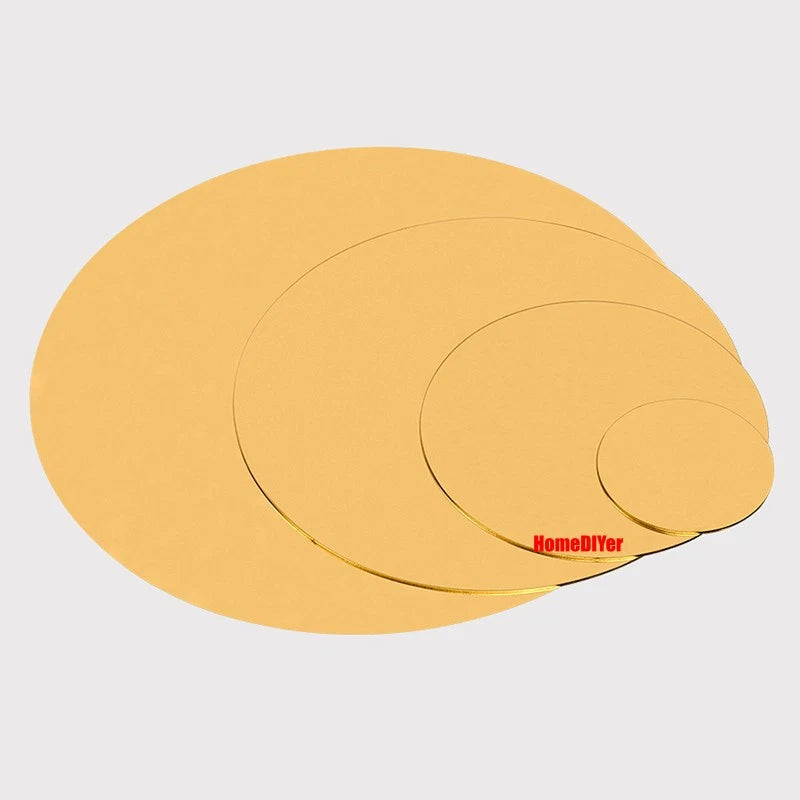
Whether you're a hobbyist struggling to find consistent-sized metal blanks for stamping, a jeweler sourcing disc stock for pendants, or a maker building custom hardware, sourcing reliable brass circles in exact dimensions can be a real headache. These H62 solid brass disc blanks solve that problem with a wide range of diameters and thicknesses available in one place, ready to cut, drill, engrave, or finish.
Each disc is cut from H62 brass alloy — a copper-zinc alloy known for its warm golden tone, good machinability, and moderate corrosion resistance. Discs are available in diameters from 10mm to 300mm (approximately 0.39" to 11.81") and thicknesses of 1.5mm, 2mm, 3mm, 4mm, 5mm, and 6mm (approximately 1/16" to 1/4"). Surfaces are flat-cut with smooth edges suitable for further finishing.
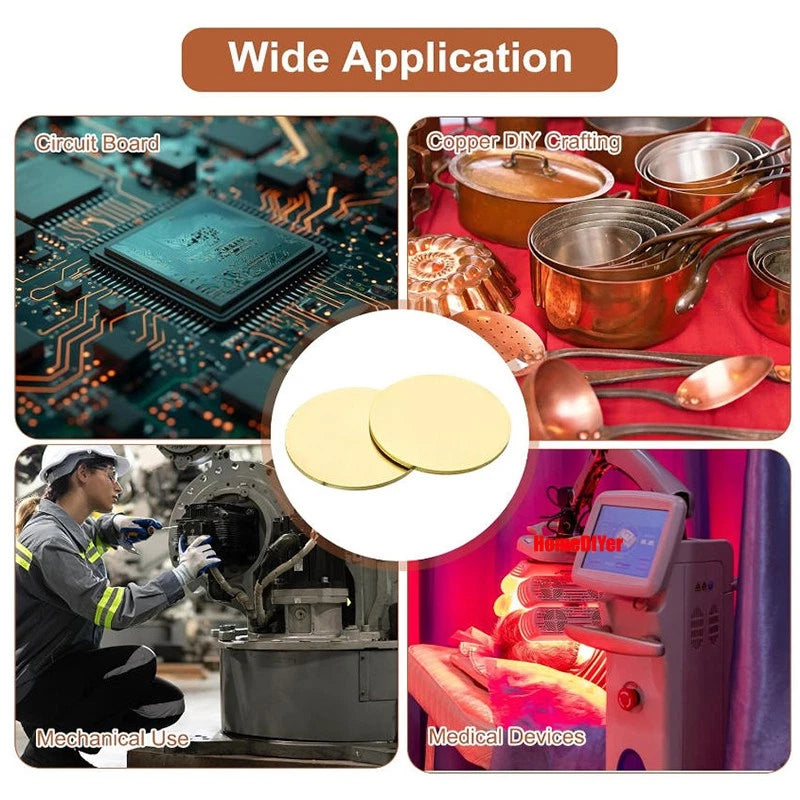
Typical applications include metal stamping blanks for jewelry and keychains, custom engraving discs for personalized gifts, spacer or shim stock in mechanical assemblies, decorative inlays for woodworking projects, and prototyping flat brass components for small-batch manufacturing.
| Material | H62 Brass (Copper-Zinc Alloy) |
|---|---|
| Shape | Round / Disc |
| Diameter Range | 10mm – 300mm (approx. 0.39" – 11.81") |
| Thickness Range | 1.5mm – 6mm (approx. 1/16" – 1/4") |
| Surface Finish | Flat-cut, unpolished (suitable for further finishing) |
| Color / Appearance | Golden yellow (natural brass tone) |
| Corrosion Resistance | Moderate — suitable for indoor and dry-environment use |
| Machinability | Good — compatible with drilling, milling, engraving, and stamping |
| Quantity per Order | See variant options |
| Weight per Piece | See variant options |
Select the diameter that matches the finished size you need — keep in mind that if you plan to drill or cut the disc further, start with a slightly larger diameter. For thickness, thinner discs (1.5mm–2mm) work well for stamping blanks and lightweight pendants, while thicker discs (3mm–6mm) are better suited for structural spacers, heavy-duty engraving, or decorative inlays where rigidity matters.
H62 brass has moderate tensile strength and is commonly used in light-to-medium mechanical applications such as spacers, shims, and bushings. It is not recommended for high-load structural applications. For precision mechanical use, verify the required load tolerance against the disc thickness you select.
H62 brass does not rust (it contains no iron), but it can oxidize and develop a patina over time when exposed to moisture or air. For indoor decorative use, a clear lacquer coat will preserve the golden finish. For outdoor or humid environments, consider a protective sealant or periodic polishing to maintain appearance.
Yes. H62 brass is well-suited for hand stamping, rotary engraving, and laser engraving. Thinner discs (1.5mm–2mm) are easier to hand-stamp, while thicker discs may require a press or CNC engraver for clean results. Always anneal (soften by heating and quenching) if you need to stamp deeply into thicker stock.
Yes. H62 brass accepts a wide range of finishes including liver of sulfur patina, chemical blackening, gold plating, and clear lacquer. The unpolished surface can be sanded to a mirror finish before applying any coating. Standard jewelry-grade polishing compounds work well on this alloy.
Each variant listing specifies the number of discs included (1PCS, 2PCS, 3PCS, 4PCS, or 8PCS). Multi-pack variants offer a lower per-piece cost and are ideal when you need multiple identical discs for batch projects such as keychains, jewelry sets, or mechanical assemblies. Select the quantity that matches your project needs from the variant selector above.
H62 brass can be machined with CNC routers using appropriate carbide tooling. For laser cutting, brass reflects CO2 laser wavelengths and typically requires a fiber laser for effective cutting. For engraving (not cutting through), CO2 lasers with a marking compound or fiber lasers work well on brass surfaces.