The chain is fine...but I ordered the wrong size. Nine links of the chain I ordered equals six of the size I wanted. My error...
How can I straighten out the springs? I can't use them coil uo as is.
Your payment information is processed securely. We do not store credit card details nor have access to your credit card information.
Get fitment advice & recommendations
When your conveyor line, assembly table, or material-handling station demands frictionless, multi-directional movement, a worn or mismatched ball transfer unit becomes a costly bottleneck. Engineers, maintenance technicians, and DIY fabricators who need a dependable ball transfer bearing unit that handles real industrial loads without seizing or corroding will find exactly what they need here.
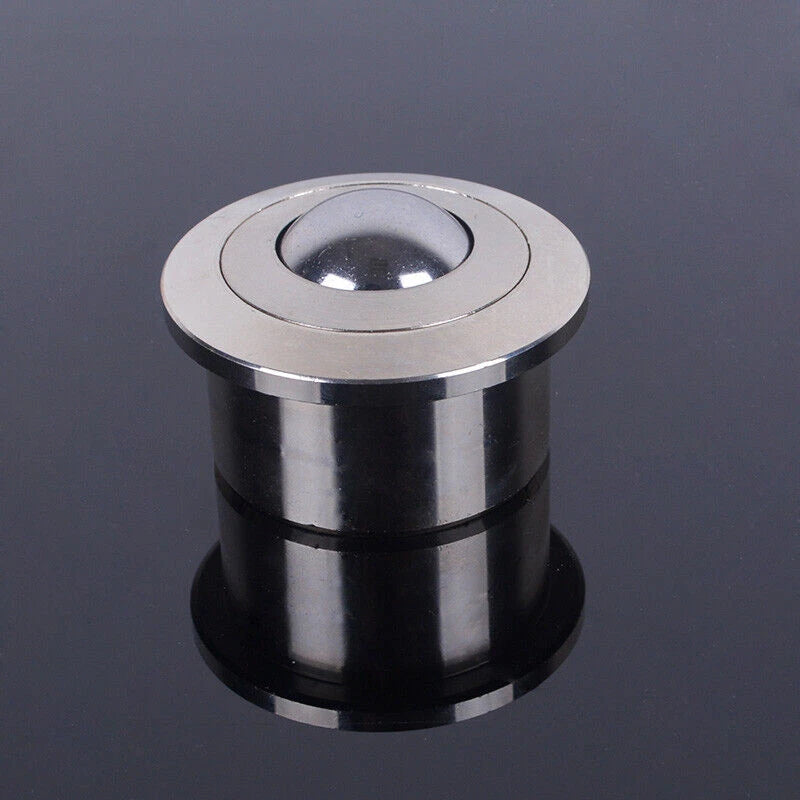
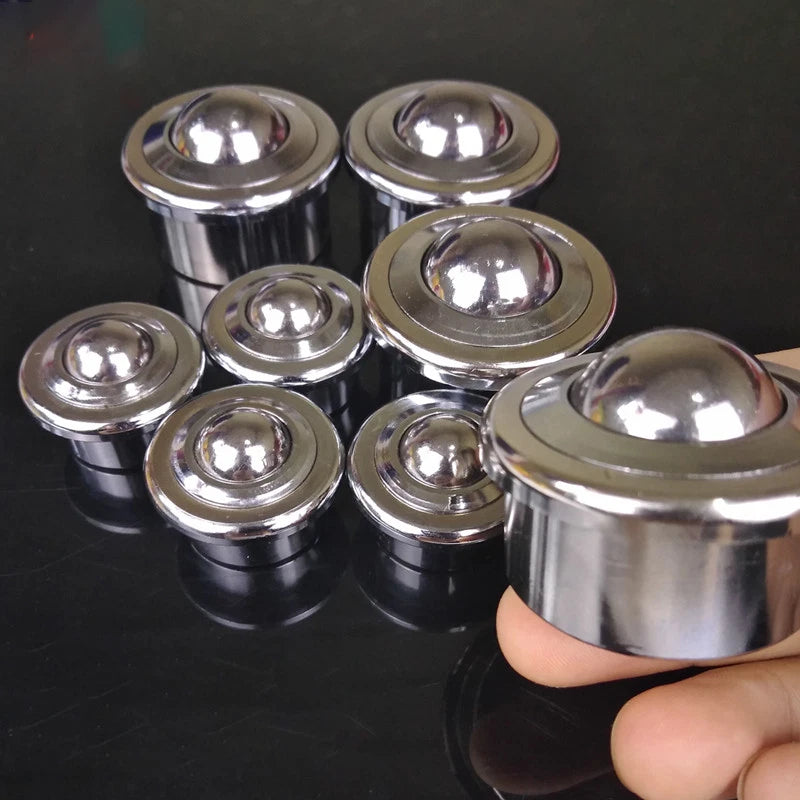
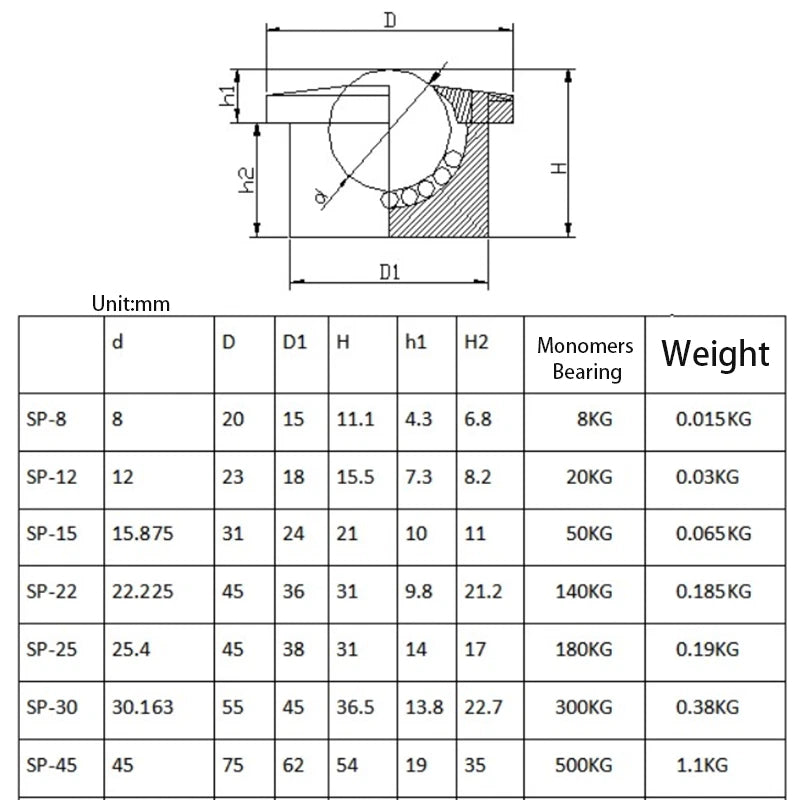
Each ball transfer bearing unit consists of a hardened load ball seated in a precision-machined housing packed with recirculating bearing balls. Available in two materials — Bearing Steel for high-load, cost-effective applications and 304 Stainless Steel for corrosion-sensitive environments — and spanning eight model sizes from SP8 (8 mm / 0.31 in load ball) through SP45 (45 mm / 1.77 in load ball). Housing outer diameters range from approximately 22 mm (0.87 in) for SP8 up to approximately 105 mm (4.13 in) for SP45.
Typical use cases include gravity conveyor roller tables for warehouse order-picking lines, omni-directional transfer decks at production line merge points, and custom DIY workbench inserts for rotating heavy sheet-metal panels — all scenarios where a ball transfer unit conveyor roller must handle repeated cycling without lubrication downtime.
| Product Type | Ball Transfer Bearing Unit (Conveyor Roller) |
|---|---|
| Model Range | SP8, SP12, SP15, SP22, SP25, SP30, SP38, SP45 |
| Load Ball Diameter | 8 mm – 45 mm (0.31 in – 1.77 in), see variant options |
| Housing Outer Diameter | See variant options |
| Mounting Hole Diameter | See variant options |
| Material Options | Bearing Steel / 304 Stainless Steel |
| Ball Array Type | Recirculating inner bearing balls |
| Load Direction | Multi-directional (360° horizontal) |
| Static Load Capacity | See variant options |
| Dynamic Load Capacity | See variant options |
| Corrosion Resistance | Standard (Bearing Steel) / Corrosion-resistant (304 SS) |
| Pack Quantity | 1 / 2 / 3 / 4 / 5 / 8 / 10 pcs per pack |
| Weight per Unit | See variant options |
Select the model based on two factors: the load per unit and your panel thickness. Larger SP numbers indicate a bigger load ball and higher load capacity. As a general rule, measure the maximum weight that will rest on a single unit, divide by the number of units in your array, then choose the model whose rated static load exceeds that figure. Your panel thickness also determines the minimum housing depth — confirm the counterbore depth matches the housing height for your chosen model.
Bearing Steel (typically GCr15 / 52100 equivalent) offers higher hardness and load capacity at a lower cost, making it ideal for dry indoor conveyor lines and assembly tables. 304 Stainless Steel resists surface rust and mild chemical exposure, making it the better choice for washdown environments, outdoor installations, or anywhere moisture is present. If in doubt about your environment, choose 304 Stainless Steel.
These units are designed primarily for horizontal surface mounting where the load presses down onto the load ball. They are not rated for vertical-mount or inverted applications. For angled conveyor decks, ensure the resultant load vector remains within the manufacturer's specified cone angle — typically within 30° of vertical — to avoid premature wear on the inner ball array.
Most SP-series ball transfer units are pre-lubricated at the factory and sealed for life under normal operating conditions. For high-cycle or high-load applications, periodic re-lubrication through the grease nipple (if present on your model) is recommended. Bearing Steel units should be kept dry and free of corrosive fluids; 304 Stainless Steel units tolerate occasional moisture but should still be wiped down after washdown cycles.
Yes. These units follow the SP-series dimensional standard, so they are interchangeable with other SP-series ball transfer units of the same model number. Always verify the counterbore diameter and depth for your specific model before drilling, as dimensions vary between SP8 and SP45. Contact us to confirm exact hole dimensions if you are retrofitting an existing panel.
A common rule of thumb is to space ball transfer units on a grid of 75–150 mm (3–6 in) center-to-center, depending on the size and rigidity of the items being conveyed. Divide the total load by the number of units to ensure each unit stays within its rated capacity. For a standard 600 × 1200 mm (24 × 48 in) transfer table, 20–40 units of SP12 or SP15 are typical for loads up to 50 kg per item.
Mechanically, yes — the housing dimensions are identical for the same model number regardless of material. However, mixing materials in a corrosive or washdown environment is not recommended, as galvanic interaction between dissimilar metals can accelerate corrosion on the Bearing Steel units. For consistent performance and longevity, use the same material throughout a single installation.